
 2 June 2026

Achieve healthcare cybersecurity compliance: A practical guide
15 May 2026
 9:33 MIN Read time
  BY
Amju
BY
Amju
Healthcare organizations face a brutal reality: breaches in 2024 exposed more than 275 million individuals through OCR-recorded incidents alone. For compliance officers and IT managers at startups and SMEs, this isn’t just a headline. It translates into regulatory scrutiny, broken customer trust, and potential fines that can end a young company’s story fast. The good news is that building a defensible cybersecurity compliance program doesn’t require a Fortune 500 budget. It requires clarity, the right framework, and a commitment to evidence-based processes over checkbox exercises.
Table of Contents
- Understanding core regulations: HIPAA, NIST, and beyond
- Building a risk-based compliance program: Steps that work
- Mitigating modern risks: Data breaches and IoT challenges
- Audit, reporting, and third-party certification: Aligning evidence with expectations
- Why compliance is about evidence—not just checklists
- Next steps: How Testvox helps healthcare organizations secure compliance
- Frequently asked questions
Key Takeaways
| Point | Details |
|---|---|
| Start with HIPAA basics | Begin your compliance journey with a structured HIPAA Security Rule risk analysis and safeguard implementation. |
| Map to actionable frameworks | Translate regulatory needs into testable controls with NIST and consider HITRUST for certification and partner assurances. |
| Address modern threats | Prioritize security for IoT, third-party vendors, and continuously monitor for new attack vectors. |
| Evidence over checklists | Focus on documented risk-based processes and evidence, not just completing forms, to demonstrate real security. |
| Audit for growth | Leverage third-party audits and certifications to build trust and support business objectives in the healthcare ecosystem. |
Understanding core regulations: HIPAA, NIST, and beyond
With awareness of what’s at stake, let’s clarify which rules actually matter and how they fit together.
Most healthcare startups stumble at the first hurdle: understanding what each framework actually requires versus what it recommends. These aren’t interchangeable documents. They serve different purposes, and confusing them leads to gaps that auditors and attackers will both find.
HIPAA Security Rule is the legal foundation. It establishes mandatory safeguards for ePHI (electronic protected health information), covering administrative controls like workforce training and access management, physical controls like facility access policies, and technical controls like encryption and audit logging. Non-compliance isn’t theoretical; it carries civil monetary penalties ranging from $100 to $50,000 per violation category. For startups handling any patient data, HIPAA is the non-negotiable baseline.
NIST SP 800-66 Revision 2 is the practical translator. Where HIPAA says “you must conduct risk analysis,” NIST tells you precisely how to implement risk management and select appropriate safeguards. It provides crosswalks, checklists, and prioritized activities that map HIPAA requirements to real-world security practices. For resource-limited teams, this guidance is invaluable. Think of HIPAA as the “what” and NIST as the “how.”
HITRUST CSF takes the next step. Designed to harmonize multiple authoritative frameworks including HIPAA, NIST, SOC 2, ISO 27001, and more into a single certifiable control framework, HITRUST is what enterprise partners and larger hospital systems often require from their vendors. Achieving HITRUST certification signals that your compliance program meets a recognized, independently audited standard. It’s especially valuable as you scale toward larger contracts.
For context on how device-specific regulations interact with these frameworks, understanding FDA cybersecurity requirements becomes critical for any organization developing or integrating connected medical devices. Similarly, medical device cybersecurity compliance adds another layer of specificity for device manufacturers.
Here’s how the three frameworks compare at a glance:
| Framework | Type | Legal requirement? | Best used for |
|---|---|---|---|
| HIPAA Security Rule | Regulation | Yes | Baseline ePHI protection requirements |
| NIST SP 800-66 Rev 2 | Guidance | No | Implementing HIPAA risk practices |
| HITRUST CSF | Certifiable framework | No | Cross-framework certification and vendor trust |
Key distinctions to keep in mind:
- HIPAA applies to covered entities and business associates directly
- NIST provides risk-based implementation guidance with no enforcement authority of its own
- HITRUST certification requires a third-party assessor and periodic renewal
- FIPS compliance (Federal Information Processing Standards) may apply if you handle federal healthcare programs or work with government contractors
Most startups should begin with HIPAA as their legal floor, use NIST to build practical controls, and consider HITRUST when enterprise partnerships or investor due diligence demand it.
Building a risk-based compliance program: Steps that work
Once the frameworks are clear, here’s a stepwise process you can actually use to go from confusion to audit-ready compliance.
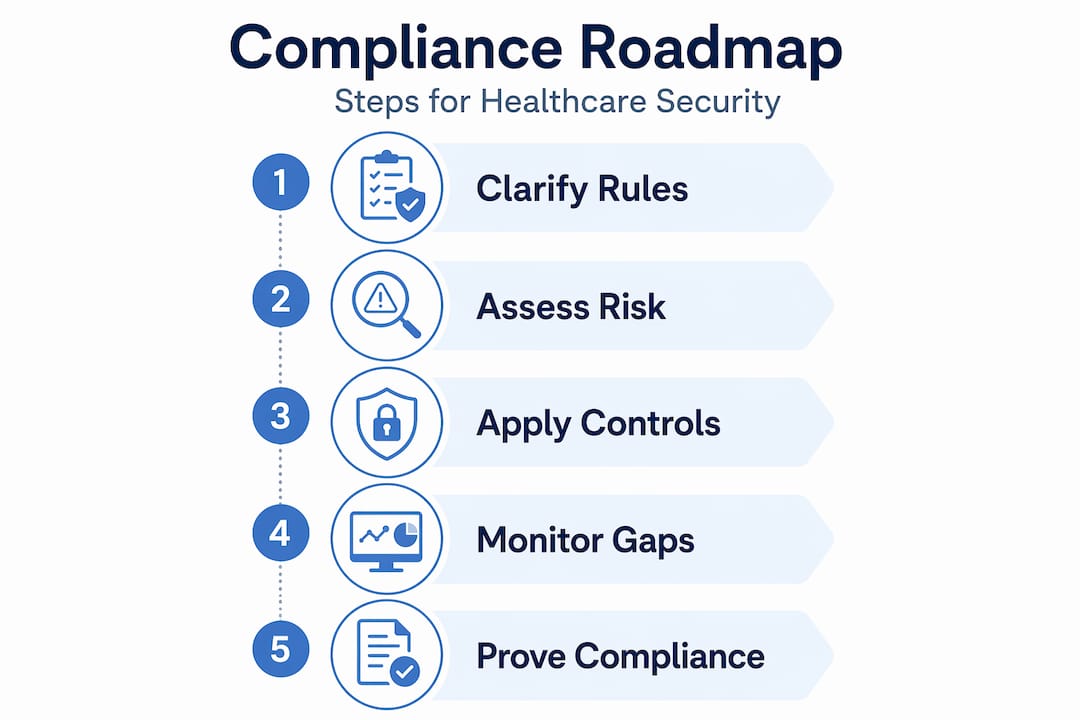
The mistake most small healthcare teams make is treating compliance as a one-time project. They complete a risk assessment, generate a policy document, and move on. Then an audit happens or a breach occurs, and those documents don’t hold up under scrutiny because they never reflected reality. A risk-based program is a living process, not a filing cabinet exercise.
Here’s a process that works for resource-limited teams:
- Conduct a formal HIPAA risk analysis. Document every system, application, and workflow that touches ePHI. Map data flows. Identify threats and vulnerabilities for each asset. Assign likelihood and impact scores. This isn’t optional under HIPAA. It’s the foundational requirement from which every other control decision flows. Without it, you’re guessing.
- Translate risk findings into control selections using NIST. NIST SP 800-66 Rev 2 translates HIPAA’s requirements into practical security activities, including specific control categories and implementation tiers. For each identified risk, document which NIST-recommended control addresses it, what implementation looks like, and who owns it.
- Implement and configure controls with documented evidence. Encryption policies mean nothing without configuration screenshots, audit logs, and vendor attestation letters. Build an evidence library from day one. Store it where auditors can access it without requiring your team to reconstruct history under pressure.
- Establish continuous monitoring routines. Set up automated log reviews, access recertification cycles (quarterly works for most SMEs), and vulnerability scanning schedules. Manual spot checks at random intervals don’t satisfy regulators, and they definitely don’t catch attackers in time to limit damage.
- Prepare structured evidence packages for audits and partner reviews. Organize your evidence by control domain. When a business associate agreement negotiation kicks off or an enterprise customer requests a security questionnaire, you should be able to respond in hours, not weeks.
Pro Tip:
Don’t wait for an audit to discover your documentation gaps. Run a “mock audit” internally every six months using your own risk assessment as the test. If your team can’t locate evidence for a given control in under ten minutes, that control isn’t actually implemented from a compliance standpoint.
For teams that need to build assessment capabilities quickly, a structured approach to risk assessments for compliance provides a repeatable methodology. For organizations with FDA-regulated products, aligning with a medical device cybersecurity strategy ensures regulatory expectations are baked in early rather than retrofitted.
Mitigating modern risks: Data breaches and IoT challenges
With foundational controls in place, understanding and addressing practical attack vectors is the next challenge.
Numbers tell the story clearly. OCR-recorded breaches in 2024 exposed more than 275 million individuals. Hacking and IT incidents account for the overwhelming majority of large-scale exposures, not insider threats or lost laptops. Your biggest risk sits at the network perimeter, in third-party integrations, and inside connected devices.
The modern healthcare environment is deeply distributed. Telehealth platforms connect to patient smartphones. Electronic health record systems talk to billing platforms. Medical IoT devices stream real-time data to cloud dashboards. Each connection point is a potential entry path for attackers. And third-party risk and vendor ecosystem security are where most compliance programs fall dangerously short.
Most healthcare organizations spend significant effort hardening their core systems while leaving their vendor access pathways largely unmonitored. Attackers have noticed.
Here are the most critical mitigation strategies for startups and SMEs:
- Vendor risk management: Require every third-party vendor with ePHI access to complete a security questionnaire, provide evidence of their own controls, and sign a business associate agreement. Review these annually, not just at onboarding.
- Security baselines for connected devices: Every IoT or networked medical device should meet a documented minimum security standard before it touches your network. This means known-good firmware versions, default credential changes, and logging enabled.
- Network segmentation: Clinical networks, IoT device networks, and administrative networks should not share the same flat architecture. Segmentation limits how far an attacker can move after initial access.
- Incident response planning: A documented and tested incident response plan reduces both the duration and the cost of a breach. Organizations with tested playbooks contain incidents significantly faster than those without.
- Continuous monitoring: One-time penetration tests and annual assessments are necessary but not sufficient. They represent snapshots of security posture, not ongoing assurance.
Building network resilience matters especially in distributed care environments. Real-world network security for healthcare telehealth case studies show that segmentation and monitoring are the most impactful investments for organizations scaling their virtual care offerings.
The ability to spot and fix healthcare device security gaps quickly depends on having both monitoring tools and clear remediation ownership. A cybersecurity assessment for medical devices is often the fastest way to benchmark your current exposure before investing in specific controls.

The uncomfortable truth is that most SMEs discover their IoT and vendor vulnerabilities during breach investigations rather than during proactive assessments. The organizations that reverse that order are the ones that avoid making the 275-million-individuals list.
Audit, reporting, and third-party certification: Aligning evidence with expectations
Once risks are addressed, it’s time to make compliance visible and reliable for customers, partners, and regulators.
Compliance documentation serves a dual purpose. Internally, it drives accountability and improvement. Externally, it provides the evidence that customers, investors, and regulators need to trust your platform with patient data. These two audiences have different expectations, and your documentation strategy needs to satisfy both.
Here’s how to build an audit-ready posture:
- Maintain a living risk register. Update it whenever systems change, new vendors are onboarded, or threat intelligence suggests an emerging risk. A risk register that was last updated eighteen months ago signals to auditors that your program exists on paper only.
- Build policy version control. Security policies should have clear version histories, approval signatures, and review dates. This demonstrates governance maturity, not just technical security.
- Track and close remediation actions. Every risk finding should have an assigned owner, a target remediation date, and documented closure evidence. Open findings with no remediation timeline are audit red flags.
- Prepare for SEC disclosure requirements if growth is on the horizon. Public companies must disclose material cybersecurity incidents and provide annual disclosures about their cybersecurity risk management strategy and governance. Planning for this early avoids painful restructuring when IPO or acquisition conversations begin.
- Consider HITRUST certification strategically. HITRUST CSF supports tailored, risk-based assessments and certifications that map directly to HIPAA, NIST, and other recognized frameworks. For companies pursuing contracts with large hospital systems or health insurers, HITRUST certification often removes lengthy custom security review processes from the sales cycle entirely.
Pro Tip: Use third-party penetration testing reports as dual-purpose evidence. They satisfy both compliance evidence requirements and partner security review questionnaires. A well-scoped penetration testing for compliance engagement generates documentation that holds up in multiple contexts simultaneously.
Understanding data center certification requirements also matters if you’re evaluating cloud or co-location providers. Your compliance program is only as strong as your infrastructure partners’ controls.
Why compliance is about evidence—not just checklists
Here’s the view from the trenches that most articles skip over: auditors, enterprise buyers, and seasoned investors don’t actually care about your policy documents. They care about whether those documents reflect reality.
We’ve seen healthcare startups with beautifully written 80-page security programs that couldn’t produce a single access log when asked. And we’ve seen lean five-person teams with sparse documentation but complete, queryable audit trails that satisfied due diligence requests in a day. The second category wins every time.
The compliance programs that succeed under real pressure share three qualities. First, they treat the risk analysis as a living operational document, not an annual report. Second, they assign control ownership to specific individuals, not teams or departments. Third, they build evidence as a byproduct of normal operations, not as a retroactive documentation sprint before an audit.
For resource-limited teams, the prioritization question is always about return on risk reduction. Not every control is equal. Controls that address the highest-frequency attack vectors, like credential compromise and third-party access, reduce both the probability of a breach and the “blast radius” if one occurs. Start there. Don’t spend your first compliance budget on physical security theater while leaving MFA unconfigured.
Shadow IT deserves specific attention. Fast-growing healthcare startups accumulate unsanctioned tools fast. A developer uses a personal cloud storage service to share a prototype. A sales team uses an unapproved video conferencing platform with screen sharing. Each of these creates ePHI exposure that your documented controls don’t cover. Addressing shadow IT requires organizational culture work alongside technical controls, and it’s the gap that often appears in breach postmortems.
Understanding how to avoid FDA cybersecurity mistakes is also directly relevant here. The same shortcuts that create FDA submission problems create compliance program weaknesses that surface during audits or incidents.
The teams that build defensible compliance programs stop asking “are we compliant?” and start asking “can we prove we’re secure?” That shift in framing changes how every decision gets made.
Next steps: How Testvox helps healthcare organizations secure compliance
If you’re ready to turn compliance insight into implementable action, here’s how Testvox can accelerate your results.

Testvox’s security testing services are purpose-built for healthcare startups and SMEs navigating exactly the complexity described in this guide. From security testing for healthcare environments to full VAPT engagements aligned with OWASP and HIPAA expectations, we bring structured methodology to organizations that need results, not just reports. Our security testing case studies show how compliance management systems get hardened under real testing conditions. Whether you need to close a specific audit gap or build a complete vulnerability assessment program for healthcare, Testvox can scope a testing engagement that generates compliance evidence and reduces actual risk simultaneously. Reach out to discuss a compliance readiness assessment tailored to your organization’s current stage and regulatory obligations.
Frequently asked questions
What is the main difference between HIPAA, NIST, and HITRUST frameworks for healthcare cybersecurity compliance?
HIPAA sets mandatory legal rules for protecting healthcare data, NIST provides practical guidance for implementing risk management decisions, and HITRUST harmonizes multiple frameworks including both into a single certifiable control structure.
What is required for a healthcare startup to begin building a cybersecurity compliance program?
Startups should start with a formal risk analysis and implement administrative, physical, and technical safeguards required under HIPAA, then use NIST to select and document specific controls.
Why are breaches in healthcare increasing and what causes the largest exposures?
OCR-recorded breaches in 2024 exposed more than 275 million individuals, with hacking and IT incidents as the dominant cause, particularly through third-party access vectors and IoT device ecosystems with weak security baselines.
Is third-party certification mandatory for healthcare cybersecurity compliance?
No, certification is not legally required, but HITRUST CSF certifications provide tailored, risk-based assessments that map to recognized frameworks and significantly streamline partner and customer security reviews.
Recommended
- How to spot and fix cybersecurity gaps in healthcare devices
- Medical device cybersecurity: compliance steps to enter the market
- FDA cybersecurity requirements: what startups must know
- How medical device manufacturers can ace cybersecurity assessment
2 June 2026

 13 January 2023

ABOUT TESTVOX

Testvox is a software testing company help your product reach its full potential. Get full cycle testing for your mobile and web applications while ensuring all quality assurance standards are met... Read More
100+
Applications
Assured
Assured

5 Star Rating

5 Star Rating
“By participating in our release lifecycle, Testvox's standard QA process has helped us to launch quality products faster.”

Rima Hudaifa
Manager | Cadvil
Manager | Cadvil
