




UAE
Testvox FZCO
Fifth Floor 9WC Dubai Airport Freezone

 22 May 2026
 8 min 37 sec
  BY
Aparna Arangil
BY
Aparna Arangil
Security testing is no longer a checkbox at the end of a sprint. Why security testing matters comes down to a single, uncomfortable reality: the global average breach cost hit $4.44 million in 2026, and most of that damage is preventable. For developers shipping fast, IT teams managing complex infrastructure, and business leaders accountable for customer data, leaving vulnerabilities undetected is not a calculated risk. It’s an avoidable liability. This article covers the real costs of skipping security testing, what the process actually involves, how to integrate it without slowing your team down, and where the discipline is heading next.
| Point | Details |
|---|---|
| Breaches carry massive costs | The average breach costs $4.44M, but tested incident response plans alone can save $2.66M per incident. |
| Early detection pays for itself | Fixing vulnerabilities in development costs up to 30x less than fixing them after production release. |
| Security testing is a defined discipline | It spans SAST, DAST, penetration testing, and SCA across code, infrastructure, and runtime layers. |
| Integration beats isolation | Embedding security testing in CI/CD pipelines catches issues faster and gives developers ownership of fixes. |
| Shift-everywhere is the new standard | Full lifecycle coverage from design to production is replacing the narrower shift-left approach. |
Most teams that skip proactive security testing are not ignoring risk on purpose. They underestimate it. They assume their cloud provider handles the hard parts, or that their codebase is too small to attract attention. Neither assumption holds up under scrutiny.
29% of security assessments in 2025 found at least one severe vulnerability across more than 7,500 tests. That’s not a niche problem. That’s close to one in three applications carrying a critical flaw that an attacker could exploit before your team even knows it exists.
The financial picture is just as stark. Beyond the $4.44 million average, the how fast you detect a breach matters enormously. Organizations using AI security tools detected incidents 80 days faster and saved $1.9 million per incident as a result. Detection speed is the most controllable cost variable in your breach lifecycle.
The hidden costs go deeper than the headline number:
“Security is not a product, but a process.” That framing, attributed to Bruce Schneier, captures why one-time audits are never enough. Threats evolve continuously, and so must your testing.
The hidden costs of neglecting security testing are rarely visible until they surface in the worst possible context, a production incident, a regulator’s letter, or a news headline. Teams that treat security testing as optional almost always revise that position after their first serious incident.

Security testing is the practice of identifying vulnerabilities, weaknesses, and misconfigurations in software before an attacker finds them. The goal is not just to find bugs. It’s to validate that your application behaves securely under adversarial conditions.
It covers several distinct approaches, each targeting different layers of your application:
| Testing type | What it examines | When it runs |
|---|---|---|
| SAST (Static Analysis) | Source code and binaries | During development, pre-commit |
| DAST (Dynamic Analysis) | Running application behavior | Staging, CI/CD pipelines |
| SCA (Software Composition Analysis) | Open-source dependencies | Continuous, on every build |
| Penetration testing | Full attack simulation | Pre-release, periodic audits |
| IAST (Interactive Analysis) | Runtime code paths | QA and staging environments |
Each method catches different classes of vulnerability. A SAST tool finds a hardcoded API key in your repository. DAST catches an authentication bypass that only appears when the app is running. SCA alerts you when a third-party library ships a critical CVE. Penetration testing chains multiple small weaknesses into a realistic attack path that automated tools might miss entirely.
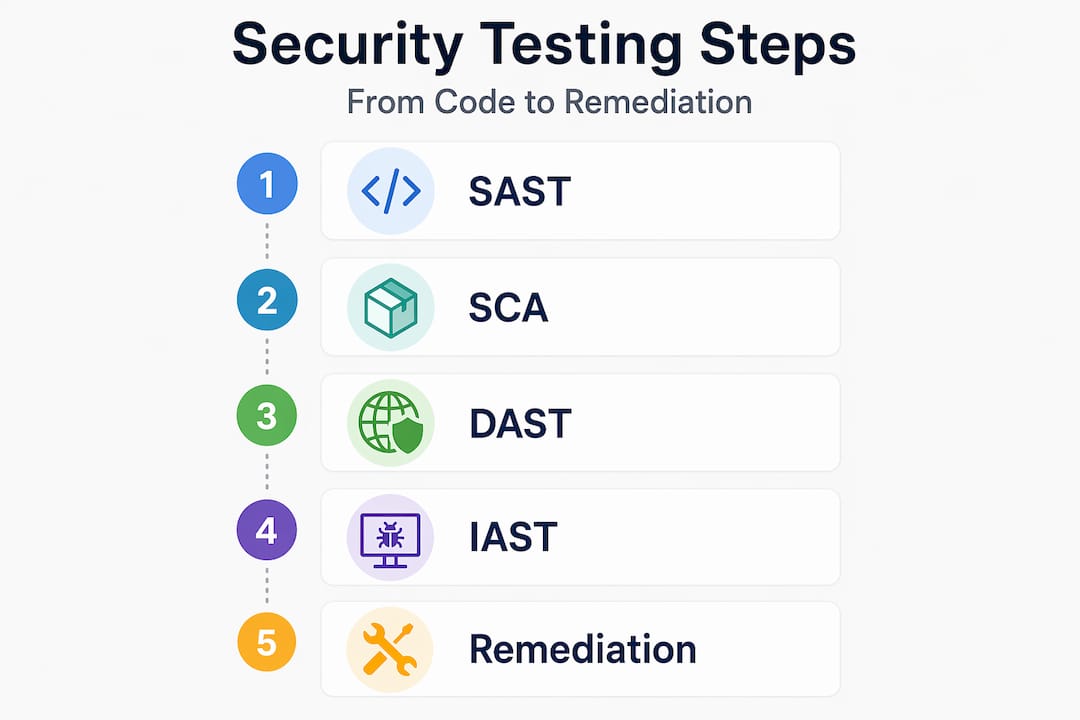
Recognized frameworks give this discipline structure. OWASP WSTG and NIST SP 800-115 provide a shared language, audit trails, and tested methodology that makes your security posture defensible to customers, auditors, and regulators. Following a recognized standard is not just about rigor. It signals to stakeholders that your testing program is repeatable and trustworthy.
Pro Tip: If your team is new to security testing, start with SAST on your main branch and SCA on your dependency tree. Both can be configured in under a day and will surface the most common vulnerabilities before you invest in more advanced tooling.
The shift-left movement pushed security earlier into the software development lifecycle, catching issues in code review rather than after deployment. That was a significant improvement. But as we’ll explore shortly, it’s not the whole answer.
The importance of security testing multiplies when it’s woven into how your team already works, rather than treated as a separate audit phase. The numbers make the case clearly: fixing vulnerabilities during production costs up to 30 times more than catching them during development, and mature programs that embed testing early resolve issues in hours instead of weeks.
Here’s what that integration looks like in practice:
The developer experience point deserves more attention than it usually gets. Security tools that generate hundreds of low-priority alerts train developers to ignore them. That’s not a tooling problem. It’s a process design failure. When AI-powered tools reduce false positives and surface findings with contextual reasoning, developers actually fix issues instead of closing tickets.
The security testing advantages here are tangible: faster release cycles, lower remediation costs, higher fix rates, and engineering teams that understand security as part of craft rather than as an obstacle.
Pro Tip: Combine SAST and SCA as your baseline CI/CD security layer before adding DAST. The first two tools have near-zero false positive rates when well-configured and give your team quick wins that build organizational confidence in the process.
For fintech and e-commerce teams especially, where payment data and user identity are in scope, AI-powered testing approaches now offer a way to maintain continuous coverage without hiring a dedicated security engineer for every squad.
Shift-left was the right call for its time. Moving security checks earlier in the development lifecycle was a meaningful step forward. The problem is that shift-left alone assumes your biggest risks live in the code your team wrote, and only during the build phase. That assumption no longer holds.
Modern applications are assembled from dozens of third-party services, open-source libraries, cloud configurations, and runtime environments. Vulnerabilities enter from every direction:
Shift-everywhere security addresses this by combining SAST, DAST, IAST, and RASP tools to cover vulnerabilities at design, build, runtime, and production simultaneously. It’s not a single tool or phase. It’s a posture.
| Coverage phase | What it catches | Tooling category |
|---|---|---|
| Design | Architecture flaws, threat models | Manual review, threat modeling tools |
| Build | Code vulnerabilities, dependency CVEs | SAST, SCA |
| Test/Staging | Runtime behavior, injection flaws | DAST, IAST |
| Production | Live exploits, anomalous behavior | RASP, runtime monitoring |
The role of AI in this picture is growing fast. LLM-powered triage layers in CI/CD pipelines reduce reviewer fatigue by prioritizing findings with contextual reasoning, which keeps testing efficient even as the volume of findings scales with your application complexity. Teams that implement this well scale their security coverage without scaling their headcount at the same rate.
The practical challenge is not technical. It’s organizational. Development velocity targets and security rigor pull in opposite directions if you treat them as competing priorities. The teams that succeed set security gates in CI/CD that block critical findings while routing lower-severity issues to a backlog, which keeps releases moving without bypassing real risks. Staying current with security testing trends for 2026 helps CTOs and founders make those prioritization calls with current context rather than outdated assumptions.
I’ve watched enough security programs succeed and fail to have a clear opinion on the most common mistake: organizations invest in security testing tools and skip the process and culture work that makes those tools effective.
I’ve seen teams run penetration tests annually, collect a 60-page report, file it, and make no changes before the next release. The test was real. The outcome was theater. The disconnect was that nobody connected the findings to a developer’s daily workflow. Nobody owned remediation. Nobody tracked whether issues were actually fixed before they shipped.
What I’ve learned working with startups and SMEs across fintech and e-commerce is that the technical side of security testing is genuinely the easier part. The harder work is convincing a CTO that a two-week security review before launch is not a delay. It’s an acceleration. Because the alternative, addressing a breach response, regulatory inquiry, or customer churn event, costs far more in engineering time, leadership attention, and money than the test would have.
My strongest advice to business leaders reading this: treat security testing as a non-negotiable line item the same way you treat infrastructure costs. To developers: own your findings. When a scanner flags an issue in your code, that’s your issue, not the security team’s problem. The cultural shift is to stop thinking of security testing as an audit and start treating it as feedback. Fast feedback you can act on.
The need for security testing is not about compliance or fear. It’s about building things that work under adversarial conditions, which is the actual definition of quality software.
— Testvox

Testvox provides end-to-end security testing services designed for startups and SMEs that need thorough coverage without the overhead of an in-house security team. Their VAPT practice follows OWASP standards and covers everything from static code analysis to full penetration testing, giving you a defensible security posture before you ship.
Whether you need a deep-dive audit before beta release or continuous security coverage integrated into your CI/CD pipeline, Testvox’s security testing services are built to match your development pace. You can also explore real-world results in their security testing case studies to see exactly how these approaches reduce risk across fintech, e-commerce, and compliance-heavy applications.
Security testing is the process of identifying vulnerabilities, misconfigurations, and weaknesses in software applications before attackers can exploit them. It spans static code analysis, dynamic testing, penetration testing, and software composition analysis across the full application stack.
29% of security assessments find at least one severe vulnerability, and the average data breach costs $4.44 million. Security testing is the primary mechanism for catching those vulnerabilities before they become incidents.
Fixing a vulnerability in production costs up to 30 times more than addressing it during development. Beyond remediation, breaches carry regulatory, legal, and reputational costs that compound quickly for customer-facing products.
Shift-left moves security testing earlier in the development lifecycle, typically into code review and CI/CD. Shift-everywhere extends coverage across all phases from design through production, using a combination of SAST, DAST, IAST, and runtime protection tools.
Yes. Starting with SAST and SCA in your CI/CD pipeline requires minimal setup and immediately covers the most common vulnerability classes. Managed security testing services like those offered by Testvox let smaller teams access expert-level coverage without building internal capabilities from scratch.

Results-driven digital marketing professional with a strong focus on content strategy, SEO, and client engagement. She brings hands-on experience in planning and executing marketing campaigns, coordinating webinars, and supporting brand visibility across digital platforms.
 29 April 2026

Let us know what you’re looking for, and we’ll connect you with a Testvox expert who can offer more information about our solutions and answer any questions you might have?
