




UAE
Testvox FZCO
Fifth Floor 9WC Dubai Airport Freezone
 BY
Testvox
BY
Testvox
Most medical device manufacturers arrive at the conformity assessment process expecting a separate cybersecurity checklist, a standalone regulation, or a dedicated standard they can simply tick off. That expectation sets them up for friction. Cybersecurity under the EU Medical Device Regulation (MDR) is not a separate lane. It runs through your entire technical file, your risk management, your quality system, and your post-market obligations. Notified Bodies (NBs) assess it accordingly, and manufacturers who misunderstand this structure consistently encounter delays, nonconformities, and costly remediation cycles.
| Point | Details |
|---|---|
| Integrated regulation | Cybersecurity is woven into MDR safety and performance requirements, not handled by a separate regulation. |
| Rigorous assessment | Notified Bodies evaluate your risk management, documentation, and technical testing in detail. |
| Mandatory testing | Penetration testing, fuzzing, and vulnerability scanning are expected for connected or higher-risk devices. |
| Continuous monitoring | Post-market cybersecurity activities are required, including vulnerability management and PMS integration. |
| Proactive compliance | Meeting minimum requirements is not enough—ongoing improvement and harmonization are essential for future NB audits. |
The first thing to internalize: there is no standalone EU cybersecurity regulation for medical devices. Cybersecurity requirements are embedded in Annex I of the MDR as General Safety and Performance Requirements (GSPRs), particularly GSPR 17.2, which mandates protection against unauthorized access. This architecture means that a cybersecurity gap is simultaneously a safety gap, a regulatory gap, and potentially a clinical risk. Notified Bodies treat it exactly that way.
The primary guidance document shaping NB expectations is MDCG 2019-16. This guidance structures both pre-market and post-market cybersecurity frameworks, and NBs reference it extensively when evaluating technical documentation. The guidance establishes minimum security features that manufacturers must demonstrate: authentication controls, encryption of data in transit and at rest, security logging with tamper resistance, and structured vulnerability monitoring after market launch. It also requires manufacturers to implement coordinated vulnerability disclosure processes, meaning there must be a defined way for external researchers or customers to report discovered vulnerabilities.
Understanding how the EU MDR approach compares to the FDA framework helps clarify what NBs are and are not looking for:
| Dimension | EU MDR | FDA approach |
|---|---|---|
| Regulatory structure | Integrated into GSPRs and risk management | Prescriptive guidance documents |
| Mandatory documentation | Technical file, risk management file | Cybersecurity bill of materials (SBOM), dedicated submissions |
| Vulnerability disclosure | Encouraged via MDCG 2019-16 | Formally required |
| Post-market obligations | Part of PMS system | Specific patch management timelines |
| Testing mandate | Risk-proportionate, NB-guided | More explicitly required for connected devices |
Manufacturers targeting both markets need to understand that the FDA cybersecurity requirements are considerably more prescriptive. The EU approach gives manufacturers more flexibility but also places more responsibility on them to interpret and apply the requirements appropriately within their risk management framework.
Several other standards feed directly into how NBs evaluate cybersecurity:
“Notified Bodies do not evaluate cybersecurity as a separate checklist item. They look at how cybersecurity is woven into risk management decisions, software development practices, and post-market monitoring systems.”
The harmonization of NB cybersecurity requirements across European NBs is an active and evolving process. Manufacturers should not assume that what satisfied one NB in 2023 will satisfy the same or a different NB in 2026.
Having established the regulatory frameworks, let’s break down exactly what NBs scrutinize during the assessment process. This is where many manufacturers discover uncomfortable gaps between their internal assumptions and external expectations.

Conformity assessment for cybersecurity covers integration into risk management under ISO 14971, software lifecycle processes under IEC 62304, technical documentation completeness, QMS audit findings, and post-market surveillance. These are not separate boxes. They form an interconnected evaluation where a weakness in one area raises suspicion about the others.
Here is what a structured NB review typically covers, in approximate order of assessment:
Pro Tip: Treat every cybersecurity risk management entry as a mini-narrative. Each entry should read: “This specific threat, exploited via this specific interface, leads to this specific clinical consequence with this estimated probability.” Generic entries like “unauthorized access may cause harm” will not satisfy an experienced NB reviewer.
One of the most common sources of nonconformities we see involves the failure to maintain living documents. The NB does not expect a perfect document frozen in time. It expects evidence that cybersecurity documentation is updated when new vulnerabilities emerge, when software is changed, and when PMS data reveals new threat patterns. To spot and fix cyber gaps before the NB does, manufacturers need internal processes that treat documentation as an ongoing responsibility, not a one-time deliverable.
For reference, here is a simplified view of what documentation each assessment area typically requires:
| Assessment area | Key documentation required |
|---|---|
| Risk management | Threat model, harm analysis, risk controls |
| Software lifecycle | Security requirements, test cases, traceability matrix |
| Technical file | Architecture diagrams, interface specs, test reports |
| QMS | Security procedures, change control records |
| Post-market surveillance | PMS plan, vigilance procedures, vulnerability tracking log |
Understanding the regulatory compliance expectations that apply across complex technical products reinforces why manufacturers need to treat cybersecurity compliance as a system-level discipline rather than a product-level feature.
Once the assessment criteria are clear, manufacturers need to know what practical testing methods are required and how to execute them in a way that satisfies NBs. This is where abstract regulatory language meets engineering reality.
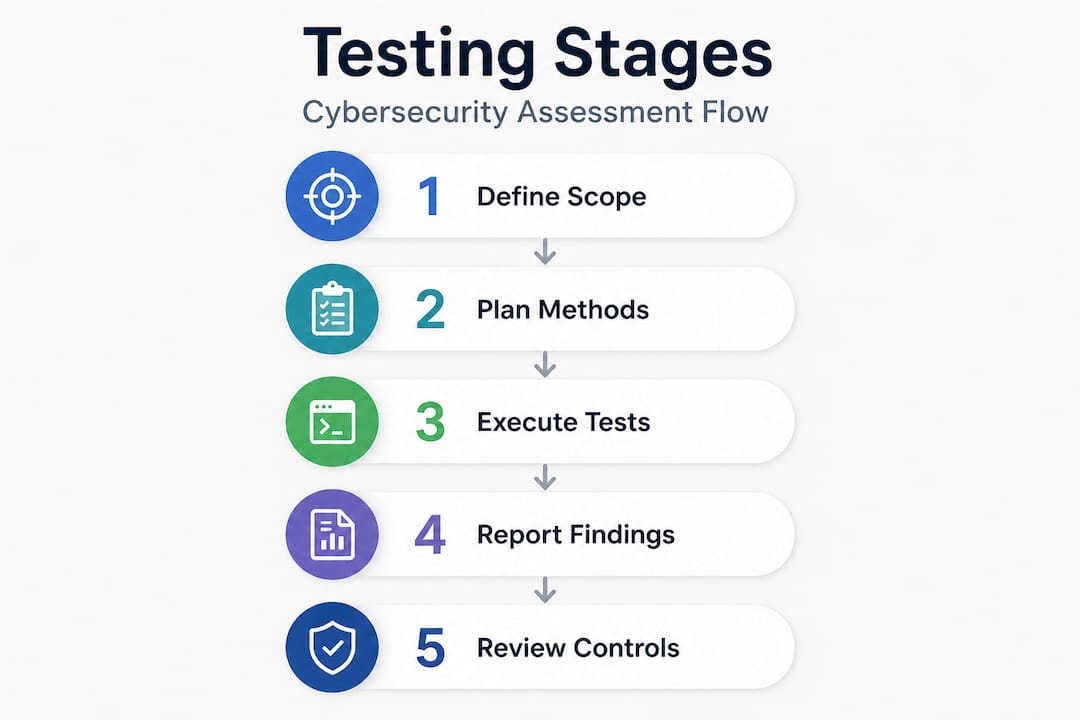
Penetration testing by qualified experts covering all device interfaces and communication protocols is the standard expectation for connected devices. That means physical ports (USB, serial, JTAG), wireless interfaces (Bluetooth, Wi-Fi, Zigbee), network protocols, and any cloud-connected backend systems. Leaving even one interface untested creates a finding.
The expected testing program typically includes:
“Testing is not a pass or fail event. It is an evidence-generating process. Every finding, even minor ones, must link to a documented mitigation decision and a residual risk assessment connected to clinical harm.”
This linkage is critical. An NB reviewer does not just want to see a penetration test report. They want to see how each finding was categorized by severity, what mitigation was implemented, and how the residual risk was accepted within the risk management framework under ISO 14971. A clean test report with no findings can actually raise suspicion if the test scope was narrow or the methodology was not rigorous.
For manufacturers building out their testing programs, the penetration testing guide covers scope definition, methodology selection, and documentation requirements in practical detail. Real-world examples of compliant testing execution are also visible in published VAPT testing case studies that show how findings translate into regulatory evidence.
Pro Tip: When selecting a penetration testing provider for regulatory purposes, confirm that they can produce structured test reports that map findings to CVSS scores, affected interfaces, and recommended mitigations. An informal report suitable for IT security will not satisfy an NB reviewer looking for documented evidence.
Choosing testing partners with medical device experience matters more than choosing partners with generic security credentials. The complete security testing guide for patient monitoring devices illustrates how testing evidence must be structured to support both FDA and EU MDR submissions. The mobile security considerations that manufacturers face in connected device environments further reinforce why interface-specific expertise is non-negotiable.
Testing is only part of the process. Maintaining and improving cybersecurity after your device reaches the market is equally weighted in the NB’s ongoing surveillance activities. This is where many manufacturers underinvest, and where NB surveillance visits most often surface nonconformities.
The harmonized NB approach to post-market cybersecurity, reinforced by Team-NB’s formal position on the issue, establishes that manufacturers must actively maintain cybersecurity throughout the device lifecycle, not just at the time of initial conformity assessment. Team-NB issued a formal letter in 2026 supporting enhanced cybersecurity efforts and signaling that NBs are increasingly aligned in their post-market expectations.
Ongoing post-market cybersecurity obligations include:
A statistic worth internalizing: post-market surveillance failures are consistently among the top five reasons for NB nonconformity findings in EU MDR assessments. Cybersecurity-specific PMS failures are a growing subset of that category. Reviewing a security compliance management case demonstrates how structured post-market processes can both satisfy NBs and improve actual device security outcomes in parallel.
Understanding broader website security strategies used in other regulated industries also offers useful patterns for how vulnerability disclosure and patch communication can be structured professionally and transparently.
We have worked with manufacturers across regulated markets, and the pattern that consistently leads to NB problems is not ignorance of the regulations. It is the quiet organizational assumption that meeting the minimum documented requirement is sufficient. It is not. Not in 2026, and certainly not going forward.
NBs are not static in their expectations. The harmonization effort led by Team-NB signals that reviewers are becoming more consistent, more knowledgeable about cybersecurity specifics, and more likely to push back on documentation that technically satisfies the letter of MDCG 2019-16 but lacks genuine substance. We have seen manufacturers produce technically compliant threat models that contain no realistic threats. We have seen penetration test reports that covered only one of six interfaces because the scope was deliberately narrowed to avoid findings. NBs are getting better at identifying these patterns.
The practical shift required is from compliance-as-documentation to compliance-as-practice. That means threat intelligence actually feeds your risk management process. It means PMS data is reviewed by someone with cybersecurity expertise, not just regulatory affairs staff. It means coordinated disclosure is a real program, not a generic email address in your instructions for use.
The MedSecurance critique of MDCG 2019-16 highlights exactly where the current guidance falls short of what the threat landscape demands. Manufacturers who read that critique and use it to get ahead of future guidance revisions will be in a fundamentally better position than those waiting for updated requirements to become mandatory. The compliance steps for medical device cybersecurity that distinguish leading manufacturers from struggling ones are not more documentation. They are better processes that generate documentation as a natural output.
Meeting NB cybersecurity expectations requires more than regulatory knowledge. It requires structured testing programs, compliant documentation, and a testing partner who understands both the security techniques and the regulatory evidence requirements.

Testvox specializes in medical device security testing aligned with EU MDR, MDCG 2019-16, ISO 14971, and IEC 62304 expectations. Our VAPT team conducts penetration testing, fuzz testing, and vulnerability scanning across all device interfaces, producing structured reports that map directly to risk management documentation requirements. We have supported manufacturers through initial conformity assessments and NB surveillance visits, with documented outcomes visible in our security testing case study for an FDA-ready patient monitoring device. Whether your device is approaching a first submission or preparing for a notified body surveillance audit, Testvox provides the testing evidence and documentation structure you need to move forward with confidence.
NBs expect penetration testing for higher-risk and connected devices, with test scope calibrated to the device’s risk classification and interface complexity. Lower-risk, non-connected devices may require less extensive testing but still need documented security risk assessments.
No. Cybersecurity requirements are integrated directly into MDR GSPRs, risk management obligations, and post-market surveillance requirements rather than existing as a separate regulatory document.
MDCG 2019-16 guidance establishes expectations including authentication controls, encryption, security logging, post-market vulnerability monitoring, and coordinated disclosure processes as baseline requirements.
Yes. Harmonized NB expectations require continuous vulnerability monitoring, integration of PMS data into cybersecurity risk files, and coordinated disclosure programs throughout the device’s commercial lifecycle.
EU MDR integrates cybersecurity within the broader safety and risk management framework, giving manufacturers interpretive flexibility; the FDA approach is more prescriptive, requiring specific deliverables such as a software bill of materials and defined patch management timelines.

Let us know what you’re looking for, and we’ll connect you with a Testvox expert who can offer more information about our solutions and answer any questions you might have?
