
 23 December 2025

QA outsourcing: How startups achieve reliable testing
10 May 2026
 10 min 13 sec
  BY
Amju
BY
Amju
Hiring a full in-house QA team sounds like the responsible move, but for most fintech and e-commerce startups, it’s actually one of the most expensive ways to slow yourself down. QA outsourcing is widely misread as a cost-cutting tactic for resource-strapped teams, when in reality it’s a speed, objectivity, and quality strategy that some of the fastest-growing product companies rely on. This guide breaks down what QA outsourcing actually means, which models fit startup realities, how to avoid the failure patterns, and when it makes the most strategic sense to bring in an external quality partner.
Table of Contents
- Understanding QA outsourcing: Definition, models, and why it matters
- Key advantages and limitations of QA outsourcing
- How to maximize QA outsourcing success: Best practices for startups
- When should fintech and e-commerce teams consider QA outsourcing?
- Our perspective: Why ‘outsider’ testing often beats in-house for startups
- Next steps: How expert QA outsourcing accelerates your secure launches
- Frequently asked questions
Key Takeaways
| Point | Details |
|---|---|
| QA outsourcing defined | Entrusting quality assurance to an external specialist boosts objectivity and speed for startups. |
| Know the pros and cons | QA outsourcing cuts bias and can launch faster, but risks miscommunication and knowledge loss if not managed. |
| Right timing matters | Outsource QA when speed, unbiased review, or specialized compliance requirements are critical for your launch. |
| Best practices drive results | Clear documentation, defined escalation paths, and strong onboarding vastly increase QA outsourcing success. |
| Leverage outsider perspective | External QA teams often spot issues internal teams miss, especially in fintech or e-commerce launches. |
Understanding QA outsourcing: Definition, models, and why it matters
QA outsourcing means handing off all or part of your software quality assurance process to an external specialist team instead of building that function in-house. The outsourced team handles test planning, execution, bug reporting, and in some cases, automation framework development and security validation. You retain oversight and prioritization. They bring the bench strength, tooling experience, and fresh eyes.
This is fundamentally different from hiring a freelance tester or asking your developers to double-check their own work. How QA outsourcing works in practice involves an external team operating alongside your development sprints, embedded in your workflow but organizationally independent from your product decisions.
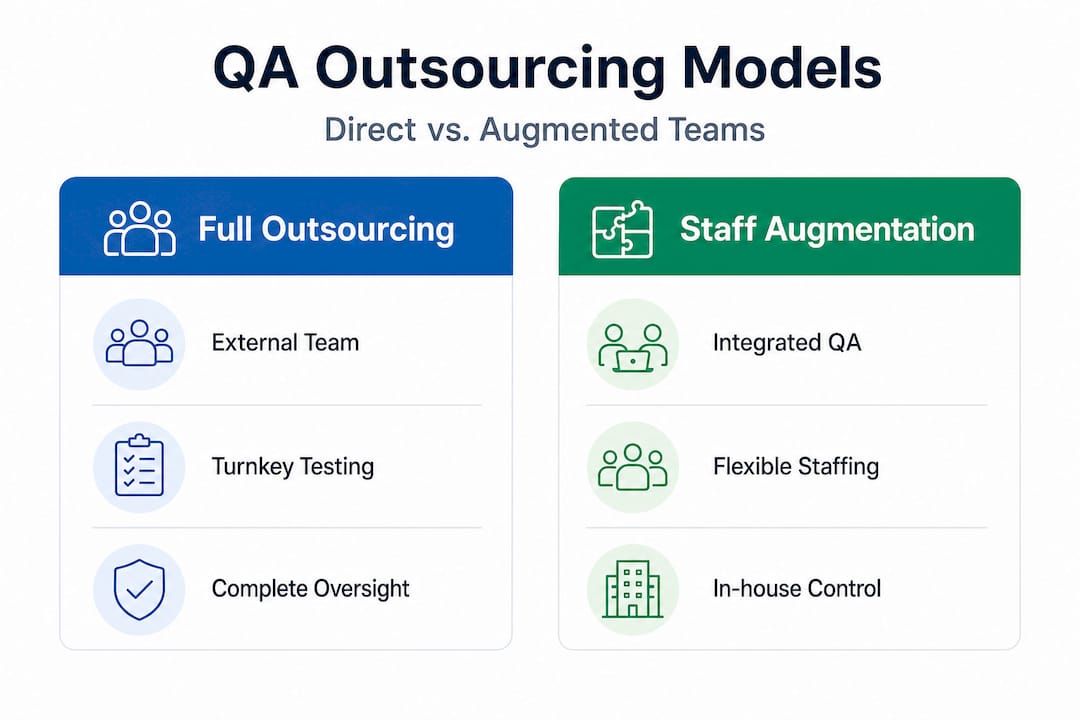
There are four primary models to understand:
- Managed testing services: The QA vendor takes full ownership of the testing function. They design the test strategy, manage the team, and report outcomes. Best for startups without any QA infrastructure.
- Staff augmentation: You embed external QA engineers directly into your internal team. They work under your direction, using your tools and processes. Best when you have some QA leadership but need more hands.
- Project-based QA: Scoped engagement around a specific feature, release, or audit. Starts and ends at defined milestones. Ideal for pre-launch security audits or major version releases.
- Crowdsourced QA: A distributed crowd of testers explores your app across many devices, browsers, and usage patterns. Useful for coverage breadth, less useful for deep compliance or security testing.
Most fintech and e-commerce companies use blends of these models. You might run staff augmentation during active development and then layer in a project-based security audit before launch. The benefits of outsourcing QA shift depending on which model you choose and how tightly you integrate the partner.
One critical nuance worth calling out: independent testing reduces bias and tends to produce more thorough reviews than in-house testing, but only if the knowledge transfer between your team and the outsourced partner is genuinely strong. Without it, even the best external tester is working blind.
Pro Tip: Before onboarding any QA partner, build a product primer document. This covers your core user journeys, regulatory context, known edge cases, and data sensitivity rules. Share it on day one and update it at each sprint boundary.
Key advantages and limitations of QA outsourcing
With QA outsourcing defined, it’s crucial to weigh both its strengths and the potential pitfalls before making a strategic decision.
The case for outsourcing QA is genuinely strong for fast-growing startups. Here’s where it creates real leverage:
Advantages you should count on:
| Advantage | Why it matters for fintech/e-commerce |
|---|---|
| Unbiased test perspective | External testers aren’t attached to the product, so they probe harder |
| Speed to coverage | No hiring cycle. Ramp up in days, not months |
| Scalable resources | Scale test capacity up or down per release cycle |
| Access to specialist skills | VAPT, automation engineers, compliance testers on demand |
| Cost flexibility | Pay for outcomes, not for full-time salaries and benefits |
Limitations you should plan for:
| Limitation | Mitigation |
|---|---|
| Domain knowledge gaps | Invest in structured onboarding and a living product wiki |
| Miscommunication risks | Define escalation paths and response SLAs from day one |
| Time zone friction | Overlap windows and async reporting formats reduce delay |
| Process dependency | If your team’s documentation is weak, outsourced QA suffers too |
Startup QA outsourcing benefits are real, but they don’t materialize on their own. The most common failure mode isn’t bad testers. It’s broken communication loops.
“A critical risk in outsourced QA is communication and coordination breakdown, spanning time zones, escalation paths, and feedback loops. Even strong test execution becomes worthless if the right people aren’t informed at the right moment.”
External testing reduces bias and increases objectivity, but this advantage evaporates if testers don’t understand the product context they’re validating against.
Red flags that signal a poor fit or poor execution:
- The QA partner can’t name your top three user flows after onboarding
- Bug reports lack reproducible steps or severity reasoning
- You receive test results but no test coverage metrics
- There’s no defined escalation contact on the vendor side
- Your internal team reviews bugs but never closes the feedback loop with the QA partner
These aren’t just vendor problems. Many of these signals point to gaps on the startup side too. Both parties have to own the process.
How to maximize QA outsourcing success: Best practices for startups
To translate the theory into results, startups need tactical guidance for extracting maximum value from QA outsourcing partners.
Here’s a practical sequence that actually works for fintech and e-commerce teams:
- Set specific quality goals before the engagement starts. “Find bugs” is not a goal. “Achieve zero critical payment failures in checkout regression” is a goal. Specificity drives focus and accountability.
- Document requirements at the feature level, not just the epic level. External testers need enough context to know what correct behavior looks like. Vague requirements produce vague test cases.
- Run a structured onboarding session, not just a repository invite. Walk the QA team through the product live. Record it. Share test data environments and credentials on day one. Don’t assume they’ll figure it out.
- Define communication cadence explicitly. Daily async bug log updates, a mid-week sync call, and a Friday coverage summary keeps both sides aligned without drowning anyone in meetings.
- Build escalation paths into the contract, not just the relationship. If a critical bug lands on a Friday at 6 PM, who do you call? Name the person. Have a backup. The coordination breakdown risk spikes hardest when escalation is ambiguous.
- Close the loop on every reported bug. Whether a bug gets fixed, deferred, or rejected, the QA team should hear why. This feedback shapes future test priorities and improves the partner’s product understanding over time.
Pro Tip:
Make test case documentation a shared, versioned artifact. Use a tool both teams can access and edit. When requirements change, the test cases should update within the same sprint cycle. Stale test cases cause false confidence.
Here’s how a healthy communication workflow typically looks for a startup running outsourced QA alongside bi-weekly sprints:
| Communication type | Frequency | Owner | Response SLA |
|---|---|---|---|
| Bug log update | Daily | QA partner | Same business day |
| Sprint sync call | Bi-weekly | Product lead | Live discussion |
| Test coverage report | Per sprint | QA partner | 24 hrs after sprint end |
| Critical bug escalation | As needed | QA partner | 2 hours max |
| Requirement change alert | As needed | Product lead | Before next test cycle |
For fintech applications specifically, you also need to address how the QA partner handles sensitive data. Define a synthetic data policy. Real PII (personally identifiable information) should never enter a test environment. Regulatory test scenarios, such as KYC (know your customer) flows, transaction limits, and fraud triggers, should be documented explicitly. QA’s impact on user experience is enormous in regulated sectors because poor UX in a verification flow isn’t just annoying. It’s a compliance and conversion problem simultaneously.

When choosing the best QA partner, look for domain experience in your vertical, a defined onboarding process, and the ability to explain their test strategy clearly in the first conversation.
When should fintech and e-commerce teams consider QA outsourcing?
Even with best practices in hand, understanding exactly when QA outsourcing adds the most value means spotting the right internal signals.
The honest answer is that most fintech and e-commerce startups reach the inflection point earlier than they expect. Growth accelerates, the feature backlog grows, and suddenly your two developers are also your only testers. That’s when quality starts slipping quietly.
Here are the clearest signals it’s time to bring in an external QA partner:
- Your release cycle is getting longer, not shorter, as the product grows
- Your team is manually testing the same flows every sprint with no automation in place
- A recent release caused a production incident your team didn’t catch in testing
- You’re approaching a regulated market launch (payments, lending, insurance) where compliance is non-negotiable
- You need to validate a third-party integration, like a payment gateway or fraud detection API, with objectivity
- Your product is scaling geographically and you need multi-region or multi-device test coverage fast
- You’re running a crowdfunding round or enterprise sales process where a public bug would be catastrophic
Independent external testing consistently provides more objective review than internal testing, which makes it especially valuable before high-stakes events like public betas, enterprise demos, or regulatory submissions.
For fintech specifically, the rollouts that benefit most from QA outsourcing include: payment gateway integrations, fraud detection system launches, digital onboarding flows with KYC or AML (anti-money laundering) logic, and mobile banking app releases. For e-commerce, the highest-value scenarios include checkout flow launches, promotional campaign stress tests, cross-border payment validations, and third-party marketplace integrations.
Teams that don’t yet have any QA function at all should look at AI-augmented and scalable testing as a bridge strategy while building their QA foundation.
The market trend is clear. Software failures in fintech are increasingly costly not just financially but reputationally. A single broken payment flow during a peak sales event or a KYC bypass vulnerability at launch can trigger regulatory scrutiny, user churn, and investor concern simultaneously.
Our perspective: Why ‘outsider’ testing often beats in-house for startups
Having mapped the when and why, let’s share what most QA guides leave out: our hard-won view from years working with fast-moving fintech and e-commerce teams.
The Hidden Cost of Familiarity
The myth that needs retiring is this: only people who built the product have enough context to find what’s wrong with it. That belief sounds logical. It’s actually one of the most expensive assumptions a startup CTO can hold.
In-house developers and product managers are deeply familiar with how the system is supposed to work. That familiarity is an asset in building. It’s a liability in testing. When you know what a button is meant to do, your brain auto-corrects your observations. You click through edge cases without fully registering them because your mental model fills in the gaps. This isn’t carelessness. It’s how human cognition works under routine. And it’s why internal teams consistently miss the bugs that external users find on day one.
How Third-Party Testers See Different Risks
Third-party testers ask different questions. They read error messages literally. Try combinations your team never documented because they follow user curiosity rather than internal assumptions. They document what is actually happening, not what should be happening. In regulated sectors like fintech, that distinction can mean the difference between identifying a compliance gap during testing and discovering it during an audit.
A Real-World Example of External QA Value
We’ve seen this play out concretely. One fintech client trusted their internal team to validate a new transaction approval flow. The team tested the expected paths thoroughly. An external review, structured as a pre-launch audit, found that a specific sequence of rapid approvals under a concurrent login scenario bypassed a fraud rule entirely. The internal team had not tested it because the scenario did not match their mental model of user behavior. Real users, however, found it within hours of release.
Why External QA Works Best Before Launch
QA’s role in agile teams is increasingly about continuous objectivity, not just sprint velocity. The highest-leverage moment for an external QA partner is the final pre-launch audit. Bring them in precisely when your team is most confident, because that is when confirmation bias reaches its peak.
The uncomfortable truth is simple: your team cares deeply about the product, and that caring creates blind spots. Outsider testing is not a vote of no confidence in your engineers. It is a structural safeguard against the cognitive traps that come with proximity and ownership.
Next steps: How expert QA outsourcing accelerates your secure launches
If you want to see QA outsourcing at its highest level of impact, here are your best options for a secure, high-quality launch.
At Testvox, we work directly with fintech and e-commerce startups that are scaling fast and can’t afford a buggy or insecure release. From functional and automation testing to VAPT security audits aligned with OWASP standards, our approach is built around your launch timeline, not a generic testing template.

Our “One-Round Complete Testing” model is specifically designed for teams approaching beta. It’s a structured, deep-dive audit that covers user experience, payment gateway integrations, security posture, and edge-case coverage in a single focused engagement. You can explore real examples of how this has worked for regulated products in our fintech testing case studies and e-commerce QA success stories. If you’re ready to understand the full value of a professional testing partnership, we’re ready to show you exactly what that looks like for your product.
Frequently asked questions
What is the main difference between in-house and outsourced QA?
Outsourced QA brings objectivity and can uncover issues that internal teams miss due to familiarity bias, but requires strong knowledge transfer to be effective in domain-specific contexts like fintech or e-commerce.
Does QA outsourcing save time when launching a new app?
Yes, because external teams ramp up quickly without a hiring cycle, and their specialist skills mean faster test coverage from the start. Objective external review also reduces back-and-forth caused by missed bugs post-launch.
What are the risks of QA outsourcing?
The most significant risks are miscommunication, domain knowledge gaps, and time zone friction. Coordination breakdown across escalation paths and feedback loops is the most common failure pattern, even when test execution itself is technically solid.
How do startups ensure knowledge transfer to outsourced QA teams?
Document core user journeys, regulatory requirements, and known edge cases before onboarding starts, then run a live product walkthrough and keep a shared, versioned test case repository that both teams maintain throughout the engagement.
Is QA outsourcing recommended for highly regulated fintech and e-commerce apps?
Absolutely. With rigorous onboarding and clear data handling protocols, outsourced QA provides unbiased compliance testing and broader test coverage than most internal teams can realistically deliver during a high-pressure release cycle.
Recommended
- AI Shift Left Testing | QA Strategy for Startups
- Hybrid Testing Model | AI + Human QA for Startups
- Outsourcing software testing – How it benefits your business ?
- 5 Reasons Why Your Business Needs a Dedicated Testing Team – Testvox
23 December 2025
 29 October 2024


ABOUT TESTVOX

Testvox is a software testing company help your product reach its full potential. Get full cycle testing for your mobile and web applications while ensuring all quality assurance standards are met... Read More
100+
Applications
Assured
Assured

5 Star Rating

5 Star Rating
“By participating in our release lifecycle, Testvox's standard QA process has helped us to launch quality products faster.”

Rima Hudaifa
Manager | Cadvil
Manager | Cadvil
