
 16 April 2026

Why Invest in Software Testing: ROI and Business Impact
23 May 2026
 8:33 MIN Read time
  BY
Amju
BY
Amju
Every dollar you skip on testing has a way of coming back to cost you ten. The question of why invest in software testing is not philosophical — it’s financial. Poor software quality costs the US economy $2.41 trillion annually, and a significant chunk of that loss comes from companies that treated testing as a line item to cut, not a function to fund. If you’re a CTO or founder at a startup or SME in the US or India, this article breaks down the real economic case for investing in QA, with benchmarks, ROI data, and practical frameworks you can act on.
Table of Contents
- Key Takeaways
- Why invest in software testing: the cost of not doing it
- The real ROI of test automation
- How testing improves products, trust, and your competitive position
- Building a testing strategy that fits your budget
- My take: testing is how you afford to grow fast
- How Testvox helps you get testing ROI faster
- FAQ
Key Takeaways
| Point | Details |
|---|---|
| Defects cost exponentially more later | A bug caught in design costs 1x to fix; the same bug in production costs 60 to 100x more. |
| Automation delivers measurable ROI | Enterprise test automation programs average a 4.5x ROI over three years with a 13-month payback period. |
| Testing protects brand and revenue | Undetected bugs damage user trust, trigger churn, and create compliance exposure that compounds over time. |
| Risk-based testing controls costs | Startups and SMEs can maximize testing budgets by focusing efforts on critical business transaction flows first. |
| Defect avoidance drives the most value | The largest ROI driver in test automation is not speed or labor savings. It is defect avoidance and risk reduction. |
Why invest in software testing: the cost of not doing it
The most compelling argument for investing in software testing is not what testing gives you. It’s what skipping it costs you.
Defects found in production cost up to 100 times more to fix than those caught in the design phase. That’s not a rounding error. That’s the difference between a developer spending 30 minutes fixing a logic flaw during a sprint and your entire engineering team spending two weeks reverse-engineering a live incident while customers churn in real time.
The table below makes this concrete.
| SDLC Phase | Relative Cost to Fix a Defect | Typical Discovery Method |
|---|---|---|
| Requirements / Design | 1x | Code reviews, specification walkthroughs |
| Development | 5-10x | Unit tests, peer code review |
| QA / Testing | 10-20x | Functional, regression, integration tests |
| Staging / Pre-release | 20-40x | UAT, performance tests |
| Production | 60-100x | User complaints, monitoring alerts |
There’s also a hidden cost that almost nobody puts in their software testing cost analysis: developer context switching. When a production bug lands, your engineers don’t just fix it. They stop what they’re building, reconstruct mental context from weeks ago, coordinate with support, and sometimes undo days of work. Context switching from production bugs creates a productivity drain that never appears on a bug ticket but shows up in missed sprint goals and slower feature velocity.
The principle that addresses this directly is shift-left testing. Shifting quality activities earlier in the software development lifecycle means early testing saves time at the 1x cost point instead of letting defects compound into 60x problems. For startups in particular, this matters because the speed cost of late-stage bug fixing is often more damaging than the direct financial cost.
Pro Tip: Before your next sprint, ask your team to track how many hours they spend fixing bugs versus building new features. That ratio is your baseline for measuring the ROI of any QA investment.
The real ROI of test automation
Not all testing investments are equal, and automation is where the numbers get genuinely interesting.
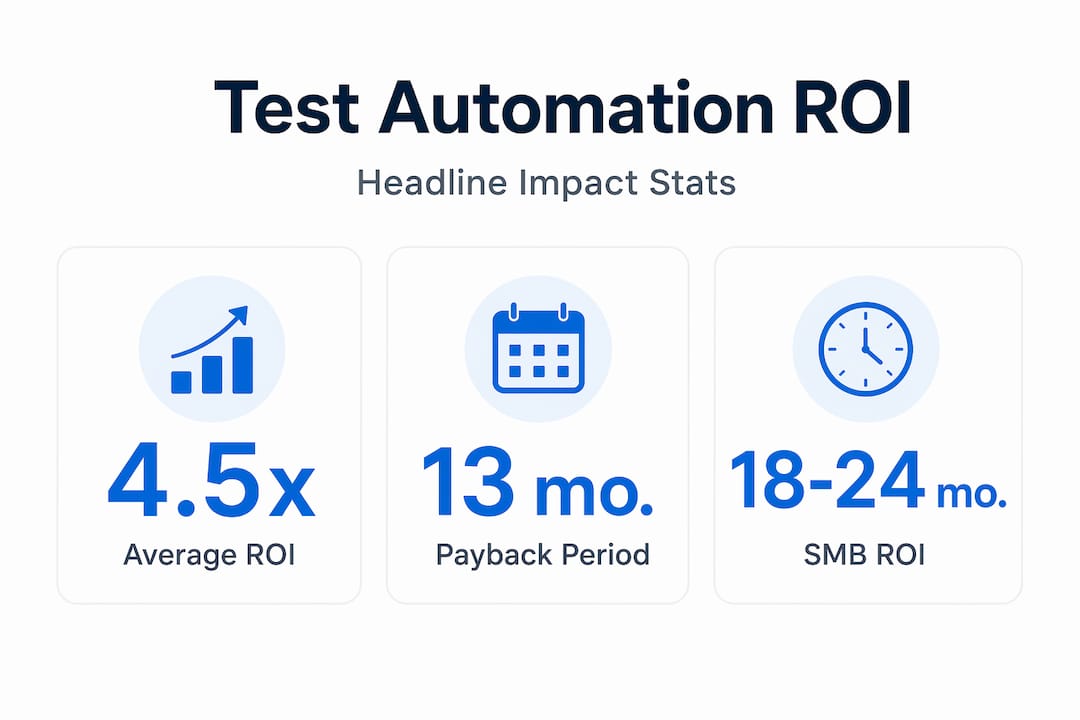
Forrester’s TEI research documents an average 4.5x ROI over three years for enterprise test automation programs, with a 13-month payback period. For a startup or SME evaluating whether to build or buy automation capacity, that’s a legitimate business case.

But where does that return actually come from? Most founders assume it’s about going faster or cutting QA headcount. That framing is wrong, and it’s why many early automation programs underperform. The largest value driver in test automation ROI models is defect avoidance and risk reduction, not speed or labor savings. Preventing a critical bug from reaching production in a fintech app is worth orders of magnitude more than saving three hours of regression time.
Here’s a direct comparison to put the investment decision in context.
| Factor | Manual Testing | Automated Testing |
|---|---|---|
| Regression cycle time | 40+ hours per cycle | 2-4 hours per cycle |
| Defect catch rate | Declining over time due to tester fatigue | 95%+ defects caught consistently |
| Scalability | Costs scale linearly with coverage | Marginal cost drops as test suite grows |
| Upfront investment | Low | Moderate to high |
| Long-term cost | High due to repetition | Lower after initial build |
| Best fit | Exploratory, UX, one-off tests | Regression, smoke, integration tests |
One important nuance for smaller teams: smaller automation programs with 50 to 150 tests see positive ROI in 18 to 24 months, not 13. That’s still a strong return, but it means your business case needs to reflect your actual scale rather than enterprise benchmarks.
The biggest risk to automation ROI is not the initial cost. It’s brittle test suites. Automation targeting unstable UI elements inflates maintenance costs and erodes ROI steadily. The fix is architectural: build tests around stable, business-critical flows rather than UI details that change with every redesign. Check out how smart test automation approaches this structurally to maintain high signal over time.
Pro Tip: Focus your first automation investments on your three to five most critical business flows, typically checkout, authentication, and payment processing. These provide the highest defect avoidance value and are stable enough to maintain without constant rework.
How testing improves products, trust, and your competitive position
There is a version of the testing argument that focuses purely on defect counts, and it undersells the real case. The advantages of software testing extend well beyond bug prevention into territory that directly affects whether customers stay, spend, and recommend you.
Testing uncovers security vulnerabilities and functional issues early, before they become breaches, compliance failures, or front-page problems. For fintech and e-commerce startups especially, a single security incident can trigger regulatory scrutiny, payment processor penalties, and user exodus simultaneously. You cannot patch your way out of that. You prevent it.
Beyond security, consider what consistent software quality does to customer behavior:
- Reduced churn from reliability failures. Users abandon apps after two or three bad experiences. A crash during checkout or a data sync failure costs you that customer and the revenue they would have generated.
- Lower support costs. Every bug that reaches a user generates a support ticket, a refund request, or a social media complaint. Testing prevents the problem at the source instead of managing it downstream.
- Fewer emergency hotfixes. Hotfixes under pressure introduce new bugs and slow your release cadence. Teams that test well ship with confidence and maintain momentum.
- Regulatory and compliance coverage. In industries like fintech, healthcare software, or any product touching EU or US consumer data, untested code is a compliance liability. Testing is part of your audit trail.
- Innovation capacity. Teams that aren’t buried in production incidents have time to build. Why quality assurance matters at this level is simple: it’s what separates companies that ship new features from those that spend their sprints on firefighting.
The reputational dimension compounds over time in a way that’s hard to quantify but easy to observe. Brands that consistently ship reliable software attract better engineers, retain customers longer, and close enterprise deals faster because procurement teams do ask about QA maturity.
Building a testing strategy that fits your budget
Knowing the benefits of software testing is one thing. Building a program you can actually fund and maintain as a startup or SME is another.
The most practical framework for resource-constrained teams is risk-based testing. Rather than attempting to test everything, risk-based testing aligns your testing scope with critical business transaction flows and regulatory requirements. You test the parts of your product where failure is most expensive or most likely first.
Here’s how to put this into practice:
- Map your critical paths. Identify the five to ten flows where a failure would directly cost you revenue, users, or compliance standing. These get tested first and most often.
- Define your automation candidate list early. Not every test should be automated. Exploratory testing, UX evaluation, and edge-case flows are better handled by skilled manual testers. Automate your regression suite first.
- Integrate testing into your CI/CD pipeline. Running automated tests on every code commit catches defects before they compound. This is where you get the speed benefit that complements the defect avoidance value.
- Partner strategically if your team is lean. Startups in India and the US increasingly use staff augmentation or managed QA services to access senior testing expertise without the overhead of a full-time team. This is especially effective during pre-launch or beta phases.
- Track defect patterns across releases. Early and automated testing builds a continuous improvement loop. When you track where bugs originate across sprints, you identify systemic weaknesses and fix them at the source.
For a detailed breakdown of how to frame the financial case internally, the cost-benefit analysis of software testing is a useful starting point for building your budget proposal. You can also define clearer testing scope by aligning with how custom software requirements shape what needs to be validated from the start.
Pro Tip: If you’re building your first QA program, start with a one-time QA audit before your beta release. It surfaces systemic gaps and gives you a prioritized remediation list that’s far more useful than ad hoc testing.
My take: testing is how you afford to grow fast
In my experience working with startups across fintech, e-commerce, and SaaS, the teams that chronically underinvest in QA share a recognizable pattern. They ship fast in the early months, accumulate defects they don’t track, and then hit a wall around Series A or their first major enterprise client where the technical debt becomes the conversation instead of the product.
I’ve also seen the opposite: founders who treated testing as a growth function from day one. They didn’t test everything. They tested smartly, focused on critical flows, and built automation incrementally. Those teams scale without the technical reckoning.
The conventional view is that testing slows you down. I think that’s backwards. Untested code slows you down. Testing is what lets you keep moving. When your regression suite runs in two hours instead of two days, you ship daily instead of weekly. When production incidents drop, your engineers build instead of firefight.
The most expensive mistake I see in automation specifically is building tests against UI elements that change constantly. You end up maintaining the test suite instead of expanding it, and the ROI never materializes. Architecture discipline upfront is what separates automation programs that compound in value from those that become a burden.
Invest in testing early. Size it to your risk profile. And treat your QA function as the thing that makes everything else you build worth shipping.
— Testvox
How Testvox helps you get testing ROI faster
If you’ve read this far, you’re likely at a decision point: build QA capability internally or partner with a team that’s already done it.

Testvox works with startups and SMEs in the US and India to build testing programs that match their risk profile and budget. From security testing services that protect your application before launch to QA auditing that identifies systemic gaps in your current process, every engagement is scoped around your actual business flows. For teams building accessible, inclusive products, Testvox also covers accessibility testing aligned with legal compliance standards. Whether you need a one-time deep-dive audit before beta or an ongoing QA partner embedded in your sprint cycle, Testvox is built for exactly the stage you’re at.
FAQ
What is the main reason to invest in software testing?
The primary reason is financial: defects caught in design cost 1x to fix, while the same defects in production cost 60 to 100x more. Testing prevents the expensive problems before they reach users.
What ROI can startups expect from test automation?
Enterprise programs average a 4.5x ROI over three years with a 13-month payback period. Smaller teams with 50 to 150 automated tests typically see positive ROI in 18 to 24 months.
How does software testing improve product quality beyond bug fixing?
Testing surfaces security vulnerabilities, validates performance under load, and confirms regulatory compliance before release. This protects brand reputation and reduces the customer churn that follows reliability failures.
Is manual testing still worth investing in?
Yes, for the right use cases. Manual testing excels at exploratory testing, UX evaluation, and edge cases. Automated testing handles regression and smoke testing more reliably and at lower cost at scale. The optimal approach combines both.
How should a startup with a limited budget prioritize software testing?
Use risk-based testing to focus your budget on the critical flows where failure is most costly, such as authentication, payment processing, and core user journeys. Automate those first before expanding coverage.
Recommended
- The ROI of Software Testing: A Cost-Benefit Analysis – Testvox
- Cost Benefits Of Software Testing Staff Augmentation Compared To In-House Hiring – Testvox
- Mastering CRM Software Testing: A Comprehensive Guide
- Performance Testing – The non-functional testing technique
16 April 2026

 13 January 2023

ABOUT TESTVOX

Testvox is a software testing company help your product reach its full potential. Get full cycle testing for your mobile and web applications while ensuring all quality assurance standards are met... Read More
100+
Applications
Assured
Assured

5 Star Rating

5 Star Rating
“By participating in our release lifecycle, Testvox's standard QA process has helped us to launch quality products faster.”

Rima Hudaifa
Manager | Cadvil
Manager | Cadvil
