




UAE
Testvox FZCO
Fifth Floor 9WC Dubai Airport Freezone
 BY
Testvox
BY
Testvox
Your in-house QA team cannot replicate the device chaos of India and MENA markets. A fintech app that runs perfectly on your office MacBook may break on a budget Android running a localized OS variant used by 40 million people in Tier-2 Indian cities, or render incorrectly in a right-to-left Arabic interface on a Samsung mid-range device popular in Saudi Arabia. Crowd testing solutions in India MENA markets exist precisely to close that gap, using real testers on real devices in real conditions to surface issues your lab will never find. This article gives you a practical framework to build, secure, and run those programs.
| Point | Details |
|---|---|
| Target regional demographics | Specifying India and MENA participant profiles improves test relevance and device coverage. |
| Use ethical hackers for security | Crowdsourced security testing with vetted experts yields actionable vulnerability findings. |
| Control app distribution securely | Enterprise-grade secure distribution minimizes risks during mobile crowd testing. |
| Manage access carefully | Ephemeral access and NDAs protect sensitive data and increase testing quality. |
| Pilot before scaling | Testing small groups first validates scenarios and bug report formats for better outcomes. |
Crowdtesting matches testers to your target audience by geography, device type, OS version, and demographic profile, then deploys them in real-world conditions rather than controlled lab environments. That distinction matters enormously. A lab test tells you the app works. A crowd test tells you the app works for the people who will actually use it.
For India and MENA, that distinction becomes even sharper. India has over 600 million smartphone users spread across dozens of device brands, Android versions, and network conditions ranging from 5G in Mumbai to 2G in rural Rajasthan. MENA adds another layer: Arabic language support, right-to-left layouts, and culturally specific user flows that require testers who actually live in those contexts.
Here is what a well-designed crowd testing service in India covers:
One crowd testing case study illustrates this well: deploying QA testers across 20 countries simultaneously revealed regional bugs that would have taken months to surface through sequential in-house testing. The feedback loop collapsed from weeks to days.
The core principle is simple: in-house QA validates that your software does what you built it to do. Crowd testing validates that it does what your users need it to do, on the hardware they own, in the conditions they live in.
Functional crowd testing and security crowd testing are not the same discipline, and conflating them is a costly mistake. You would not ask a usability tester to audit your payment gateway encryption. Security crowd testing requires professional ethical hackers who understand attack vectors, not general testers who report UI bugs.
The most effective model uses a curated network of vetted professionals. Intigriti operates a network of 80,000+ vetted ethical hackers running bug bounty programs with managed triage, meaning every reported vulnerability is validated before it reaches your team. That triage step is what separates actionable security intelligence from noise.
For startups in India and MENA, this model offers three specific advantages:
Pro Tip: Before launching a bug bounty program, define your scope precisely. Limit it to production-equivalent staging environments and exclude modules with live customer data. This protects you legally and keeps tester focus where it generates the most value.
Complement your crowd security program with a formal security testing service that includes VAPT aligned to OWASP standards. Crowd security testing finds what attackers find. Structured VAPT finds what they might find next. Together, they cover both known and emerging threat surfaces. You can review real security testing outcomes to understand what this looks like in practice.
Sending your unreleased app to 200 testers across India and the Gulf creates real exposure if distribution is not controlled. A build that leaks before launch can damage competitive positioning, expose proprietary code, or violate data protection regulations increasingly enforced across MENA markets.

Enterprise-grade distribution platforms address this directly. Sauce Labs Mobile App Distribution supports configurable secure app delivery, SSO integration, and complies with SOC 2 Type II and ISO 27001/27701 standards, giving you documented compliance for regulated industries like fintech and healthcare.
Key controls to enforce during mobile crowd testing:
| Control | Risk it addresses | Compliance relevance |
|---|---|---|
| SSO integration | Unauthorized tester access | SOC 2 Type II |
| Time-limited builds | Stale build exposure | ISO 27001 |
| Remote revocation | NDA breach, data leak | GDPR, PDPA |
| Encrypted data transfer | Interception of app builds | ISO 27701 |
Pro Tip: Treat your test build like a production secret. Use a separate signing certificate for test builds so they cannot be confused with your release binary, and rotate it after each major test cycle.
For a deeper look at how these controls apply across platforms, the mobile app testing case studies show how controlled distribution prevented pre-launch leaks in real deployments.
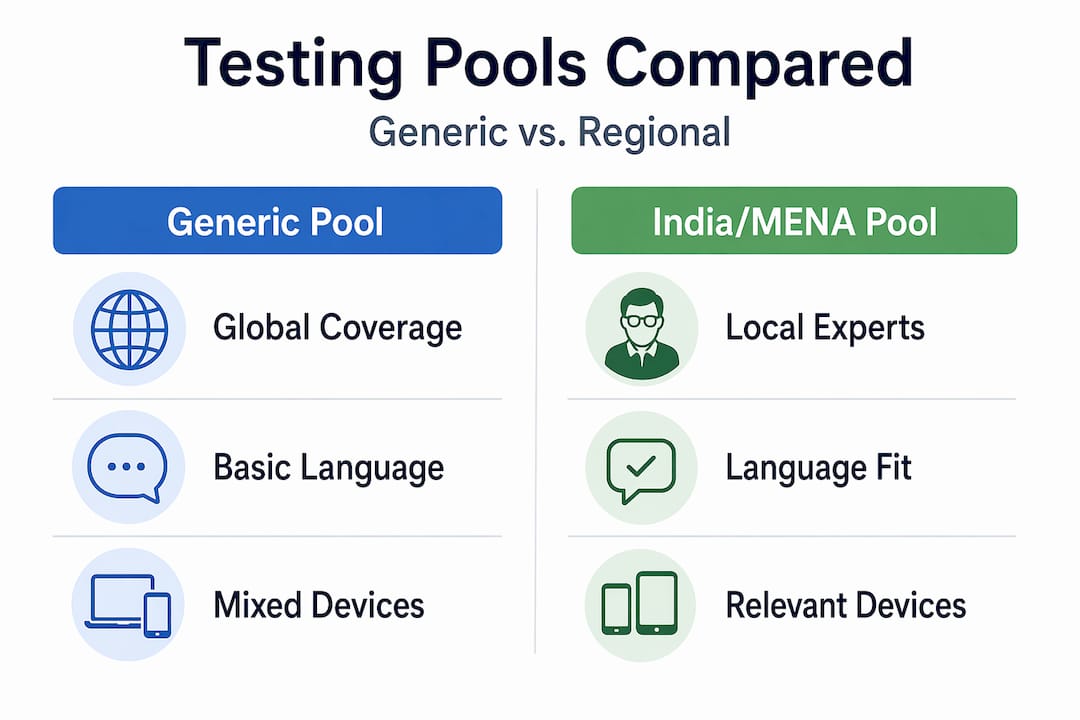
Generic crowd testing platforms pull from a global pool. That sounds like an advantage until you realize your Arabic-language e-commerce app is being tested by someone in Eastern Europe who has never navigated a right-to-left checkout flow. Regional specificity is not a nice-to-have. It is the difference between feedback that improves your product and feedback that misleads your roadmap.
UsersArabia offers tester recruitment across UAE, Saudi Arabia, Qatar, and Gulf countries with filters for demographics and research needs, making it one of the few platforms built specifically for the Arabic-speaking user research context. That regional focus surfaces issues a global pool will consistently miss: dialect-specific UI copy that confuses Levantine users, payment flows that do not account for cash-on-delivery preferences in Saudi Arabia, or notification timing that conflicts with prayer schedules.
When building your tester recruitment strategy, consider these dimensions:
| Dimension | Generic crowd pool | Regional pool (India/MENA) |
|---|---|---|
| Device coverage | Broad but unfocused | Matched to target market |
| Language accuracy | English-dominant | Native language and dialect |
| Cultural relevance | Low | High |
| Regulatory context | Generic | PDPA, DIFC, local norms |
For teams building Arabic-first products, Arabic usability testing in UAE provides a structured way to validate UX with native speakers before launch.
Running a crowd testing program without operational discipline produces two outcomes: low-quality bug reports and security incidents. Neither is acceptable when you are weeks from a product launch.
Higher-performing programs use ephemeral access, NDAs, and pilot groups to ensure quality and security. Here is how to implement that in practice:
“The programs that produce the highest ROI are not the ones with the most testers. They are the ones with the clearest scope, the shortest feedback loops, and the most disciplined access controls.”
Pro Tip: After each test cycle, run a retrospective with your internal QA lead. Ask which reported bugs were genuinely new versus issues your team already knew about. That ratio tells you whether your crowd testing scope is well-targeted or redundant.
For a detailed look at how crowd testing quality management works across multiple countries simultaneously, the linked case study breaks down the operational model used across 20 markets.
Here is the uncomfortable pattern we see repeatedly: a CTO reads about crowd testing, signs up for a platform, shares a build link with 200 testers, and gets back 400 bug reports. Half are duplicates. A third are out of scope. Twenty are genuinely useful. The program is declared a failure and abandoned.
The failure was not crowd testing. It was the absence of program design.
Many programs fail when builds are shared too broadly without ephemeral access or proper pilot testing phases. But the deeper issue in India and MENA specifically is that founders underestimate regional complexity. They treat “India” as one market when it is effectively dozens of sub-markets with different devices, languages, and connectivity profiles. They treat “MENA” as a single Arabic-speaking bloc when the UX expectations of a Riyadh user differ meaningfully from those of a Cairo user.
The fix is not more testers. It is better-designed test cycles. That means:
The ROI on crowd testing compounds when you treat it as a program, not a one-time event. Teams that run quarterly crowd testing cycles across their India and MENA user base build a feedback loop that continuously improves product quality in ways no internal QA team can replicate at the same cost.
If the framework above feels like a lot to build from scratch, that is because it is. Designing regionally targeted test cycles, managing secure app distribution, recruiting vetted testers, and triaging reports at scale requires infrastructure most startups do not have in-house.
Testvox brings that infrastructure to you. Their crowd testing services are built specifically for India and MENA markets, combining regional tester networks with enterprise-grade secure distribution and managed triage. Their security testing solutions add VAPT and ethical hacker coverage for teams that need both functional and security validation before launch. And if you want to see what this looks like in production, the crowd testing case study across 20 countries shows the operational model and outcomes in detail.
Crowd testing uses a large group of real testers on their own devices in real-world conditions to find software issues that lab testing misses, which is especially critical in India and MENA where device and demographic diversity is extreme.
Intigriti’s vetted ethical hackers run bug bounty programs focused specifically on security vulnerabilities with managed triage, whereas general crowd testing targets functional bugs and usability issues rather than exploitable security flaws.
Sauce Labs provides configurable secure delivery with SSO integration, time-limited access, remote revocation, and compliance with SOC 2 Type II and ISO 27001/27701, protecting unreleased builds from unauthorized access or leakage.
UsersArabia specializes in recruiting participants from UAE, Saudi Arabia, Qatar, and Gulf countries with demographic and task-specific filters, giving you testers who reflect the actual cultural and linguistic context of your target users.
Effective crowd testing programs use ephemeral access credentials, mandatory NDAs integrated into tester onboarding, pilot groups before full-scale launches, and tightly scoped test environments that exclude sensitive modules from tester access.

Let us know what you’re looking for, and we’ll connect you with a Testvox expert who can offer more information about our solutions and answer any questions you might have?
