
 4 July 2024

How smart test automation reduces bugs and boosts quality
17 April 2026
 8 MIN READ
  BY
Amju
BY
Amju
Releasing buggy software is not just embarrassing for a fintech or e-commerce startup. It is expensive. A single defective payment flow or broken checkout experience can cost you users, revenue, and regulatory goodwill in markets as competitive as India and the UAE. Smart test automation uses the test pyramid, AI-driven self-healing scripts, predictive prioritization, and CI/CD integration to reduce maintenance overhead and flakiness simultaneously. This guide walks you through how to assess your current approach, adopt the right pillars, integrate automation into your workflow, and blend AI with human expertise to ship higher-quality products faster.
Table of Contents
- Assessing your current testing approach
- The pillars of smart test automation
- Implementing smart automation in your workflow
- AI and human testers: Achieving quality in regulated domains
- What most CTOs get wrong about test automation
- Ready to upgrade your software quality?
- Frequently asked questions
Key Takeaways
| Point | Details |
|---|---|
| Strategic foundations | A thoughtful automation strategy based on the test pyramid reduces bugs and costs better than tool-chasing. |
| AI-enhanced reliability | Self-healing and predictive test automation cut maintenance by up to 70% and speed up defect detection. |
| Balanced collaboration | Combining AI automation and skilled manual testing ensures quality, compliance, and resilience in fintech and e-commerce releases. |
| Practical implementation | Integrating automation from unit to end-to-end in your CI/CD pipeline delivers faster, safer deployments. |
Assessing your current testing approach
Before you can fix your testing process, you need to see it clearly. Most teams we work with at Testvox already have some form of automation in place. The problem is rarely a total absence of tests. It is a misaligned strategy that creates more noise than signal.
Here are the most common symptoms of an ineffective automation setup:
- Frequent false positives: Tests that fail without a real code change erode team trust. Engineers start ignoring red builds, and that is when real bugs slip through.
- High maintenance burden: Scripts break every time the UI changes. Your QA team spends more time fixing tests than writing new ones.
- Slow release cycles: A test suite that takes four hours to run is not a safety net. It is a bottleneck.
- Thin coverage in critical areas: Payment flows, KYC verification, and cart logic are under-tested while login screens have dozens of redundant checks.
The root cause behind most of these problems is a lack of strategic planning. 83% of teams choose the wrong automation framework without a holistic strategy guiding their decisions. They pick a tool because it is popular, not because it fits their architecture or team maturity.
Another common mistake is over-relying on UI-level tests. End-to-end (E2E) tests are slow, brittle, and expensive to maintain. When they make up the majority of your suite, you get a test pyramid that is inverted. The result is a slow, fragile process that does not scale with your product.
Understanding functional testing basics is the first step toward building a more balanced approach. A well-structured test suite should have a wide base of fast unit tests, a middle layer of integration tests, and a narrow top of E2E scenarios covering only the most critical user journeys.
“A test suite without a strategy is just organized chaos. You are running tests, but you are not managing risk.”
Pro Tip: Audit your current test suite by categorizing every test as unit, integration, or E2E. If your E2E tests outnumber your unit tests, you have an inverted pyramid and a maintenance crisis waiting to happen. Teams that have invested in a long-term test automation partnership consistently report that this single audit step saves months of rework.
The pillars of smart test automation
Once you understand where your current approach falls short, you can build something better. Smart test automation is not about using the most advanced tool. It is about applying the right principles in the right order.
1. The test pyramid
The optimal test pyramid allocates 70% of your tests to unit testing, 20% to integration, and 10% to end-to-end scenarios. Unit tests are fast, cheap, and pinpoint failures precisely. Integration tests validate how components communicate. E2E tests confirm that real user journeys work as expected. This balance gives you speed at the bottom and confidence at the top.
2. AI-driven and self-healing automation
Traditional test scripts break when a button label changes or a DOM element shifts position. AI-driven testing tools learn the intent behind a test and adapt automatically. AI-driven self-healing can reduce test maintenance by up to 70%. For a startup shipping weekly, that is a massive time saving that goes directly back into building features.

3. Predictive test prioritization
Not all tests are equally valuable at any given moment. Predictive prioritization uses historical failure data and code change analysis to run the tests most likely to catch defects first. This means your CI/CD pipeline surfaces critical bugs within minutes, not hours.
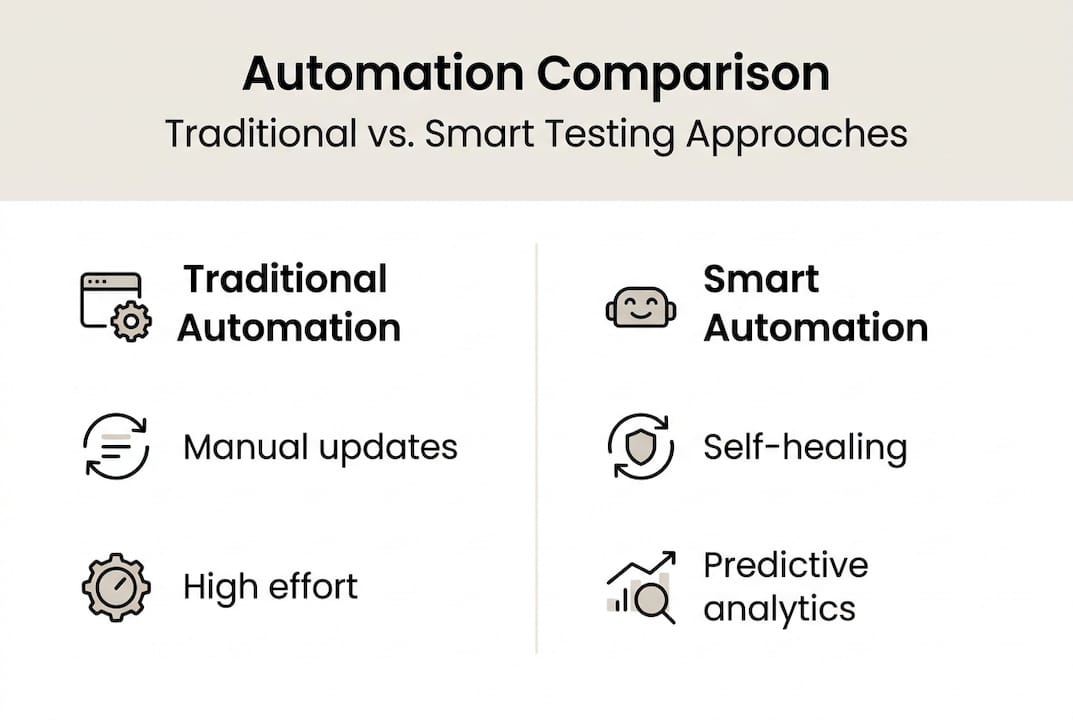
Here is a quick comparison of traditional versus smart automation approaches:
| Dimension | Traditional automation | Smart automation |
|---|---|---|
| Test maintenance | High, manual updates | Low, AI self-healing |
| Feedback speed | Slow (hours) | Fast (minutes) |
| Flakiness | Common | Minimized |
| Coverage strategy | Ad hoc | Pyramid-driven |
| Defect detection | Reactive | Predictive |
For teams building mobile-first products, applying these principles to mobile automation testing is especially important given the device fragmentation across Android and iOS ecosystems in India and the UAE. Similarly, teams using robotic process automation should review RPA automation best practices to ensure their bots are tested with the same rigor as their core application logic.
Implementing smart automation in your workflow
Knowing the principles is one thing. Putting them into practice inside a live CI/CD pipeline is another. Here is a step-by-step approach that works for fintech and e-commerce teams scaling from seed to Series A.
Step 1: Assess your automation maturity
Before adding new tests, map your existing pipeline. Identify which stages have no automation, which have brittle automation, and which are already reliable. This gives you a prioritized backlog instead of a guessing game.
Step 2: Start with core unit tests
Target your most critical business logic first. For a fintech app, that means transaction calculations, interest rate formulas, and fraud detection rules. For e-commerce, it means pricing logic, discount engines, and inventory checks. These are the functions where a bug has direct financial consequences.
Step 3: Layer in integration tests
Once your unit layer is solid, add integration tests for your APIs, third-party payment gateways, and data pipelines. This is where many startups discover hidden assumptions between services that only surface under realistic conditions.
Step 4: Add selective E2E tests
Choose only the five to ten user journeys that, if broken, would cause immediate business impact. Checkout, KYC submission, fund transfer, and account creation are typical candidates. Keep these tests lean and maintain them rigorously.
Step 5: Track outcomes with dashboards
Integrating automation early in CI/CD reduces release defects measurably, but only if you track the right metrics. Monitor test pass rate, defect escape rate, and mean time to detect (MTTD) over time. A real-world dashboard automation case study shows how visualizing these metrics helps teams make faster, smarter release decisions.
Pro Tip: Use your CI/CD pipeline’s branching structure to enforce test gates. Reviewing branching strategies in automation will help you decide which test layers run on feature branches versus main, so you catch bugs at the earliest possible stage without slowing down every developer commit.
| Workflow stage | What to automate | Key metric to track |
|---|---|---|
| Pre-commit | Unit tests | Pass rate |
| Pull request | Integration tests | Defect detection rate |
| Staging | E2E critical paths | Test coverage % |
| Production | Smoke tests | Mean time to detect |
AI and human testers: Achieving quality in regulated domains
AI-powered automation is genuinely impressive. It can run thousands of test scenarios overnight, flag anomalies, and fix broken scripts without human intervention. But there is a ceiling to what it can do, and in regulated industries, that ceiling matters enormously.
Here is where AI excels in a QA workflow:
- Repetitive regression testing: Running the same 500 test cases after every deployment, consistently and without fatigue.
- Self-healing scripts: Adapting to minor UI changes without manual intervention.
- Performance and load simulation: Generating realistic traffic patterns to stress-test payment infrastructure.
- Anomaly detection: Flagging unusual patterns in test results that a human reviewer might miss.
But here is where human testers remain irreplaceable:
- Regulatory edge cases: A fintech app operating under RBI guidelines in India or CBUAE regulations in the UAE needs testers who understand what compliance failure actually looks like in context.
- Usability judgment: Does this onboarding flow feel right for a first-time investor? AI cannot answer that.
- Business logic nuance: When a discount rule interacts with a loyalty tier and a regional tax exemption, a human tester can reason through the expected outcome. An AI tool may not have the domain model to do so.
AI augments but humans are essential for edge cases in regulated fintech. That is not a limitation of current AI. It is a structural reality of complex, high-stakes domains.
“Automation handles the volume. Human testers handle the judgment. Both are non-negotiable in fintech and e-commerce.”
Understanding AI’s role in software testing helps you set realistic expectations for what your tools can and cannot do. And for startups that want the benefits of AI-driven testing without building a large internal QA team, AI-augmented QA models offer a practical middle path that scales with your growth.
What most CTOs get wrong about test automation
Here is the uncomfortable truth we have seen play out across dozens of fintech and e-commerce projects: most CTOs approach test automation as a tooling problem, not a strategy problem. They evaluate frameworks, compare pricing, and run proof-of-concept sprints. Then they ship a fragile test suite that the team quietly stops trusting within six months.
The real issue is that automation without a clear quality strategy is just automated noise. Chasing the latest AI testing tool or adopting RPA because a competitor mentioned it in a blog post leads to exactly the kind of brittle, high-maintenance setup we described earlier. The tool is never the bottleneck. The thinking behind it is.
What actually works is building a testing strategy that evolves with your product. Start simple, measure outcomes, and expand coverage based on where defects actually appear. Teams that invest in a persistent automation partnership rather than one-time implementations consistently outperform those chasing silver-bullet solutions. Quality is not a sprint. It is a compounding investment.
Ready to upgrade your software quality?
If this guide has surfaced gaps in your current testing approach, you are not alone. Most fintech and e-commerce startups in India and the UAE are somewhere in the middle of this journey, with partial automation, growing technical debt, and release anxiety that slows down their teams.

At Testvox, we have helped startups move from chaotic manual testing to structured, AI-assisted automation that actually reduces bugs and speeds up releases. Explore how we approached e-commerce automation for a real client, review our fintech app testing best practices, or browse our full library of e-commerce case studies to see what measurable quality improvement looks like in practice. Let’s build something that ships clean.
Frequently asked questions
What is the test automation pyramid and why does it matter?
The test pyramid recommends 70% unit, 20% integration, and 10% end-to-end tests, giving teams a fast, maintainable suite that catches defects at the lowest possible cost.
How does AI improve test automation quality?
AI-driven self-healing reduces test maintenance by up to 70% by automatically adapting broken scripts and prioritizing the tests most likely to reveal critical defects before release.
Why can’t everything be automated, especially in fintech apps?
Regulated fintech apps require human testers to evaluate compliance edge cases, business logic nuance, and usability judgment that current AI automation cannot fully replicate.
What is predictive test prioritization?
Predictive prioritization uses historical data and AI to run the highest-risk tests first, which halves detection costs and accelerates feedback loops inside CI/CD pipelines.
Recommended
- The Death of Brittle Scripts: Why Production-Led Quality Engineering is the New Standard for 2026 – Testvox
- AI QA Testing | How Startups Scale Quality with AI
- Automation testing for dashboard system by Testvox
- Automation Testing: Enhancing Software Quality and Efficiency
- Errores comunes al usar inteligencia artificial y cómo evitarlos – TecnoHoy
4 July 2024



ABOUT TESTVOX

Testvox is a software testing company help your product reach its full potential. Get full cycle testing for your mobile and web applications while ensuring all quality assurance standards are met... Read More
100+
Applications
Assured
Assured

5 Star Rating

5 Star Rating
“By participating in our release lifecycle, Testvox's standard QA process has helped us to launch quality products faster.”

Rima Hudaifa
Manager | Cadvil
Manager | Cadvil
