
 27 August 2024

How to test e-commerce checkout flows for higher conversions
26 April 2026
 10:55 MIN Read time
  BY
Aparna Arangil
BY
Aparna Arangil
A broken checkout flow is one of the most expensive problems an e-commerce business can have. Customers who reach the payment screen are your warmest leads, yet a confusing UPI redirect, a tax calculation that doesn’t match expectations, or a page that loads slowly on a mid-range Android phone can push them away in seconds. For businesses operating in India and the UAE, these challenges carry extra weight because payment ecosystems are fragmented, mobile dominates, and customer expectations for speed are high. This guide walks you through every stage of checkout flow testing, from tool selection to result interpretation, so you can fix bottlenecks before they cost you revenue.
Table of Contents
- Preparing for checkout flow testing: tools and setup
- Defining test cases: critical scenarios for India and UAE
- Executing checkout tests: step-by-step process
- Interpreting results and optimizing your checkout flow
- What most teams miss when testing checkout flows
- Take your checkout testing to the next level with Testvox
- Frequently asked questions
Key Takeaways
| Point | Details |
|---|---|
| Automate end-to-end flows | Use Playwright, Cypress, or Selenium with real device clouds to cover every checkout scenario. |
| Test regional payment methods | Tailor your test suite to cover UPI, net banking, wallets, and region-specific flows for maximum conversion. |
| Analyze failures and optimize | Address payment, address, and shipping/tax issues quickly to prevent abandonment and grow sales. |
| Embrace mobile-first testing | Ensure a seamless mobile experience since most buyers in India access e-commerce via Android. |
| Iterate continuously | Use test results to drive ongoing improvements for targeted conversion gains. |
Preparing for checkout flow testing: tools and setup
Before you write a single test script, your environment needs to reflect the real world your customers live in. That means mobile-first configurations, regional payment sandbox accounts, and a pipeline that catches regressions before they reach production.
Choosing the right automation tools
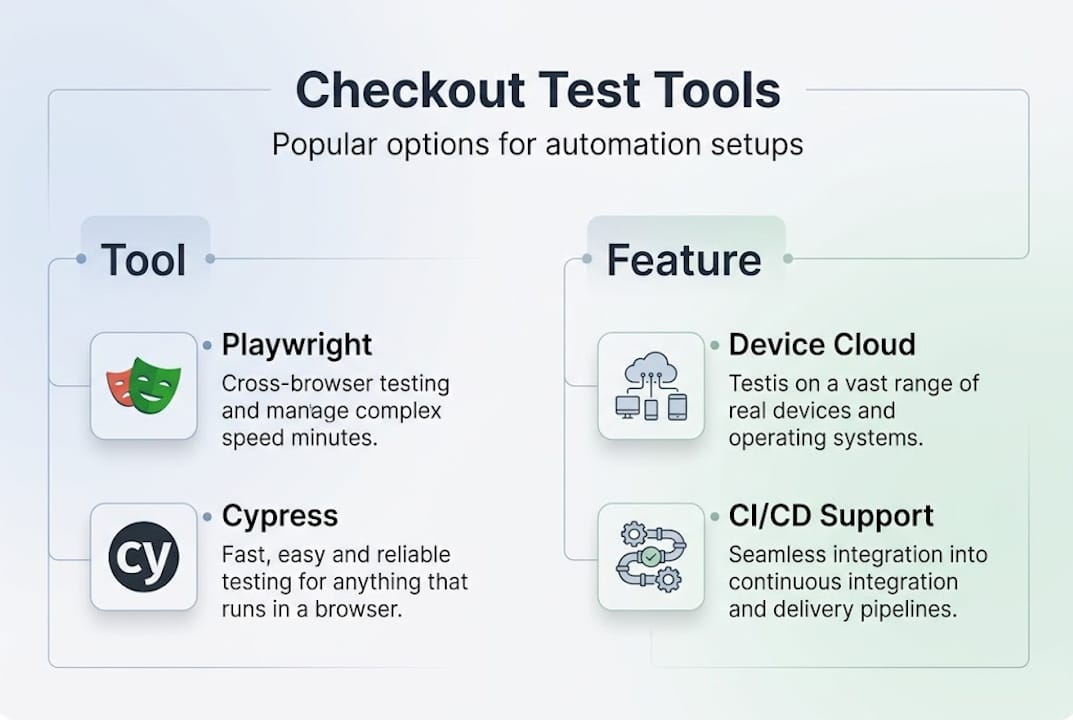
Automation tools like Playwright, Cypress, and Selenium on real device clouds such as BrowserStack are the industry standard for end-to-end checkout testing, with CI/CD integration for regression coverage. Each tool has a distinct strength. Playwright handles modern browser APIs well and supports network interception, which is useful when simulating bank timeouts. Cypress excels at rapid iteration during development. Selenium remains the most compatible option for legacy payment gateway SDKs that rely on older browser behaviors.
Here is a quick comparison to help you pick:
| Tool | Best for | Real device support | CI/CD friendly |
|---|---|---|---|
| Playwright | Modern SPAs, network mocking | Via BrowserStack | Yes |
| Cypress | Fast dev-cycle feedback | Limited natively | Yes |
| Selenium | Legacy gateway SDKs | Via BrowserStack | Yes |
Setting up a mobile-first test environment
India and the UAE share one critical trait: most shoppers are on mobile. Your test lab must reflect this. Configure emulators for popular mid-range Android devices (Samsung Galaxy A-series, Redmi Note series) alongside flagship models. For the UAE, include iOS coverage because iPhone penetration is higher there than in India.
Key environment setup steps:
- Create sandbox accounts for UPI (Razorpay, PayU), net banking simulators, and wallet providers (PhonePe, Paytm, Amazon Pay)
- Set up UAE-specific gateways such as PayTabs and Telr in test mode
- Configure address validation libraries for Indian pincodes and UAE emirate-based postal codes
- Enable GST calculation logic for India and VAT (5%) for UAE in your staging environment
Pro Tip: Use Testvox’s payment transaction automation case study as a reference for structuring your sandbox environment. Teams that mirror production payment configurations in staging catch 40% more payment-related bugs before go-live.
Integrating with CI/CD
Connect your test suite to your CI/CD pipeline so every code push triggers a checkout regression run. Tools like GitHub Actions or GitLab CI work well with Playwright and Cypress out of the box. Set your pipeline to fail the build if any critical payment path breaks. This approach, which you can see in action across our automation case studies, prevents regressions from reaching customers silently.
For checkout functionality testing, a good rule of thumb is to separate smoke tests (fast, run on every commit) from full regression suites (run nightly or before release). This keeps your pipeline fast without sacrificing coverage.
Defining test cases: critical scenarios for India and UAE
With the tools in place, the next step is outlining what you’ll actually test, ensuring your coverage matches local needs.
Payment method scenarios
For India and UAE markets, you must test UPI Intent vs UPI Collect flows, mobile-first paths (95% of India’s traffic comes from Android), local payment methods like net banking and wallets, address validation for regional shipping zones, and tax and shipping localization. These are not optional edge cases. They are the core of your checkout.
Here is a breakdown of the most critical payment scenarios and what to validate in each:
| Payment method | Key validation points | Common failure modes |
|---|---|---|
| UPI Intent | App redirect, deep link handling | App not installed, redirect loop |
| UPI Collect | VPA validation, timeout handling | Wrong VPA, 30-second timeout |
| Net banking | Bank selection, redirect, callback | Session timeout, callback failure |
| Wallets | Balance check, OTP flow | Insufficient balance, OTP delay |
| Cards (India/UAE) | 3DS flow, international cards | 3DS timeout, card type mismatch |
Building your test case list
Follow this numbered approach to build a complete test suite:
- Happy path first. Test the ideal scenario for each payment method: customer adds item, proceeds to checkout, enters valid details, and receives a confirmation. This is your baseline.
- Failure and retry paths. Simulate a declined card, a UPI timeout, or a net banking session expiry. Verify that your UI shows a clear error and allows the customer to retry without losing their cart.
- Address validation. Enter incomplete pincodes, invalid emirate codes, and PO Box addresses (common in the UAE). Confirm that your system flags these correctly without blocking legitimate orders.
- Tax and shipping calculation. Verify that GST rates apply correctly for different product categories in India. For the UAE, confirm that 5% VAT appears before the final payment step, not as a surprise on the confirmation page.
- Order confirmation and webhook. Confirm that the payment gateway webhook fires correctly and the order status updates in your backend within an acceptable time window.
Pro Tip: Review our regional e-commerce test case for a real example of how address validation and tax localization testing was structured for a GCC market. The approach translates directly to UAE deployments.
For broader ecommerce testing patterns, and especially for teams expanding across both India and the UAE, our UAE case studies show how payment and address flows differ between the two markets in ways that catch many teams off guard.
Executing checkout tests: step-by-step process
Once test cases are defined, it’s crucial to execute your tests thoroughly for reliable results.
Automated vs manual checkout testing

Automation handles repetitive, high-volume scenarios well. Run your happy path and failure path tests automatically on every build. Manual testing, however, is irreplaceable for nuanced UX checks: does the UPI app redirect feel smooth? Does the error message actually make sense to a real person? Is the “Retry payment” button easy to find on a small screen?
A practical execution workflow looks like this:
- Run automated smoke tests on every pull request. Cover the top three payment methods for your primary market (UPI Intent, net banking, and cards for India; cards, PayTabs, and wallets for UAE).
- Run full regression suites nightly or before every release. Include all payment methods, address validation scenarios, and tax calculation checks.
- Execute manual exploratory tests on real devices before any major release. Focus on gesture-based interactions, app redirects for UPI, and screen transitions during payment loading.
- Test on real device clouds. As recommended for E2E checkout flows, use BrowserStack or similar platforms to cover a realistic range of Android and iOS devices without maintaining a physical device lab.
- Simulate network conditions. Use tools like Chrome DevTools or Playwright’s network throttling to test checkout behavior on 3G connections, which remain common in tier-2 and tier-3 cities in India.
“A checkout flow that works perfectly on a flagship device in a Mumbai office can fail completely on a mid-range phone on a 3G connection in Jaipur. Real device testing on real network conditions is not optional for India-facing products.”
Edge case identification
Edge cases are where real revenue loss hides. Common ones to prioritize:
- Bank server downtime during peak sale events (Diwali, White Friday in UAE)
- Simultaneous payment attempts from the same account
- Session expiry mid-checkout when a customer switches apps to check their UPI balance
- Currency display issues for UAE customers paying in AED vs USD
Our e-commerce application testing case study covers how automated edge case detection was built into a CI pipeline, reducing post-release payment bugs by a significant margin. For teams exploring intelligent automation, our bot test automation work shows how Power Automate can be used to simulate complex multi-step payment scenarios at scale.
Interpreting results and optimizing your checkout flow
After you’ve executed your tests, it’s time to make sense of the findings and drive actionable improvements.
Success metrics to track
Not all test failures are equal. Prioritize your analysis around these metrics:
- Payment success rate by method. Track this separately for UPI Intent, UPI Collect, net banking, wallets, and cards. A drop in one method points to a specific integration issue.
- Checkout completion rate. The percentage of users who reach the cart and complete payment. Industry benchmarks vary, but a rate below 60% signals serious friction.
- Error frequency by device and OS. If failures cluster on Android 12 or a specific browser version, you have a targeted fix to make.
- Webhook delivery time. Slow webhook processing causes order confirmation delays, which increase customer support tickets.
Understanding regional failure patterns
UPI Intent Flow achieves a 98% success rate compared to UPI Collect, and network jitter and bank downtimes can be addressed through retry logic and webhooks. In the UAE, high abandonment rates in fashion categories signal that shipping and tax surprises at the final step are driving customers away.
These two data points should shape your optimization priorities immediately. For India, switch your default UPI flow to Intent where your gateway supports it. Implement exponential backoff retry logic for failed payment attempts. Set up webhook listeners that update order status even if the customer closes the browser tab after payment.
For UAE, the fix is simpler but often overlooked: show the full landed cost (product price plus VAT plus shipping) as early as the product page or at least on the cart page. Customers who see a price jump at the payment screen abandon. Those who see the full cost upfront convert.
The continuous optimization cycle
Checkout optimization is not a one-time project. Build a cycle:
- Review payment success metrics weekly during peak seasons
- Re-run regression suites after every gateway SDK update
- Add new test cases whenever a customer complaint reveals an untested scenario
- Track abandonment by step in your analytics to pinpoint where customers drop
For deeper analysis of how performance bottlenecks affect conversion, our performance testing insights show how load-related failures translate directly to lost transactions, a pattern that applies equally to checkout flows under sale-day traffic spikes.
What most teams miss when testing checkout flows
Here is the uncomfortable reality: most QA teams test checkout flows the way they test a desktop web form. They run scripts on Chrome, validate that the payment gateway returns a success code, and call it done. That approach misses the actual experience your customers have.
The biggest blind spot is over-reliance on desktop simulation. Chrome DevTools’ mobile emulation is a useful starting point, but it does not replicate the actual behavior of a UPI deep link on a real Android device. It does not capture the lag when a mid-range phone switches from your app to the UPI app and back. It does not simulate what happens when a customer’s phone receives a call mid-payment. These are real scenarios that cause real failures, and they only surface on real devices.
The second blind spot is treating UPI as a single payment method. UPI Intent and UPI Collect are fundamentally different flows with different success rates and different failure modes. Teams that test one and assume the other works are leaving a significant gap in their coverage.
Regional shipping and tax logic is the third area where teams consistently underinvest. A product that ships from a warehouse in Maharashtra to a customer in Kerala involves a different GST treatment than an intra-state order. Getting this wrong does not just cause test failures. It causes incorrect charges to real customers, which triggers disputes and erodes trust.
Smart teams build test environments that mirror the actual diversity of their customer base. They maintain a device lab or use a cloud device platform. They create test accounts for every payment method they support. And they treat checkout bugs and best practices as a living document that grows with every new failure pattern they discover. The teams that do this consistently outperform those that rely on generic checklists.
Take your checkout testing to the next level with Testvox
Checkout quality is a competitive advantage, and the gap between teams that test thoroughly and those that don’t shows up directly in conversion rates and customer retention.

Testvox specializes in exactly this kind of high-stakes testing for e-commerce teams in India and the UAE. From UPI flow automation to VAT localization validation, our team builds test suites that reflect how your actual customers shop. Explore our automation case studies to see how we’ve helped e-commerce businesses reduce payment failures and improve checkout completion rates. Ready to build a checkout testing strategy that matches your market? Our functional testing services are designed for teams that need fast, reliable, and regionally accurate quality assurance.
Frequently asked questions
What are the top payment methods to test for e-commerce in India?
You should prioritize UPI Intent, UPI Collect, net banking, popular wallets like PhonePe and Paytm, and card payments. Testing UPI Intent vs Collect flows along with net banking and wallets covers the vast majority of Indian e-commerce transactions.
Why is mobile-first testing critical for India/UAE checkout flows?
Most e-commerce traffic is mobile, and 95% of India’s traffic is Android, meaning mobile-specific flows like UPI deep links and app redirects surface issues that desktop testing simply cannot catch.
How can I reduce checkout abandonment in the UAE?
Show the complete landed cost including VAT and shipping fees before the final payment step. High fashion abandonment in the UAE is directly linked to pricing surprises at checkout, and eliminating that surprise is the fastest fix.
Which automation tools are best for e-commerce checkout flow testing?
Playwright, Cypress, and Selenium are the most proven options for end-to-end automation. Using these tools on real device clouds like BrowserStack gives you both automation coverage and real-world device accuracy.
How do I handle bank downtimes and payment failures during testing?
Build retry logic with exponential backoff into your payment flow and configure webhook listeners to capture delayed payment confirmations. Addressing network jitter and bank downtimes via retries and webhooks is the most reliable way to prevent lost orders during infrastructure outages.
Recommended
- E-commerce Cart and Checkout Functionality Testing: Common Bugs, Test Cases, and Best Practices –
- Ecommerce Testing Checklist: Essential Steps for Secure Stores
- Ecommerce Platform Testing | Aromatic Scent Lab Case Study
- 10 Must-Have E-commerce Tests: A Comprehensive Checklist
27 August 2024


ABOUT TESTVOX

Testvox is a software testing company help your product reach its full potential. Get full cycle testing for your mobile and web applications while ensuring all quality assurance standards are met... Read More
100+
Applications
Assured
Assured

5 Star Rating

5 Star Rating
“By participating in our release lifecycle, Testvox's standard QA process has helped us to launch quality products faster.”

Rima Hudaifa
Manager | Cadvil
Manager | Cadvil
