
 23 December 2025
QA in cloud apps: boost security and efficiency in 2026
13 April 2026
 13:33 MIN Read time
  BY
Amju
BY
Amju
Cloud platforms are reliable by design, but that reliability does not extend to your application layer. Many CTOs and founders assume that because AWS, Azure, or GCP handle infrastructure uptime, their apps are inherently safe and stable. That assumption is expensive. The software testing and QA market is projected to reach USD 50.7 billion, growing at an 11.5% CAGR, precisely because organizations are waking up to the fact that QA is not optional in cloud environments. It is the difference between a secure, high-performing product and one that leaks data, fails under load, or gets flagged by regulators. This article maps out why QA matters, what modern practices look like, and how to implement them for real business impact.
Table of Contents
- Why QA is essential for cloud applications
- Building security-first cloud applications: QA’s evolving role
- Modern QA frameworks and automation strategies in the cloud
- Implementing QA for business impact: Real metrics and regional case highlights
- Our perspective: Why strategic QA is the secret sauce for scaling cloud apps
- Supercharge your cloud app with expert QA solutions
- Frequently asked questions
Key Takeaways
| Point | Details |
|---|---|
| Cloud QA is critical | Quality assurance addresses unique risks and accelerates secure cloud app launches. |
| Automate for speed | Cloud-native automation tools enable faster releases and lower regression costs. |
| Security needs deep QA | Embedding DevSecOps and routine vulnerability testing is essential for compliance and safety. |
| Data proves QA’s ROI | Real world cases show QA cuts defects by 40% and delivers happier users. |
Why QA is essential for cloud applications
Cloud applications introduce a fundamentally different risk profile compared to traditional on-premise software. You are dealing with multi-tenant architectures, shared infrastructure, rapid continuous deployment cycles, and multi-region data flows. Each of these creates unique failure points that your cloud provider simply does not cover. The shared responsibility model means the provider secures the infrastructure, but you own everything above it, including your application logic, API endpoints, identity configurations, and data handling.
The pace of cloud development makes this even more critical. Teams push updates daily, sometimes hourly. Without embedded QA, a misconfigured IAM role or a broken API contract can reach production before anyone notices. By the time a customer or a regulator catches it, the damage is done.
Strong software quality steps bridge the gap between what cloud providers guarantee and what your users actually experience. QA validates that your application behaves correctly across regions, handles edge cases gracefully, and meets compliance requirements like GDPR, India’s DPDP Act, or UAE’s data protection regulations.
The business case is clear. Cloud-native QA reduces release cycles and improves resilience, with organizations reporting up to 40% fewer defects and 40% faster regression cycles after implementing structured QA programs.
“Robust QA is not a cost center. It is the mechanism that lets cloud teams ship fast without breaking things that matter.”
Here are the key risks that a well-structured QA program mitigates in cloud environments:
- Data leakage through misconfigured storage buckets or exposed APIs
- API abuse from insufficient input validation or broken authentication
- Identity misconfiguration in IAM roles and permission boundaries
- Compliance drift as environments scale across regions with different regulations
- Performance degradation under real-world traffic spikes in distributed systems
- Third-party integration failures in payment gateways, notification services, or data pipelines
For fintech and e-commerce companies in India and the UAE, where transaction volumes are high and regulatory scrutiny is intense, these risks are not theoretical. They are operational realities that QA directly addresses through cloud penetration testing and structured test coverage.
Building security-first cloud applications: QA’s evolving role
QA is no longer a phase that happens after development. In modern cloud environments, it is a continuous practice embedded directly into your DevSecOps pipeline. The shift is significant: instead of catching bugs at the end, you catch vulnerabilities at the point they are introduced.
Automated static analysis (SAST) scans your code as developers write it, flagging insecure patterns before they compile. Dynamic analysis (DAST) tests your running application, simulating how an attacker would interact with your APIs and interfaces. Both should live inside your CI/CD pipeline, running on every commit. QA in cyber security is no longer a separate discipline; it is woven into every release.

According to cloud penetration testing best practices, QA teams should employ SAST and DAST in CI pipelines, conduct regular vulnerability scans, and perform penetration testing following NIST and OWASP standards. This is not aspirational guidance; it is the baseline for any cloud app handling sensitive data.
IAM misconfiguration is consistently one of the top attack vectors in cloud breaches. QA plays a direct role here by validating permission boundaries, testing role assumptions, and confirming that least-privilege principles are actually enforced, not just documented. Integrating DevOps automation testing into this process ensures these checks happen automatically on every environment change.
Here is a practical sequence for implementing security-focused QA in your cloud app:
- Integrate SAST tools into your code repository to scan on every pull request
- Add DAST scans to your staging environment before every release candidate
- Run automated IAM policy validation as part of your infrastructure deployment
- Schedule quarterly penetration tests aligned with OWASP Top 10 and cloud-specific threat models
- Validate compliance controls against GDPR, DPDP, or UAE data protection requirements on each major release
- Review and update your cloud QA best practices as your architecture evolves
Pro Tip: Use CIS Benchmarks as your baseline for cloud configuration assessment. They provide specific, actionable controls for AWS, Azure, and GCP that map directly to common misconfiguration risks, giving your QA team a concrete checklist rather than vague security goals.
Modern QA frameworks and automation strategies in the cloud
Once security is embedded, the next lever is automation at scale. Manual testing simply cannot keep pace with cloud-native development. A team pushing multiple releases per week needs test suites that run in minutes, not days.
The contrast between traditional and cloud-native QA is stark:
| Dimension | Traditional QA | Cloud-native QA |
|---|---|---|
| Speed | Days to weeks per cycle | Minutes to hours per pipeline run |
| Cost | High manual labor cost | Lower per-test cost at scale |
| Coverage | Limited by human bandwidth | Parallel execution across environments |
| Resilience testing | Rare, manual | Automated chaos engineering |
| Environment consistency | Often inconsistent | Infrastructure as Code ensures parity |
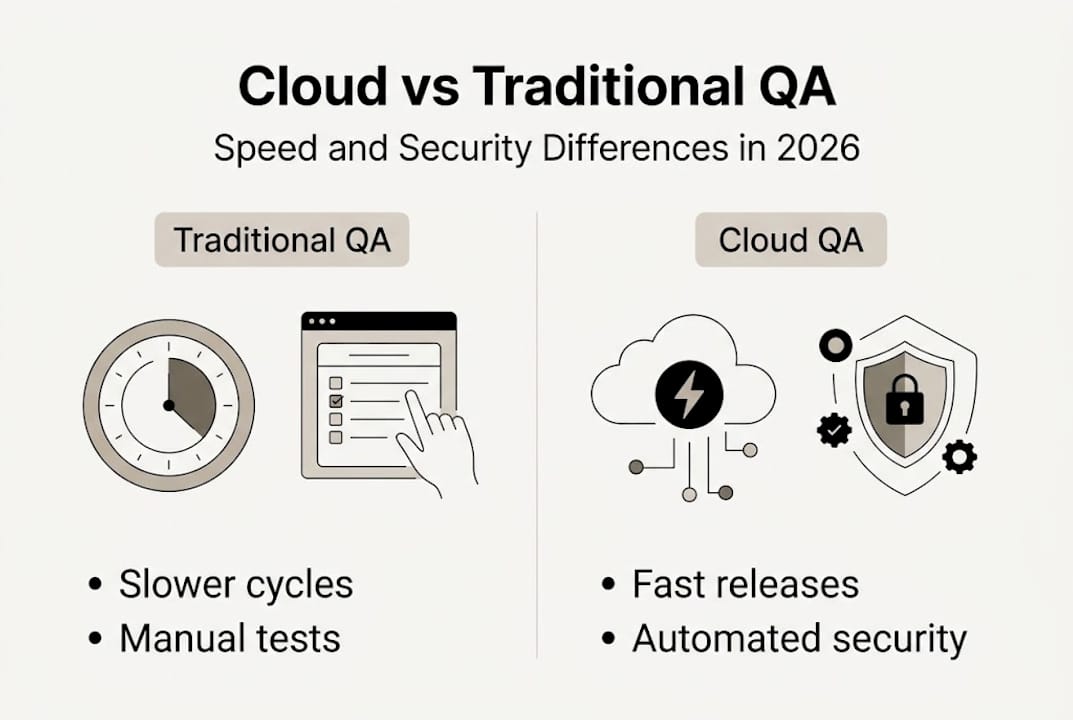
Cloud-native QA reduces release cycles significantly, and when combined with IaC testing and chaos engineering, teams see measurable gains in both speed and reliability. Infrastructure as Code testing means your test environments are provisioned identically every time, eliminating the classic “it works on my machine” problem that plagues distributed teams.
Chaos engineering takes this further by deliberately injecting failures into your microservices to see how they respond. If a database node goes down, does your app degrade gracefully or crash entirely? Chaos testing answers that before your users do.
For startups and SMEs in India and the UAE, the most practical automation stack includes:
- AWS CodeBuild or Azure DevOps for CI/CD pipeline integration
- Terraform or Pulumi for IaC testing and environment validation
- Selenium or Playwright for UI regression automation
- k6 or Gatling for load and performance testing
- Chaos Monkey or AWS Fault Injection Simulator for resilience testing
Pro Tip: Do not choose between native cloud tools and open-source frameworks. Combine them. Native tools give you deep integration with your cloud provider’s services; open-source tools give you flexibility and community support. Teams using AI-augmented testing alongside these frameworks ship faster without expanding headcount. Effective code review and collaboration between developers and testers, supported by smart branching strategies, keeps automation maintainable as your codebase grows.
Implementing QA for business impact: Real metrics and regional case highlights
Practices matter, but numbers close the argument. Here is what structured cloud QA delivers in measurable terms:
| Metric | Without structured QA | With structured QA |
|---|---|---|
| Defect rate | Baseline | Up to 40% reduction |
| Regression cycle time | Baseline | Up to 40% faster |
| AppSec accuracy (AI-driven) | Variable | Up to 98% accuracy |
| Compliance readiness | Manual, slow | Automated, continuous |
Case studies show 40% regression time reduction and 40% defect reduction in organizations that implement cloud-native QA programs. In ad-tech specifically, teams running automated regression suites cut bug counts by 40% within the first two quarters of adoption.
In the UAE, AI-driven AppSec reaches 98% accuracy in vulnerability detection while dramatically reducing false positives. That matters because security teams drowning in false alerts miss real threats. Precision in detection is as important as coverage.
For a fintech startup in India, consider a typical scenario: a payment gateway integration that handles UPI transactions across multiple bank partners. Without QA, edge cases like timeout handling, duplicate transaction prevention, and reconciliation failures only surface in production, where they cost real money and damage customer trust. With fintech QA best practices embedded from day one, these failure modes are caught in staging, not in a customer’s account.
The tangible benefits for startups and SMEs include:
- Safer product launches with fewer post-release incidents
- Faster regulatory approval cycles due to documented compliance validation
- Higher customer satisfaction scores from reduced downtime and data errors
- Lower cost per defect by catching issues earlier in the development cycle
- Stronger investor confidence, especially for funded teams with a long-term QA partnership in place
QA is not just a technical investment. It is a business growth enabler that compounds over time.
Our perspective: Why strategic QA is the secret sauce for scaling cloud apps
Most advice frames QA as a safety net, something you add to catch problems before they reach users. That framing is limiting. The teams we see scale fastest treat QA as a product accelerator, a system that gives them the confidence to ship aggressively without accumulating technical debt or security liability.
Shortcutting QA to move faster is false economy. Every defect that reaches production costs roughly six times more to fix than one caught during development. Security incidents cost exponentially more, in remediation, regulatory fines, and customer churn. The math is not close.
What separates high-growth cloud companies is that they make quality a cultural value, not just a workflow step. When QA in Agile is genuinely embedded into sprint cycles, not bolted on at the end, teams stop thinking of testing as a bottleneck and start treating it as a competitive advantage. Small teams with smart automation can ship with the confidence of organizations ten times their size. Quality is leverage. Use it.
Supercharge your cloud app with expert QA solutions
Building a secure, high-performing cloud application is achievable, but it requires the right QA foundation from day one. Testvox delivers end-to-end QA, automation, and security testing built specifically for cloud-native startups and SMEs in India and the UAE.
Whether you need cloud app security testing to validate your VAPT posture, a rapid audit like the one delivered for a Y Combinator startup, or want to explore AI in QA for smarter, faster coverage, Testvox has the expertise and regional context to help you ship with confidence. Our teams understand fintech compliance in India, UAE data protection requirements, and the speed demands of modern SaaS development. Let us help you build quality into every release.
Frequently asked questions
What types of security risks does QA address in cloud applications?
QA addresses misconfigurations, data exposure, access control gaps, and vulnerability exploits unique to cloud apps. IAM misconfigurations are among the top attack vectors, and QA validates these through CIS Benchmarks and automated policy checks.
How does automated QA improve release speed for cloud-native apps?
Automation cuts regression time by up to 40% while maintaining high resilience, enabling faster and more reliable deployments without expanding your testing team.
What are the best tools for implementing QA in cloud platforms like AWS or Azure?
Native tools such as AWS CodeBuild and Azure DevOps are strong starting points. Automating IaC testing and using native cloud load testing services alongside open-source frameworks gives the broadest coverage.
How does AI enhance application security in cloud environments?
AI-driven security testing can reach up to 98% accuracy in vulnerability detection, significantly reducing false positives and allowing security teams to focus on genuine threats rather than noise.
Is QA only about testing at the end or should it be continuous in cloud app development?
Modern QA must be continuous and embedded throughout development. Continuous QA cuts defect rates and cycle times far more effectively than end-stage testing alone.
Recommended
- QA in cyber security-Role, responsibilities and the process.
- Agile Testing: The role of QA in the Agile world
- No QA Team Yet? How AI-Augmented Testing Helps Startups Ship Faster Without Hiring a Full QA Team. – Testvox
- Improving User Experience with QA
23 December 2025


ABOUT TESTVOX

Testvox is a software testing company help your product reach its full potential. Get full cycle testing for your mobile and web applications while ensuring all quality assurance standards are met... Read More
100+
Applications
Assured
Assured

5 Star Rating

5 Star Rating
“By participating in our release lifecycle, Testvox's standard QA process has helped us to launch quality products faster.”

Rima Hudaifa
Manager | Cadvil
Manager | Cadvil
