
 12 November 2024

How to ensure software quality: expert steps for secure launches
11 April 2026
 17:33 MIN Read time
  BY
Amju
BY
Amju
A single missed bug in a payment flow can cost your startup more than just a refund. It can trigger regulatory scrutiny, kill user trust overnight, and set your roadmap back by months. For fintech and e-commerce teams in India and the UAE, where compliance expectations are high and competition is fierce, post-launch failures are not a recoverable event for many early-stage companies. Research shows that defects caught in production cost dramatically more to fix than those caught in design. This guide gives you a proven, step-by-step roadmap to build quality into your software before a single user touches it.
Table of Contents
- Shift quality left: start QA from day one
- Build on a strong foundation: testing pyramid best practices
- Automate and integrate: CI/CD quality gates and AI-powered testing
- Master the edge: handling business risks and compliance requirements
- Measure and improve: metrics that matter for elite software quality
- The truth most startups miss about reliable software quality
- Ready to deliver flawless software? Join forces with trusted QA experts
- Frequently asked questions
Key Takeaways
| Point | Details |
|---|---|
| Start QA early | Involving QA from the requirements phase cuts defect costs and risks dramatically. |
| Follow the testing pyramid | Focus 80% of test effort on unit tests for speed and coverage, using integration and E2E tests strategically. |
| Leverage AI with humans | Combine AI-led automation with expert validation to cover complex, regulated scenarios. |
| Test edge cases thoroughly | Critical paths like payments, fraud, and compliance must be validated to prevent business-impacting failures. |
| Track key quality metrics | Use metrics like defect escape rate and release speed to continuously improve software reliability. |
Shift quality left: start QA from day one
Most startups treat QA as a final checkpoint before release. That instinct is expensive. “Shift quality left” means pulling testing activity as early as possible in your development cycle, starting at the requirements and design phase, not after the code is written.
The data is clear. Defects in design cost 100x less to fix than those caught in production, and a shift-left approach reduces defect escape rates by up to 40%. For a fintech app handling real money or an e-commerce platform processing thousands of daily orders, that math is not abstract. It is the difference between a smooth launch and a crisis response.
Here is how defect cost scales across the software development lifecycle:
| SDLC phase | Relative cost to fix a defect |
|---|---|
| Requirements | 1x |
| Design | 5x |
| Development | 10x |
| QA/testing | 15x |
| Production | 100x |
The practical move for startups is to embed QA into your agile sprints from sprint one. Assign a tester or QA lead to review user stories before developers write a single line of code. When a requirement is ambiguous, a QA engineer will catch it. When an acceptance criterion is missing, they will flag it. This is not overhead. It is risk prevention at the cheapest possible moment.
Using a shift-left testing approach also means testers participate in collaboration in code reviews, catching logic errors before they become test failures. This cross-functional habit is one of the highest-leverage practices a small team can adopt.
“Quality is not an act, it is a habit.” When QA is baked into every sprint ritual, it stops being a bottleneck and starts being a competitive advantage.
Pro Tip: Define a unified QA framework at the MVP stage. Teams that standardize test case formats, bug severity labels, and review rituals early avoid painful process fragmentation as they scale from 5 to 50 engineers.
Build on a strong foundation: testing pyramid best practices
Once you have embedded QA early, you need a structured approach to ongoing verification. The testing pyramid gives you exactly that. It is a simple model that tells you how to distribute your test types for maximum speed, coverage, and cost efficiency.

The ideal distribution for most startups is 80% unit tests, 15% integration and API tests, and 5% end-to-end (E2E) tests. Unit test coverage should target 75 to 90% of your codebase.
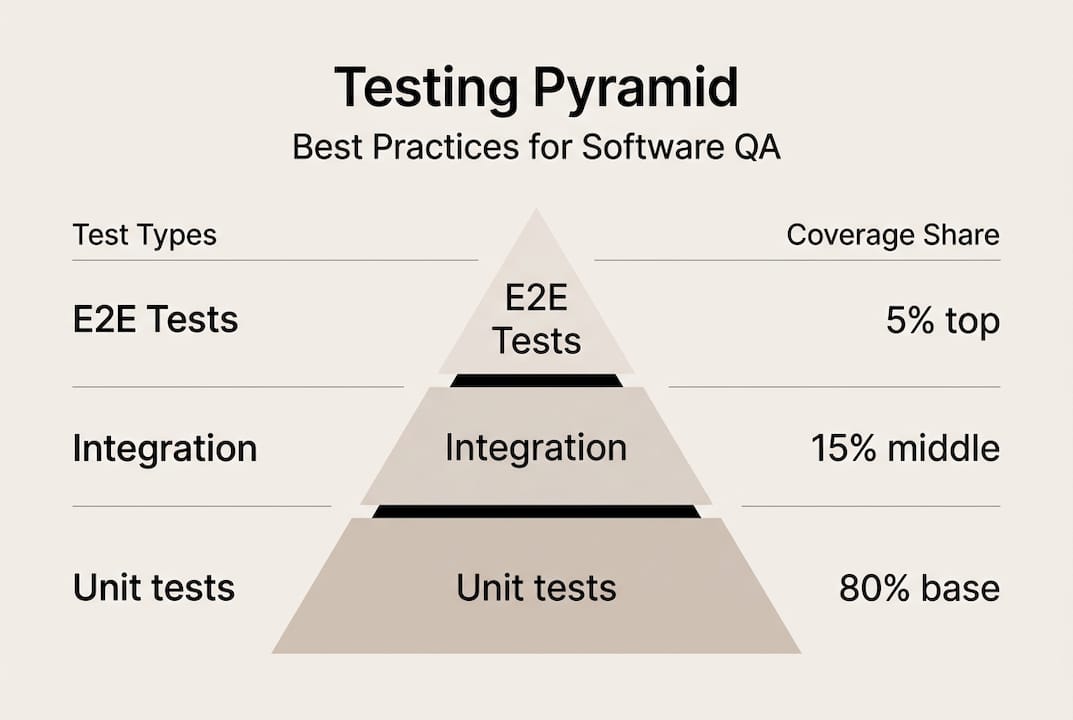
| Test type | Share of test suite | Coverage target | Speed |
|---|---|---|---|
| Unit tests | 80% | 75-90% of codebase | Very fast (seconds) |
| Integration/API | 15% | Core service contracts | Moderate (minutes) |
| E2E tests | 5% | Critical user journeys | Slow (minutes to hours) |
Here is how to implement this in an agile team:
- Start with unit tests. Developers own these. Every new function or class gets a unit test before the pull request is merged.
- Add integration tests for API contracts. Focus on service boundaries, payment gateway calls, and data pipeline handoffs.
- Write E2E tests for your top five user journeys only. Checkout flow, login, and core transactions. Keep this layer lean.
- Review your test suite monthly. If E2E tests are growing faster than unit tests, you have a coverage problem at the base of the pyramid.
- Automate test runs in your CI pipeline. Every commit should trigger the full suite. Failures block the merge.
For scalable test automation strategies that grow with your team, the pyramid is your foundation. Pair it with a solid usability testing strategy to cover the human experience layer that automated tests cannot fully capture.
Pro Tip: If your CI pipeline takes more than 15 minutes to run, your E2E layer is probably too heavy. Trim it aggressively. Speed in CI directly impacts developer productivity and release frequency.
Automate and integrate: CI/CD quality gates and AI-powered testing
With solid test coverage in place, the next step is making sure that coverage runs automatically and blocks bad code from reaching users. CI/CD pipelines with quality gates are the mechanism that makes this happen.
A quality gate is a pass/fail rule in your pipeline. If test coverage drops below 80%, the build fails. If a critical test breaks, the deploy stops. No exceptions. This is non-negotiable for fintech and e-commerce teams where a broken payment flow in production is a regulatory and reputational event.
Essential tools to build this layer:
- Jest or Pytest for unit test automation
- Postman or REST Assured for API contract testing
- Selenium or Playwright for E2E browser automation
- SonarQube for static code analysis and coverage gates
- GitHub Actions, GitLab CI, or Jenkins for pipeline orchestration
AI is now changing what is possible in this layer. AI-powered software testing tools can generate test cases, detect flaky tests, and prioritize which tests to run based on code change impact. The results are significant. AI reduced regression cycles from 8 days to 3 days, a 70% reduction, while component-level testing costs 80% less than fixing the same defect in production.
That is a meaningful shift for a startup with a lean team and tight sprint cycles. Connecting DevOps automation best practices with AI-assisted test generation means your team spends less time writing boilerplate test cases and more time on the edge cases that actually matter.
Do not let automation create a false sense of security. AI tools are powerful, but they miss context. A fraud rule that changes based on regional regulation, or a payment flow that behaves differently across Indian banking rails versus UAE payment gateways, needs a human expert to validate.
This is why production-led quality engineering is gaining traction. It combines automation at scale with human judgment at the edges, which is exactly where fintech and e-commerce risks live.
Master the edge: handling business risks and compliance requirements
Automation covers the predictable paths. Edge cases cover the paths that break your business. For fintech and e-commerce startups, edge cases are not rare scenarios. They are the scenarios most likely to cause real damage.
Early QA involvement surfaces edge cases that developers and product managers often overlook, and dynamic fraud rules in particular require manual review because they change faster than automated test suites can track.
Key edge cases you must always test:
- Payment failures and partial refunds across multiple gateways (Razorpay, PayU, Stripe, Telr)
- Fraud detection triggers under unusual transaction patterns or velocity spikes
- Multi-currency and cross-border transaction rounding errors
- Regional compliance rules including RBI guidelines in India and CBUAE regulations in the UAE
- Load spikes during flash sales, IPO subscription windows, or festival season traffic
- Session timeout and re-authentication flows during long checkout processes
Here is a practical checklist for validating your highest-risk flows:
- Map every flow that touches money or personal data. List every possible failure state.
- Write test cases for each failure state, not just the happy path.
- Run these tests with real sandbox credentials from your payment providers.
- Involve a compliance expert to review test coverage against local regulations.
- Retest after every release that touches payment logic, even minor ones.
For a deeper look at fintech app testing best practices, the key principle is that no automated tool can fully replicate the judgment needed to test a fraud rule that was updated last week.
Pro Tip: Create a dedicated “high-risk regression” test suite that runs manually before every major release. Keep it short (under two hours) but thorough on payment, fraud, and compliance flows.
Measure and improve: metrics that matter for elite software quality
You cannot improve what you do not measure. Once your QA process is running, tracking the right metrics tells you whether it is actually working or just creating the appearance of quality.
The metrics that define world-class software quality are defect escape rate, cycle time, test coverage, and mean time to detect (MTTD). Teams that track these consistently see 30 to 50% faster releases, 40% fewer defects reaching users, and defect escape rates below 1%.
Benchmarks to aim for:
- Release cycle time reduced by 30 to 50% within two quarters of structured QA
- Defect escape rate below 1% of shipped features
- Test coverage above 80% across unit and integration layers
- MTTD under 24 hours for critical production issues
- DORA elite performer standard: multiple deploys per day with less than 1% change failure rate
| Metric | What it measures | Target value |
|---|---|---|
| Defect escape rate | Bugs reaching production | Below 1% |
| Cycle time | Sprint to release speed | 30-50% faster than baseline |
| Test coverage | Code tested automatically | Above 80% |
| MTTD | Speed of detecting issues | Under 24 hours |
The routine that makes this work is a weekly quality review. Pull these numbers every Monday. If defect escape rate spikes, trace it back to which test layer missed it. If cycle time slows, check whether E2E tests are the bottleneck. Data without action is just noise. The goal is a short feedback loop between what the metrics show and what the team changes.
The truth most startups miss about reliable software quality
Here is the uncomfortable reality we see repeatedly: startups invest in the best testing tools available and still ship broken software. The tools are not the problem. The process is.
Conventional wisdom says more automation equals better quality. That is incomplete. Automation without process discipline creates a false ceiling. You end up with a fast pipeline that consistently ships the same class of defect because no one defined what “done” actually means from a quality perspective.
The startups that ship reliably are not the ones with the most sophisticated tooling. They are the ones that decided early what their quality bar was, wrote it down, and held every sprint to it. That discipline is boring. It does not look impressive in a pitch deck. But it is what separates a 99.9% uptime fintech app from one that goes down during peak trading hours.
If you are weighing whether to build this discipline in-house or bring in specialists, outsourcing your QA to a focused partner is often the faster path to process maturity. Not because your team cannot learn it, but because time is the one resource startups never have enough of.
Prioritize culture and process first. Then choose your tools. In that order.
Ready to deliver flawless software? Join forces with trusted QA experts
The steps in this guide work. But executing them well under real launch pressure, with a lean team and a hard deadline, is where most startups struggle. That is exactly the gap Testvox was built to close.

Testvox works with fintech and e-commerce startups across India and the UAE to build QA processes that hold up under pressure. From security testing services that align with OWASP and regional compliance requirements, to functional QA solutions that validate every payment flow and user journey, the team brings structured quality to fast-moving development cycles. Whether you need a pre-launch audit or ongoing QA partnership, the Testvox QA platform gives you the coverage and confidence to ship on time without cutting corners.
Frequently asked questions
What is the most cost-effective phase to catch software defects?
Defects found during design cost 100 times less to fix than those caught in production, making early-stage QA the highest-return investment a startup can make.
How much test automation coverage should a startup target?
Startups should aim for 75 to 90% unit test coverage, structured around the 80/15/5 testing pyramid of unit, integration, and E2E tests.
What software quality metrics matter most?
Track defect escape rate, release cycle time, test coverage, and MTTD. Teams tracking these metrics consistently hit 40% fewer production defects and release up to 50% faster.
Is pure AI-based QA enough for fintech or e-commerce apps?
AI handles scale and speed well, but regulatory edge cases and dynamic fraud rules require human expert validation. Relying solely on AI creates blind spots in your highest-risk flows.
Why is shift-left QA recommended for startups?
It catches defects at the cheapest possible moment. Shift-left practices reduce defect escape rates by up to 40% and dramatically lower the total cost of quality across the development lifecycle.
Recommended
- How to Prepare Your App for Launch: A 13-Point Checklist…
- Software Testing for Startups – Testvox
- Our Clients Archive – Testvox
- Insurance software testing | Testvox
12 November 2024
 29 October 2024


ABOUT TESTVOX

Testvox is a software testing company help your product reach its full potential. Get full cycle testing for your mobile and web applications while ensuring all quality assurance standards are met... Read More
100+
Applications
Assured
Assured

5 Star Rating

5 Star Rating
“By participating in our release lifecycle, Testvox's standard QA process has helped us to launch quality products faster.”

Rima Hudaifa
Manager | Cadvil
Manager | Cadvil
