




UAE
Testvox FZCO
Fifth Floor 9WC Dubai Airport Freezone
 BY
Testvox
BY
Testvox
Most CTOs already know quality matters. The question is why use agile QA specifically, rather than treating QA as a final-stage checkpoint before release. The answer isn’t about moving faster. It’s about building quality into every sprint, every commit, and every team interaction so that defects don’t compound into expensive production disasters. Agile QA is a structural decision that changes how your organization delivers software, and the ROI is measurable within weeks, not quarters.
| Point | Details |
|---|---|
| Shift quality left | Detecting bugs early reduces fix costs by up to 40 times compared to finding them in production. |
| Share quality ownership | Embedding QA into cross-functional squads removes the bottleneck of a siloed testing team. |
| Automate from sprint 1 | Starting automation early cuts escaped defects by 30 to 50% and accelerates release confidence. |
| Measure and enforce quality gates | Integrating automated gates into pull request workflows gives developers instant feedback and reduces friction. |
| Expect ROI fast | Teams typically recover Agile QA investment within 2 to 3 sprints through fewer incidents and reduced manual testing. |
Traditional QA sits at the end of the development pipeline. It reviews finished work, files bugs, and waits for fixes. That model made sense when software shipped quarterly. It does not hold up when you’re deploying weekly or daily.
Agile QA works differently. It embeds quality activities throughout every sprint, not just at the end. This practice, known as shift-left testing, means your team catches defects when they’re cheapest to fix. Shift-left testing reduces defect remediation costs by 10 to 40 times compared to fixing the same bugs in production. That’s not a marginal improvement. That’s a structural change to your cost model.
The core practices behind agile QA methodologies include:
Pro Tip: When starting a new squad, run a one-hour testing quadrant review before sprint 1. Map your existing test coverage against all four quadrants. You’ll almost always find that exploratory testing is the biggest gap.
Collaborative quality ownership ties all of this together. In agile QA, developers, QA engineers, and product managers share accountability for software quality. QA isn’t a gatekeeper passing or failing work. It’s an embedded capability inside your delivery team.
The strategic case for adopting agile QA rests on numbers, not philosophy. Here’s what the research shows across four dimensions that matter to technical leaders.
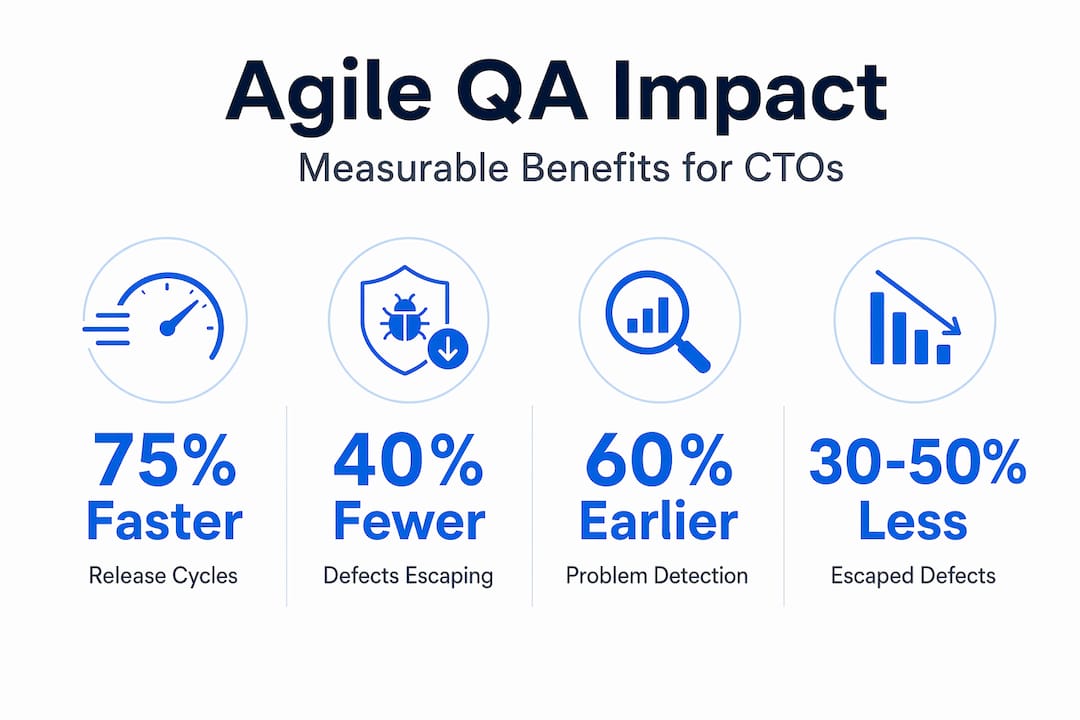
Agile QA in CI/CD pipelines enables up to 75% faster release cycles. Elite DevOps teams deploy code nearly 1,000 times more frequently than low performers, with lower change failure rates. The connection is direct: when automated tests run on every push, you get fast confirmation that a change is safe to ship.
Teams adopting shift-left report up to 40% fewer defect escapes and detect problems 60% earlier in the development cycle. That means fewer customer-reported bugs, fewer emergency patches, and fewer all-hands incidents at 2 a.m.
| Metric | Traditional QA | Agile QA |
|---|---|---|
| Defect fix cost (production) | High (10x to 40x more) | Minimal (caught early) |
| Defect escape rate | Baseline | Up to 40% lower |
| Release cycle time | Weeks to months | Days to weekly |
| Time to ROI | Quarters or years | 2 to 3 sprints |
| Annual savings potential | Limited | Up to $1.2M |
Automated testing from sprint 1 reduces escaped defects by 30 to 50% and raises developer confidence while delivering annual savings up to $1.2M through reduced incidents and lower manual testing overhead.
Fast feedback loops are a productivity multiplier. When a developer pushes a commit and gets test results in minutes, they can fix a problem while the context is fresh. When feedback arrives three days later in a bug report, the cognitive cost of re-entering that context is significant. Agile QA practices cut that delay to near zero.

The agile testing benefits compound over time. Each sprint adds more automated test coverage, which makes future sprints safer and faster. Your quality floor rises continuously instead of resetting with each release.
Technical practices alone won’t get you there. The real shift is cultural, and CTOs are the ones who have to lead it.
Traditional QA creates an adversarial dynamic. Developers build; QA finds problems; developers feel criticized; QA feels ignored. That cycle is inefficient and demoralizing. Transforming QA from gatekeeper to a continuous, shared responsibility measurably improves both team collaboration and quality outcomes.
The cultural change has two components: structural and behavioral.
Structurally, you embed QA capability inside cross-functional squads rather than maintaining a separate QA department. A QA engineer sits in sprint planning, contributes to story refinement, and writes acceptance criteria alongside developers and product managers. Quality becomes part of the definition of work, not an assessment of work after it’s done.
Behaviorally, you change what “done” means. Integrating automated quality gates directly into pull request workflows reduces developer resistance by providing immediate feedback and empowering ownership. When a developer sees a failing test on their own pull request before it goes to review, they fix it. No blame. No back-and-forth. Just a clear signal.
Key behaviors to reinforce:
Pro Tip: When you first roll out automated quality gates in your PR workflow, expect pushback. Developers dislike friction they didn’t design. Run a demo showing how a gate caught a real production-class bug in under 60 seconds. The resistance drops significantly after that.
Understanding agile QA’s role in the agile world helps leaders frame this cultural shift as an investment in team capability rather than an additional compliance layer.
Knowing the benefits doesn’t automatically produce a working implementation. Here’s how to approach it with precision rather than ambition.
Start with the testing pyramid. Build toward balanced test coverage targeting roughly 80% unit tests, 15% integration tests, and 5% end-to-end tests. Too many end-to-end tests slow your pipeline and create high maintenance costs. Too few leave critical user flows unchecked.
Integrate automation from sprint 1. Don’t defer automation to “when the codebase stabilizes.” Teams embedding automation from sprint start and integrating with CI realize faster payback and sustained quality improvements.
Redefine your Definition of Done. Every story should require passing automated tests before it can be accepted. Including automated test passing in your Definition of Done creates steady automation growth and stops technical test debt from accumulating sprint over sprint.
Assign clear ownership for test suites. Orphaned tests break and stay broken. Assign ownership at the squad level, not the individual level, to prevent bus-factor risk while keeping accountability clear.
Track quality metrics actively. Measure defect escape rate, test coverage percentage, build failure frequency, and mean time to resolve. Review these in sprint retrospectives, not just at quarterly reviews.
Apply AI where it accelerates ROI. AI-augmented testing tools can auto-generate test cases, identify flaky tests, and prioritize regression coverage based on code change analysis. For CTOs managing lean teams, understanding how startups scale quality with AI provides a practical lens on where automation investment pays off fastest.
The last point deserves emphasis. Exploratory testing catches unknown risks that pure automation misses. Relying solely on fast unit tests neglects the edge cases and usability failures that surface only when a real human navigates your product. Your agile usability testing strategy should complement your automation suite, not compete with it.
You should also consider how your software development requirements are defined upstream. Ambiguous requirements produce ambiguous tests. Defining software requirements clearly at the start of a feature dramatically reduces the cost of writing and maintaining test coverage throughout its lifecycle.
I’ve watched teams adopt Agile QA and fall short of its promise because they treated it as a tooling upgrade rather than a leadership decision. They installed CI/CD pipelines, added a test automation framework, and called it done. Six months later, test suites were unmaintained, builds were perpetually red, and developers had learned to ignore the feedback the system was giving them.
The truth is that speed and quality are not trade-offs in Agile QA. They’re the same outcome. When your test suite is trusted, developers ship faster because they’re confident. When it’s not trusted, even a passing build feels risky.
What I’ve seen work consistently is leaders who make quality a first-class engineering metric and hold that standard publicly. Not punitively. But visibly. When a CTO asks about defect escape rate in the same breath as velocity, the organization learns what actually matters.
The cultural resistance is real but temporary. I’ve found that most developers want fast, trustworthy feedback. They want to ship code that works. Agile QA gives them that. The job of technical leadership is to set up the structures that make it possible, then get out of the way.
— Testvox

If the practices above describe where you want your team to be, Testvox can help you get there without the trial-and-error cost of building it from scratch. Testvox works as an agile quality partner for technology companies, embedding QA capability directly into development sprints through staff augmentation and managed testing services.
From setting up continuous testing pipelines to running QA in cloud applications with security baked in, Testvox brings the frameworks, automation expertise, and sprint-level execution that CTOs need. Whether you’re pre-launch, scaling post-funding, or dealing with a rising defect escape rate, explore the benefits of professional QA partnership and see what embedded agile QA looks like in practice.
Shift-left testing means moving quality activities earlier in the development cycle, from post-development review to pre-development planning and in-sprint testing. This approach reduces defect fix costs by 10 to 40 times compared to catching bugs in production.
Most teams realize measurable ROI within 2 to 3 sprints through reduced incident rates and lower manual testing overhead, with annual savings reaching up to $1.2M depending on team size and product complexity.
Traditional QA is a final-stage gate that reviews completed work. Agile QA embeds quality activities throughout every sprint, with shared ownership across developers, QA engineers, and product managers rather than a siloed testing team.
A balanced testing pyramid targets roughly 80% unit tests, 15% integration tests, and 5% end-to-end tests. Too many end-to-end tests slow the pipeline and increase maintenance costs without proportionally improving defect detection.
Yes. Starting with test automation in sprint 1 and integrating quality gates into your CI/CD pipeline requires minimal tooling investment. AI-augmented testing also allows lean teams to scale quality coverage without hiring a large dedicated QA team.

Let us know what you’re looking for, and we’ll connect you with a Testvox expert who can offer more information about our solutions and answer any questions you might have?
