
 25 May 2026

How to Test APIs Securely: 2026 Practitioner Guide
26 May 2026
 9 min 26 sec
  BY
Amju
BY
Amju
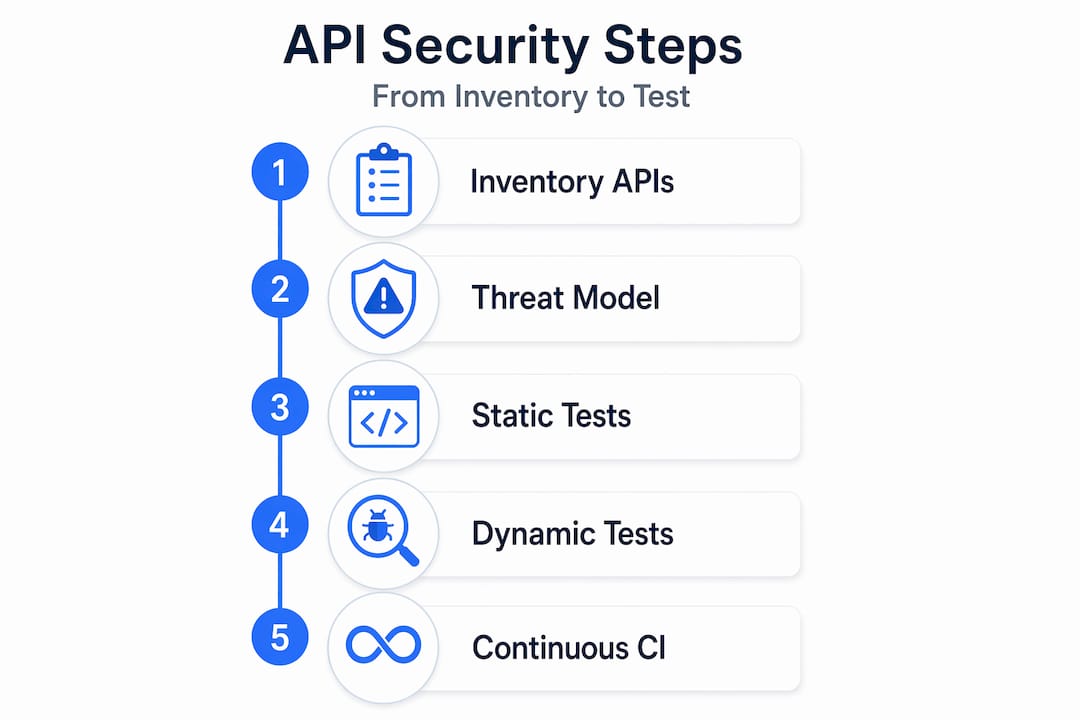
APIs are the backbone of modern applications, and they are also the most actively exploited attack surface in production systems today. Knowing how to test APIs securely is no longer optional for development teams. BOLA is the top cause of API-related data breaches in 2026, and the majority of vulnerable endpoints slip through because teams lack a structured, security-first testing approach. This guide walks you through every stage: preparation, static testing, dynamic testing, and continuous security integration, giving you a practical workflow you can act on today.
Table of Contents
- Key takeaways
- How to test APIs securely: start with a full inventory
- Static API security testing and contract testing
- Dynamic API security testing: passive and active methods
- Shifting security left: CI/CD integration and continuous testing
- Common mistakes that undermine your testing
- What I’ve learned testing APIs across fintech and e-commerce
- Take your API security testing further with Testvox
- FAQ
Key takeaways
| Point | Details |
|---|---|
| Build a complete API inventory | Shadow and undocumented endpoints are your biggest blind spot before any testing begins. |
| Run SAST before runtime | Static analysis catches insecure defaults and missing auth checks at the code and schema level. |
| DAST validates real behavior | Dynamic testing simulates attacker methods and confirms controls work under live conditions. |
| Shift security left in CI/CD | Automated security tests on every pull request shrink remediation time and reduce production risk. |
| Authentication is not authorization | Most breaches involve valid tokens accessing objects they should never reach. Test both, separately. |
How to test APIs securely: start with a full inventory
Before you write a single test case, you need to know what you are actually testing. This sounds obvious, yet over 80% of endpoints lack basic rate limiting, and a significant portion of those endpoints are shadow APIs that no one on the team formally owns or tracks.
Shadow APIs emerge from legacy integrations, third-party services onboarded without documentation, or microservices spun up during rapid development cycles. They sit outside your threat model, which means they sit outside your tests. An attacker targeting your system does not care about your documentation gaps. They will probe every reachable endpoint.
To build a usable inventory:
- Run automated API discovery tools against your staging environment to surface endpoints not in your OpenAPI spec.
- Cross-reference gateway logs and network traffic captures to catch calls that bypass the documented surface.
- Catalog each endpoint with its authentication method, data sensitivity classification, and ownership.
- Validate that your OpenAPI or AsyncAPI specifications are current before running any contract or static tests.
Pro Tip: Set a policy that no endpoint ships to staging without a corresponding spec entry. Treat an undocumented endpoint the same way you treat unreviewed code: block it.
Threat modeling at this stage pays dividends later. Map trust boundaries, identify which endpoints touch sensitive data or privileged operations, and rank them by risk. This ranking drives where you spend the most time in dynamic testing.
Static API security testing and contract testing
The Static API security testing, or SAST, operates before your API ever handles a live request. Static analysis inspects source code and API specs to detect insecure patterns without executing the application. This is where you catch misconfigured security schemes, missing authorization decorators, and policy violations that a runtime test would not surface until a real payload hits a real endpoint.
Here is a practical sequence for integrating SAST into your workflow:
- Lint your OpenAPI spec using tools like Spectral or vacuum. Define rulesets that flag missing authentication requirements, overly permissive CORS settings, and absent rate-limit headers.
- Run a SAST scanner against your API codebase. Focus on routes where authorization logic is implemented manually rather than enforced by a framework middleware.
- Write contract tests using Pact or a similar consumer-driven contract testing tool. These tests verify that your API implementation matches its specification, catching schema drift before it becomes a runtime surprise.
- Gate your CI/CD pipeline so that a failing contract test or a high-severity lint violation blocks the build.
Common static test failures include endpoints that accept any authenticated request without checking whether the caller owns the target resource, responses that leak internal stack traces, and JWT validation logic that accepts unsigned tokens. Each of these is cheaper to fix at the SAST stage than after a penetration tester or an attacker finds them in production.
| Test type | Stage | What it catches | Speed |
|---|---|---|---|
| OpenAPI linting | Pre-commit | Missing auth, schema errors | Seconds |
| SAST code scan | CI build | Insecure code patterns | Minutes |
| Contract testing | CI per PR | Spec vs. implementation drift | Minutes |
| DAST active scan | Staging | Runtime auth and injection flaws | Hours |
Pro Tip: Contract tests are not just a compatibility check. Write them to assert security properties too: confirm that a consumer with role “viewer” never receives a response body intended for role “admin.”
Dynamic API security testing: passive and active methods
Dynamic API security testing, or DAST, is where you confirm that the controls you designed actually hold up under real conditions. Active DAST simulates exploit attempts; passive DAST collects logs and network data for behavioral analysis. Both are necessary, and they serve different purposes.

Passive testing is low risk. You point a traffic-capturing proxy at your staging environment, run a representative set of legitimate API calls, and analyze the results for information leakage, missing security headers, and authentication anomalies. It will not break anything. It will also not tell you whether an attacker can actually exploit what it flags.
Active testing is where the real validation happens. This includes:
- Authorization testing for BOLA. Create two user accounts with different data ownership. Use account A’s token to request objects belonging to account B by manipulating resource IDs in the request path or body. If the API returns account B’s data, you have a confirmed BOLA vulnerability.
- Rate-limiting verification. Limiting login attempts to 20 per hour turns a 10-minute brute-force attack into a 500-hour exercise. Script a burst of requests to confirm your limits fire correctly, and verify they are enforced per user or per API key, not just per IP address.
- Input validation and injection fuzzing. Send malformed payloads, oversized strings, unexpected data types, and special characters to every parameter. Confirm your API returns 400 errors rather than 500 errors or unexpected data.
- Authentication bypass attempts. Test token expiration, algorithm confusion attacks on JWT implementations, and behavior when required headers are omitted entirely.
Pro Tip: Never run active destructive tests against production. Use mock servers for safe testing of POST, PUT, PATCH, and DELETE endpoints. Mock servers return realistic fake payloads so you can validate authorization and schema enforcement without touching real data.
Coordinate with your operations team before starting active scans. Even in staging, aggressive fuzzing can trigger alerts, consume database resources, or reveal gaps in your monitoring. Pre-scheduling also means anomalies during the test window are attributed correctly rather than escalated as incidents.
| Method | Risk level | Best environment | Primary goal |
|---|---|---|---|
| Passive traffic analysis | Low | Staging or production | Detect information leakage |
| Active auth testing | Medium | Staging only | Confirm access controls work |
| Fuzzing and injection | High | Isolated test env | Validate input handling |
| Penetration testing | High | Dedicated test env | Find exploitable chains |
Shifting security left: CI/CD integration and continuous testing
Most teams lack API security tests integrated in CI/CD pipelines, and that gap is one of the most consistent failure points observed across organizations in 2026. Shift-left means moving security validation as close to the developer as possible, ideally triggering on every pull request before code reaches a shared environment.
In practice, this looks like the following:
- Attach OpenAPI linting and contract tests to your PR check suite. A developer who introduces a schema change without updating authorization rules sees a failing check immediately, not three sprints later during a security review.
- Run a lightweight DAST scan against a short-lived staging environment spun up for each PR. Tools that integrate directly with your CI runner can do this in minutes.
- Add a security-focused contract test suite that checks authorization properties, not just response schemas. This is the layer where you combine static and dynamic testing for maximum coverage with minimal false positives.
- Use sandbox and mock environments for any test that touches data-mutating endpoints. This keeps your test suite fast and your data clean.
The most underrated benefit of shift-left API security testing is the feedback loop it creates for developers. When a security test fails in a local or PR environment, the developer who wrote the code is still context-loaded on that change. Fix time drops from days to hours. You can see a real-world example of this in practice with shift-left workflows that integrate automated security gates into modern development pipelines.
Common mistakes that undermine your testing
Even teams with good intentions make a short list of recurring mistakes that significantly reduce the value of their API security assessments.
- Conflating authentication with authorization. A valid token proves identity. It says nothing about what that identity is permitted to access. Authenticated does not mean authorized, and object-level authorization must be tested explicitly for every sensitive endpoint. You can review real-world BOLA risks in cloud environments to see how frequently this distinction gets missed in production.
- Skipping the inventory step. Testing documented endpoints while shadow APIs remain untouched gives you a false sense of coverage. An undiscovered endpoint is not a secure endpoint.
- Testing rate limiting only at the IP level. Rate limits enforced per IP are trivially bypassed with distributed requests. Apply and test limits per user, per API key, and per session token.
- Using production data in security tests. Running fuzzing or injection tests against production exposes real user data, risks accidental deletion, and can trigger compliance violations. Always test against isolated environments with synthetic data.
- Ignoring schema drift. When your API implementation diverges from its spec, contract tests break. Teams that disable or ignore failing contract tests lose the only automated signal that their authorization assumptions have changed.
Pro Tip: Build a short “security smoke test” suite of 10 to 15 targeted checks covering BOLA, rate limiting, and auth bypass. Run it on every deployment. Full regression is for scheduled testing cycles. The smoke test is your daily safety net.
What I’ve learned testing APIs across fintech and e-commerce
I’ve spent years reviewing how development teams approach API security, and the pattern that surprises me most is not the exotic vulnerabilities. It’s the authorization blind spots that exist right next to well-implemented authentication.
Teams build solid JWT validation, enforce HTTPS everywhere, and rotate secrets on a schedule. Then a user with a valid token increments a numeric order ID in a request path and pulls someone else’s invoice. The authentication worked perfectly. The authorization was never tested. That gap is responsible for more breaches than any sophisticated exploit chain.
My honest take on secure API testing methods: the preparation stage is where most teams underinvest. They treat inventory as a one-time task rather than a living artifact. Shadow APIs accumulate quietly, especially in microservices architectures where teams move fast and documentation lags behind deployment. Catching up costs far more than maintaining the spec in the first place.
The teams that get this right treat their OpenAPI spec as executable documentation, not a PDF that lives in a wiki. They lint it, contract test against it, and reject any PR that introduces a gap. That habit alone closes a significant portion of the attack surface before any dynamic testing begins.
If I had to hand a team a baseline checklist before they push to production: verify every sensitive endpoint has explicit object-level authorization, confirm rate limits fire per identity rather than per IP, run at least one active BOLA test with a second user account, and ensure no endpoint in your gateway is missing a corresponding spec entry. That is not a complete security program. But it is the floor below which no team should ship.
— Testvox
Take your API security testing further with Testvox

If you are building in fintech or e-commerce, the stakes for API vulnerabilities are higher than in most sectors. Payment gateway endpoints, user account APIs, and transaction records are exactly what attackers target first. Testvox specializes in exactly this kind of high-stakes environment. Our security testing service covers full VAPT aligned with OWASP standards, combining SAST, DAST, and manual penetration testing to surface the vulnerabilities that automated tools miss. From shadow API discovery to BOLA verification and rate-limit auditing, we work through your entire API surface before it reaches production. See how we applied this approach in our compliance system security audit for a real-world example of depth and coverage.
FAQ
What is BOLA and why does it top the API vulnerability list?
BOLA stands for Broken Object Level Authorization. It occurs when an API returns data belonging to one user in response to a request from another authenticated user, and it is the leading cause of API breaches because it is easy to introduce and frequently untested.
What are the core secure API testing methods?
The standard approach combines SAST to catch insecure code and spec violations early, DAST to validate runtime behavior under simulated attack, and contract testing to prevent schema drift between design and implementation.
How do I test API rate limiting effectively?
Script a burst of requests exceeding your documented limit using a single user credential or API key, not just multiple IPs. Confirm the API returns a 429 status and that the limit resets correctly within the defined window.
When should API security tests run in CI/CD?
Static analysis and contract tests should run on every pull request. A lightweight DAST scan should run on every deployment to a staging environment. Full penetration testing should be scheduled at major release milestones or at least quarterly.
What is the difference between passive and active DAST?
Passive DAST monitors traffic and logs without sending exploit payloads, making it safe for production adjacent environments. Active DAST sends crafted requests to test authentication, authorization, and input handling, and should only run against isolated staging or test environments.
Recommended
- Software Testing Process Optimization | QA Case Study
- Why Security Testing Matters for Every Dev Team
- Insurance software testing | Testvox
- Top Security Testing Trends for CTOs and Founders in 2026
25 May 2026
 11 July 2024


ABOUT TESTVOX

Testvox is a software testing company help your product reach its full potential. Get full cycle testing for your mobile and web applications while ensuring all quality assurance standards are met... Read More
100+
Applications
Assured
Assured

5 Star Rating

5 Star Rating
“By participating in our release lifecycle, Testvox's standard QA process has helped us to launch quality products faster.”

Rima Hudaifa
Manager | Cadvil
Manager | Cadvil
