 2 June 2026

Best Tools For Performance Testing Fintech Applications
23 June 2026
 8:33 MIN Read time
  BY
SRIYALINI
BY
SRIYALINI
Introduction
A fintech platform once lost nearly 18% of its daily transaction volume in under an hour. The reason wasn’t fraud or downtime—it was latency. During a surge in peak-hour usage, the system slowed just enough for users to abandon transactions. That subtle performance gap cost real money.
This is the reality of fintech today. Systems must handle massive transaction loads, operate in real time, and maintain accuracy under pressure. Choosing the best tools for performance testing fintech applications isn’t just a technical decision—it’s a business-critical one.
There’s no shortage of performance testing tools for fintech, but not all are created equal. Some excel at API-level testing, others at large-scale simulations, and a few shine when paired with modern monitoring platforms.
This guide breaks down the most widely used tools—JMeter, LoadRunner, K6, Gatling, and monitoring solutions like Grafana—and explains where each fits. The goal is simple: help teams choose the right toolset for their fintech environment without guesswork.
Open Source vs Enterprise Performance Testing Tools
Before diving into specific tools, it helps to address a fundamental question: should teams choose open source or enterprise solutions?
The answer isn’t always straightforward.
Open source tools like JMeter, K6, and Gatling offer flexibility and cost advantages. Enterprise tools like LoadRunner provide advanced analytics, scalability, and support.
Here’s a comparison:
| Criteria | Open Source Tools | Enterprise Tools |
| Cost | Free | Expensive |
| Flexibility | High | Moderate |
| Scalability | Requires setup | Built-in |
| Support | Community-based | Dedicated support |
| Reporting | Basic | Advanced analytics |
In practice, many fintech teams adopt a hybrid approach—using open source tools for flexibility and enterprise platforms for large-scale testing.
The debate around open source vs enterprise performance testing tools often comes down to team expertise. Skilled end expert teams can extend open source tools very effectively, while enterprise tools will limit operational overhead.
Before exploring individual tools, it’s worth noting that modern platforms like Testvox provide specialized tools and services tailored specifically for fintech performance testing. For instance, these platforms combine AI-driven insights, cloud scalability, and integrated monitoring to complement both open-source and enterprise tools. Consequently, rather than replacing traditional options like JMeter or LoadRunner, they enhance them. Ultimately, this approach bridges critical gaps in visibility, automation, and predictive analysis.
1. Apache JMeter For Fintech Testing
JMeter remains one of the most widely used tools in fintech performance testing. Its flexibility and open-source nature make it a go-to choice for many teams.
Hands-on, JMeter for fintech testing shines when simulating high user concurrency and diverse transaction flows.
A typical JMeter setup might include:
- Thread groups representing users
- HTTP samplers for API calls
- Timers to simulate real-world delays
- Assertions to validate responses
A simple test plan structure:
Thread Group (1000 users)
->Initialise: HTTP Request (Login API)
->Verify: HTTP Request (Balance Check)
-> Execute: HTTP Request (Fund Transfer)
-> Output: Listener (Results)
In one real scenario, a team stress-tested a payment gateway with JMeter and uncovered a hidden bottleneck in the authentication service. The issue only appeared under concurrent login requests—something functional testing had missed.
Pros of JMeter:
- Highly customizable
- Strong community support
- Supports multiple protocols
Cons:
- Can become complex at scale
- Requires tuning for distributed testing
Pairing JMeter with Testvox adds AI-driven insights and simplifies large-scale execution. Teams looking to modernize their setup often start by integrating both—start a free trial to see how it enhances test visibility.
2. K6 For API And Cloud Testing
K6 has gained popularity for its developer-friendly approach. It’s lightweight, scriptable, and integrates well with modern CI/CD pipelines.
K6 API testing fintech teams adopt is particularly effective for microservices-based architectures.
A basic K6 script looks like this:
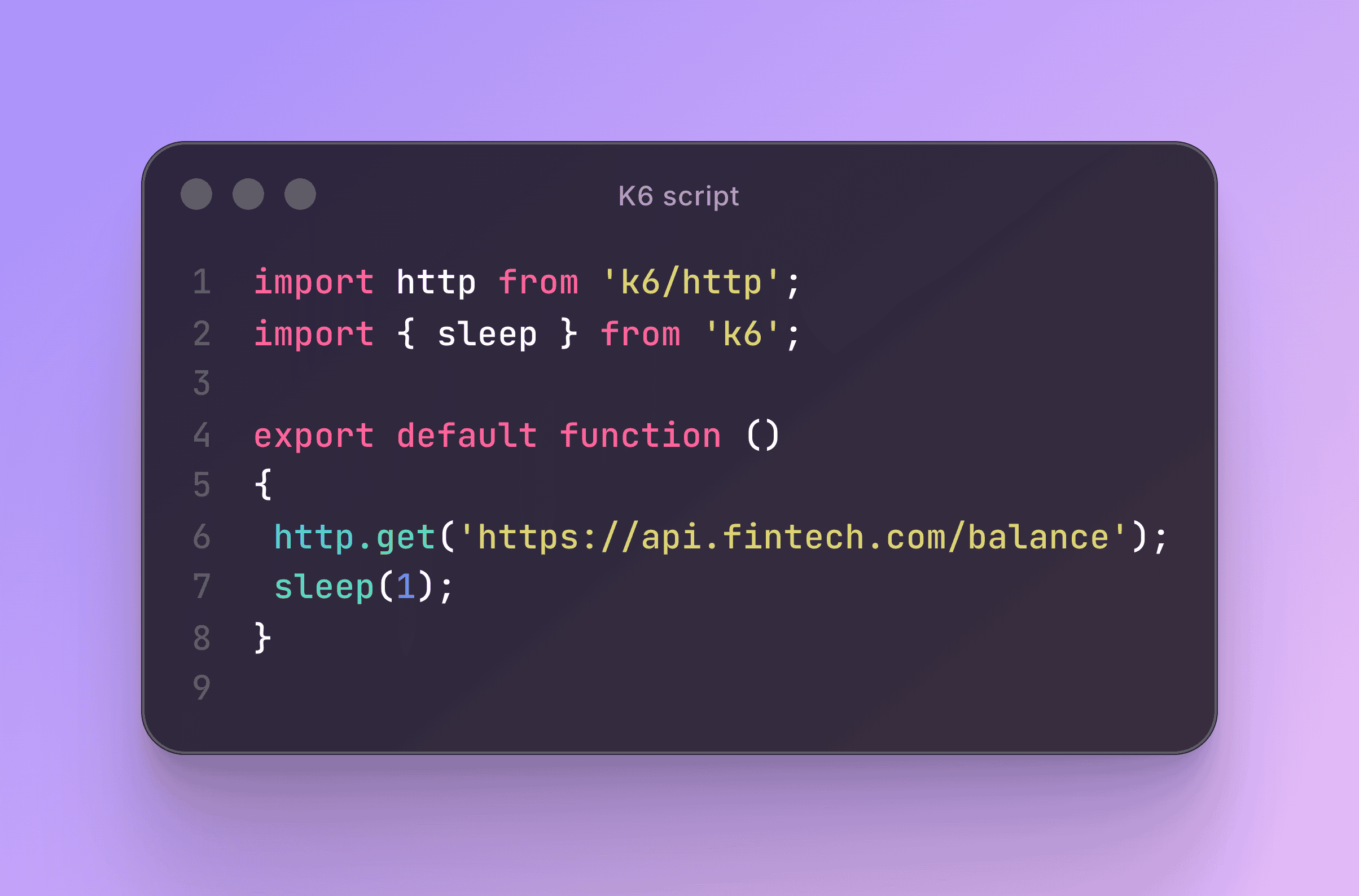
What sets K6 apart is its simplicity. Developers can write tests in JavaScript, making it accessible and easy to integrate.
Pros:
- Lightweight and fast
- CI/CD friendly
- Ideal for API testing
Cons:
- Limited GUI
- Smaller ecosystem compared to JMeter
In cloud-native fintech systems, K6 often becomes the default choice for continuous performance testing.
3. Gatling for High-Performance Systems
Gatling performance testing is known for its efficiency and scalability. It uses a code-based approach, which appeals to developers comfortable with scripting.
Gatling excels in:
- High-performance systems
- Real-time applications
- Large-scale simulations
Its asynchronous architecture allows it to handle high loads with fewer resources.
A typical Gatling scenario:
- Define user behavior in code
- Simulate concurrent users
- Analyze detailed reports
- Analyze detailed reports
Pros:
- High performance
- Efficient resource usage
- Detailed reporting
Cons:
- Requires programming knowledge
- Less beginner-friendly
In fintech environments where performance efficiency is critical, Gatling offers a strong balance between speed and control.
Monitoring Tools (Grafana, Prometheus, Splunk)
Performance testing doesn’t end with running scripts. Monitoring tools provide the visibility needed to interpret results.
Grafana for fintech monitoring is widely used for visualizing metrics. When combined with Prometheus, it offers real-time insights into system behavior.
Key tools include:
- Grafana (visualization)
- Prometheus (metrics collection)
- Splunk (log analysis)
Here’s how they compare:
| Tool | Strength |
| Grafana | Visualization dashboards |
| Prometheus | Metrics collection |
| Splunk | Log analysis and correlation |
In practice, these tools help teams:
- Identify bottlenecks
- Track system health
- Correlate performance issues with logs
Modern platforms like Testvox integrate monitoring with performance testing, offering unified dashboards and AI-based insights. This reduces the need to switch between tools and improves decision-making.
For teams building observability into their workflows, exploring [link to Testvox integrations] can streamline the process.
Selecting The Right Tool For Your Fintech Application
Choosing the right tool depends on several factors:
- System architecture
- Team expertise
- Budget constraints
- Testing requirements
Here’s a practical framework:
- Define Your Needs
- High TPS? Consider LoadRunner or Gatling
- API-heavy system? K6 is a strong choice
- Flexible testing? JMeter works well
- Evaluate Team Skills
- Developer-heavy team → K6 or Gatling
- QA-focused team → JMeter or LoadRunner
- Consider Scalability
- Small-scale testing → Open source tools
- Enterprise systems → Hybrid or enterprise solutions
- Integrate Monitoring
- Use Grafana and Prometheus for visibility
- Add AI-driven platforms for deeper insights
In many cases, the best approach is not choosing one tool but combining them.
For example:
- JMeter for load testing
- K6 for API testing
- Grafana for monitoring
Adding Testvox on top provides AI-based analytics and centralized control, making it easier to manage complex testing environments.

Conclusion
Performance testing in fintech is not optional—it is foundational. The tools chosen directly impact system reliability, scalability, and user experience.
JMeter offers flexibility, LoadRunner delivers enterprise power, K6 simplifies API testing, and Gatling provides efficiency for high-performance systems. Monitoring tools like Grafana and Prometheus complete the picture by offering visibility into system behavior.
There is no single “best” tool. The right choice depends on the specific needs of the application and the capabilities of the team.
What matters most is building a testing strategy that combines the strengths of multiple tools while addressing fintech-specific challenges like high transaction volumes, security, and real-time processing.
Choose wisely and supercharge with Testvox—contact us today.
Also Read:
Top 5 Automation Testing Tools 2026
Testing Fintech Apps: Challenges and Best Practices

2 June 2026


ABOUT TESTVOX

Testvox is a software testing company help your product reach its full potential. Get full cycle testing for your mobile and web applications while ensuring all quality assurance standards are met... Read More
100+
Applications
Assured
Assured

5 Star Rating

5 Star Rating
“By participating in our release lifecycle, Testvox's standard QA process has helped us to launch quality products faster.”

Rima Hudaifa
Manager | Cadvil
Manager | Cadvil
