
 28 June 2026
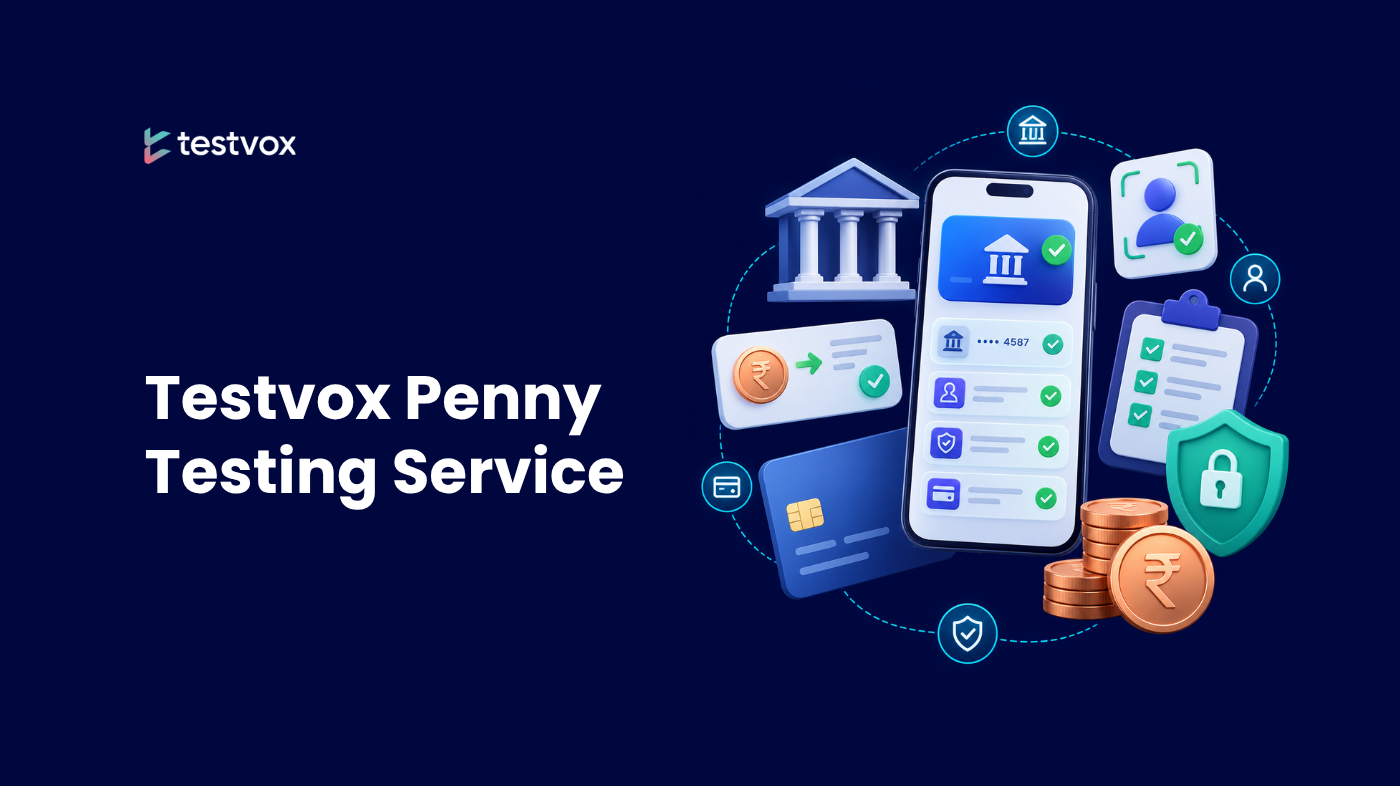
Testvox Penny Testing Service
26 August 2026
 5 min 41 sec
  BY
Pradeep K
BY
Pradeep K
If you run a fintech app, a lending platform, a payroll system, or any product that pays money into a bank account, you’ve probably come across the term penny testing (also called penny drop verification or micro-deposit verification). It’s one of the quiet, unglamorous checks that keeps digital payments safe — and when it breaks, the fallout shows up as failed payouts, angry users, and support tickets.
This guide covers what penny testing is, why businesses rely on it, the test cases QA teams need to cover before shipping a penny drop feature, and where Testvox fits in as the QA partner that helps fintech and payment teams validate these flows before they go live.
What Is Penny Testing?
Penny testing is a bank account verification method where a business sends a very small amount of money — typically ₹1 in India or USD 1 , or a few cents elsewhere — to a bank account to confirm that the account is real, active, and belongs to the person who provided the details.
Think of it as a live handshake with the banking network. Instead of trusting a form field, the business actually moves a token amount through the real payment rail (IMPS or UPI in India, ACH or wire in the US and Europe) and checks whether it lands successfully.
A successful penny drop confirms three things at once:
- The account number and routing code (IFSC, SWIFT, or sort code) are valid
- The account is active and can receive funds — not frozen, closed, or dormant
- The registered account holder’s name matches the name provided during onboarding
There’s also a reverse penny drop, where instead of crediting the user’s account, the platform asks the user to approve a small debit from their own UPI-linked account. This proves the person actually controls the account, not just that the account number is correct — a slightly stronger form of ownership verification.
Outside India, the same idea shows up as “micro-deposit verification” in payroll and treasury systems — a small test transaction run through the actual payment channel before the real, larger payment goes out.
How the Process Works, Step by Step
- The user or vendor submits their bank account number and routing/IFSC code
- The platform calls a bank verification API to trigger the penny transfer
- The bank processes the transfer and returns the account status and registered holder name
- The system compares the returned name against the name on file and generates a match score
- Based on the result, the account is approved, flagged for manual review, or rejected
Done right, this entire flow completes in seconds. Done wrong, it silently breaks onboarding, payroll runs, or vendor payouts.
Benefits of Penny Testing
- Prevents misdirected payments. Confirming the account before a large transaction goes out avoids sending money to the wrong person — a costly and often unrecoverable mistake.
- Reduces fraud risk. Verifying account ownership before onboarding a user, vendor, or contractor closes a common entry point for fraud and account takeover.
- Speeds up onboarding. Real-time API-based verification replaces slow manual document checks, letting lending, investment, and payroll platforms onboard users in seconds instead of days.
- Builds an audit trail. Every verification attempt is logged, which helps demonstrate compliance during audits or regulatory reviews.
- Cuts down failed disbursements. Catching an invalid or closed account before a large transfer avoids repeat payment attempts, reconciliation headaches, and support escalations.
- Supports regulatory requirements. Penny drop verification is referenced or required across KYC, AML, and onboarding guidelines in banking, lending, insurance, and investment sectors.
It’s worth being honest here: penny testing confirms an account is valid at that moment — it doesn’t guarantee the account stays valid, and it doesn’t fully verify the identity of the person behind the transaction. That’s exactly why it needs to be tested thoroughly as part of a broader verification stack, not treated as a one-time checkbox.
Common Test Cases in Penny Testing
This is the part most articles on penny testing skip — because most of them are written by payment API providers, not QA teams. If you’re building or shipping a penny drop feature, here are the test scenarios that matter:
Functional test cases
- Valid account number + valid IFSC/routing code → successful verification
- Valid account number + incorrect IFSC/routing code → proper failure handling
- Closed or frozen account → correct rejection with a clear error message
- Dormant account → verify system response and messaging
- Name mismatch between registered holder and submitted name → correct match-score flagging
- Partial name match (nicknames, initials, transliteration differences) → check scoring logic, not just exact match
- Non-existent account number → graceful failure, no false positive
Edge case and negative testing
- Special characters or extra spaces in account number/IFSC fields
- Account number length validation across different banks
- Retry behavior after a failed penny drop (does it double-charge or duplicate the transaction?)
- Timeout handling when the bank’s response is delayed
- Concurrent verification requests for the same account
- Testing across multiple banks and payment rails (IMPS vs. UPI vs. NEFT-based flows), since bank-side behavior isn’t uniform
Non-functional testing
- Load testing during high-volume onboarding periods (campaign launches, salary disbursement days, month-end payout runs)
- Security testing of the verification API — data in transit, PII handling, and protection against parameter tampering
- Regression testing whenever a banking partner or API provider updates their integration
- Cross-device and cross-platform testing if the verification flow is exposed in a mobile app or web onboarding form
Real-world/crowd testing considerations
- Verification with real bank accounts across different banks, not just sandbox/staging data — sandbox environments rarely replicate every real-world failure mode
- Testing across different geographies if the platform serves multiple countries, each with its own rails and response formats
- Testing the full user journey around the verification step — not just the API call, but what the user actually sees, understands, and does next
Why QA Matters for Penny Drop and Bank Verification APIs
A penny drop integration touches real money, real banks, and real user trust — which means a single untested edge case can cause a stuck onboarding flow, a duplicate transaction, or a failed payroll run for hundreds of employees at once. And because the failure often happens on the bank’s side, not just in your code, it’s easy to miss these scenarios in a standard sandbox test pass.
This is exactly the kind of feature that benefits from structured QA — functional test case design, negative and edge case coverage, load testing around peak onboarding windows, and testing with real accounts across real banks rather than relying solely on staging data.
Testvox’s Penny Testing and Bank Verification QA Service
Testvox’s Penny Drop Testing & Bank Verification QA Services
At Testvox, we help fintech, lending, payroll, trading, and payment platforms test bank verification and penny drop flows before and after they go live. Our testing approach covers:
- Functional testing of bank verification flows, including valid, invalid, and edge-case account scenarios
- Crowd testing across different devices, environments, and user scenarios to identify issues that may not appear in sandbox testing
- KYC testing covering registration, identity verification, document validation, and related onboarding flows
- Credit and debit card transaction verification across relevant payment scenarios
- Wallet transaction verification for deposits, withdrawals, transfers, and transaction status handling
- Cross-platform testing across web, iOS, and Android onboarding journeys
- Negative and edge-case testing for failed verification, incorrect account details, timeouts, OTP issues, and transaction failures
Our fintech testing experience includes financial-services applications where reliability of onboarding, verification, and transaction workflows is critical. Where project requirements and client authorization allow, we can also incorporate real-world user and account scenarios to identify issues that may not be visible in standard sandbox environments.
Frequently Asked Questions
Is penny testing the same as penny drop verification? Yes, the terms are used interchangeably. “Penny drop” is more common in India; “penny testing” and “micro-deposit verification” are used more globally, especially in payroll and treasury contexts.
How long does a penny drop verification take? Typically 5–15 seconds for API-based real-time verification in India. Micro-deposit-based verification in other countries, where the user has to report back the exact amount received, can take 1–2 business days.
Does penny testing fully prevent fraud? No. It confirms the account is valid and active at that moment, but it doesn’t verify the identity of the person behind the transaction on its own. It’s most effective as one layer in a broader KYC/AML and fraud-prevention stack.
Why do penny drop features need dedicated QA testing? Because they touch real banking rails, real money movement, and multiple banks with inconsistent response behavior. Sandbox testing alone often misses edge cases that only show up with real accounts across real banks — which is where structured QA and crowd testing add value.

28 June 2026


Founder of Testvox Helping startups and SMEs deliver high-quality software products to market, with over 10 years of experience in the software testing industry. Expertise in Automation Testing, Exploratory Testing, and Performance Testing. Passionate about enabling businesses to achieve seamless and robust software solutions through innovative testing methodologies.
ABOUT TESTVOX

Testvox is a software testing company help your product reach its full potential. Get full cycle testing for your mobile and web applications while ensuring all quality assurance standards are met... Read More
100+
Applications
Assured
Assured

5 Star Rating

5 Star Rating
“By participating in our release lifecycle, Testvox's standard QA process has helped us to launch quality products faster.”

Rima Hudaifa
Manager | Cadvil
Manager | Cadvil
