 27 November 2025
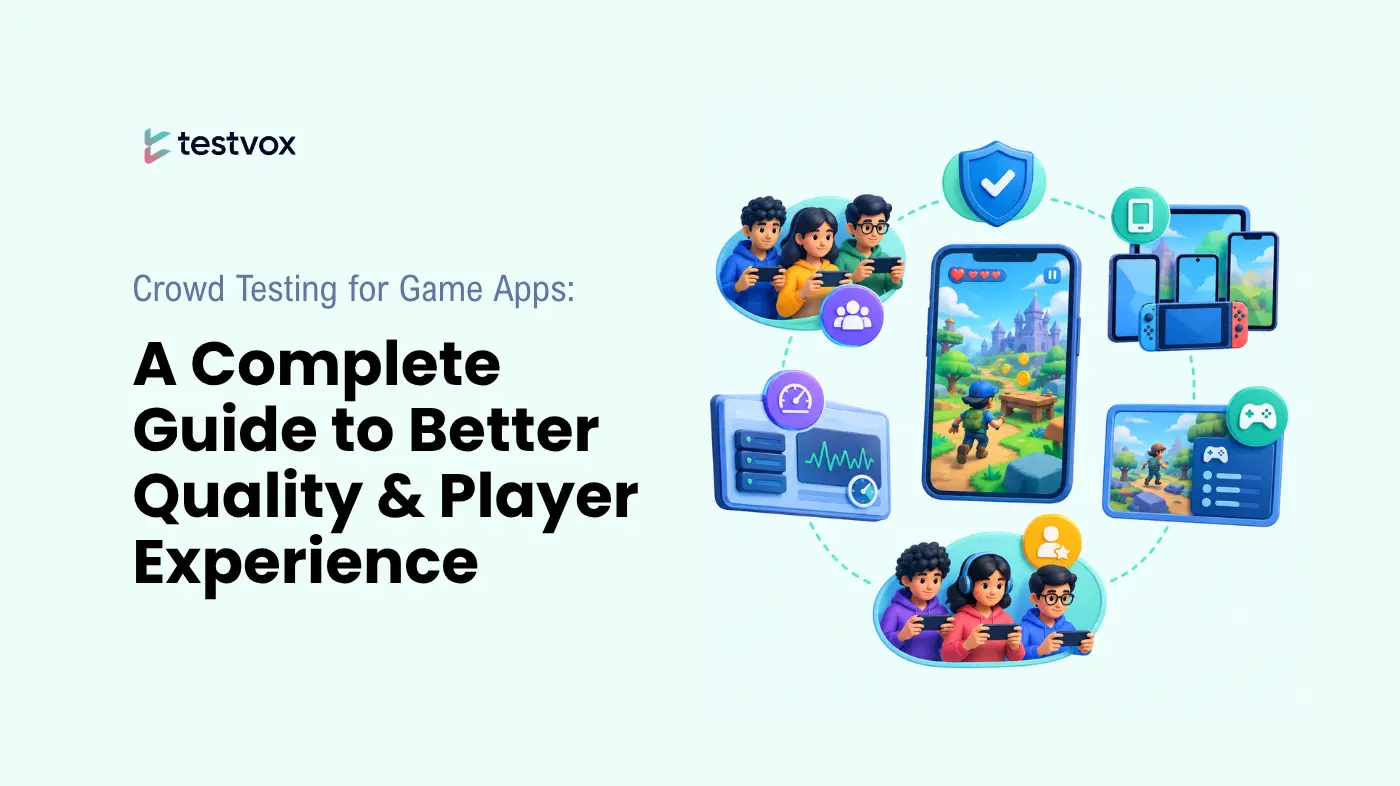
Crowd Testing for Game Apps: A Complete Guide to Better Quality and Player Experience
21 September 2026
 10:33 MIN Read time
  BY
Pradeep K
BY
Pradeep K
Quick answer
Crowd testing for game apps is a QA method where a distributed community of real players tests a game on their own devices, in their own networks, under real playing conditions. Instead of a small in-house team running scripted checks in a lab, dozens or hundreds of testers play the game the way actual users will — across different handsets, OS versions, connection speeds and skill levels — and report bugs, crashes, matchmaking failures and experience issues as they happen. It is the fastest way to find the defects that only appear at scale, and the only practical way to collect real gameplay data before launch.
What is crowd testing for game apps?
Crowd testing (also called crowdsourced testing) uses a managed community of external testers to validate an application in real-world conditions. For game apps specifically, it means real human players installing your build on their own phones and playing complete sessions — joining matches, competing against other players, winning, losing, spending in-app currency, and moving through results and history screens exactly as a paying user would.
The difference from traditional QA is not just headcount. It is context. A lab tester on a controlled Wi-Fi network with a company-issued flagship device will never reproduce what happens when ten players on ten different Android builds, on mobile data in different cities, try to join the same match at the same second. That scenario is where multiplayer games actually break — and it is exactly what crowd testing is built to surface.
Why game apps need crowd testing more than most software
A banking app has a defined set of user journeys. A game has emergent behaviour. Players do unexpected things, at unexpected speeds, on unexpected hardware. Five specific pressures make games unusually hard to test in-house:
- Device fragmentation is extreme. Games push GPU, memory and thermal limits harder than any other app category. A build that runs beautifully on a recent flagship can drop frames, overheat or crash outright on a three-year-old mid-range device — which is what a large share of your audience is actually holding.
- Multiplayer only breaks in a crowd. Matchmaking, lobby fill, player-count validation, synchronisation, disconnect handling and reconnection logic cannot be meaningfully tested by two testers on a desk. You need enough concurrent real players to fill a 4-player, 6-player and 10-player match repeatedly.
- Network conditions are uncontrollable. Real players are on congested mobile data, switching between Wi-Fi and 4G mid-match, riding in lifts and trains. Latency spikes and mid-session drops are normal, and your game has to handle them without losing a player’s entry fee or corrupting their result.
- Money and currency logic is unforgiving. If your game involves entry fees, prize pools, credits, gems or any in-app economy, a single miscalculated deduction destroys player trust and generates support tickets and refund requests immediately. These flows need to be validated across many win and loss combinations, not just the happy path.
- Fun is not a checkbox. Difficulty curves, session length, reward pacing and clarity of feedback are player-experience questions. Only real players who did not build the game can tell you honestly whether a match felt too long, whether the results screen made sense, or whether they would open the app again tomorrow.
Crowd testing vs in-house QA vs beta testing
These three are complementary, not competing. Knowing which job each one does will save you money.
| In-house QA | Crowd testing | Open beta | |
| Who tests | Trained QA engineers | Managed community of real players | Self-selected public users |
| Devices | Limited device lab | Testers’ own real devices | Anything |
| Coverage type | Deep, scripted, repeatable | Broad, real-world, scenario-based | Uncontrolled |
| Concurrency | Very limited | High — matches can be filled on demand | High but unpredictable |
| Bug report quality | Excellent | Good to excellent (structured templates, evidence attached) | Usually poor |
| Turnaround | Continuous | Days | Weeks |
| Best for | Regression, unit-level, core logic | Multiplayer, device coverage, UX, data collection | Load and sentiment, post-hardening |
The mature approach is: in-house QA holds the regression suite, crowd testing covers the real world before every major release, and open beta comes last — after the crowd has already removed the embarrassing bugs.
What crowd testers actually verify in a game app
A well-scoped game crowd testing programme is not “play it and tell us what you think.” It is a structured scenario matrix. In a typical competitive mobile game engagement, testers execute against checks like these:
Entry and matchmaking
- Game loads correctly from a cold start and after a background/foreground switch
- Correct player count is offered and enforced for each mode (for example 4-player, 6-player and 10-player configurations)
- Entry fee and prize pool are displayed accurately before the player commits
- The required number of players can join and the match actually starts
- Behaviour when a lobby does not fill, or a player abandons during matchmaking
Core gameplay
- Full-length sessions are played to completion without crashes, freezes or loading stalls
- Frame rate and responsiveness hold up on mid-range and older devices
- Scoring and progression behave correctly at different playing speeds
- Games whose length depends on player performance end correctly at both fast and slow completion times
Results and economy
- Both win and loss conditions are triggered deliberately and verified
- The correct winner and loser are identified
- Reward calculation matches the advertised prize pool
- In-app currency is deducted correctly at entry and credited correctly on win
- Balance updates immediately and consistently across screens
- The results screen and game history reflect the true outcome of every session
Stability and continuity
- Multiple consecutive matches can be played without degradation
- Navigation across all screens remains stable after long play sessions
- Recovery behaviour after a network drop, call interruption or app kill
- Battery drain and device heating over extended play
Experience feedback
- Was the objective clear within the first thirty seconds?
- Did the match length feel right?
- Was the reward outcome understandable without explanation?
- Would the tester play again voluntarily?
Crowd testing, playtesting and gameplay data collection — what’s the difference?
The terms overlap in the market, so it helps to be precise:
- Crowd testing is QA-led. The output is defects, reproduction steps, device coverage and pass/fail evidence.
- Playtesting is experience-led. The output is qualitative insight — confusion points, difficulty perception, session recordings, sentiment.
- Gameplay data collection is analytics-led. The output is volume: many real human sessions producing telemetry, event streams and behavioural data you can model against.
Many studios need all three, and a single crowd programme can be designed to deliver all three at once — the same tester playing a scripted scenario matrix also generates real session data and can answer a short structured experience survey at the end. If your priority right now is data collection, say so during scoping, because it changes how sessions are distributed across time, testers and configurations.
How a game crowd testing project actually runs
Step 1 — Scoping. Define the game modes, player configurations, session lengths, target devices, OS versions and geographies. Agree what counts as a pass. This is where most of the value is created or lost.
Step 2 — Tester selection. Testers are matched to the profile: device type, OS version, region, and where relevant, gaming experience level. For a multiplayer title, the pool must be large enough to fill your biggest lobby repeatedly, with buffer for no-shows.
Step 3 — Onboarding and test design. Testers receive the build, test accounts, currency credits where needed, the scenario matrix, and a reporting template that forces evidence — screenshots, screen recordings, device details, timestamps, network type and exact reproduction steps.
Step 4 — Execution in coordinated waves. Multiplayer testing requires synchronised sessions: testers are scheduled into slots so that enough players are live at once to fill 4-, 6- and 10-player matches, across both platforms.
Step 5 — Triage and consolidation. This is the step that separates managed crowd testing from a free-for-all. Raw reports are deduplicated, reproduced, severity-rated and consolidated by a QA lead before anything reaches your developers. Your team should receive a clean, prioritised defect list — not four hundred overlapping notes.
Step 6 — Reporting and retest. You get a structured report: defects by severity, device and OS coverage matrix, scenario pass rates, stability observations and experience findings. Fixes are then verified in a retest cycle.
Case study: crowd testing a skill-based competitive gaming app
Client and application details are confidential. Shared with permission in anonymised form.
The challenge. A skill-based competitive mobile gaming platform needed real-world validation across four distinct game titles inside a single application. Each title supported multiple player configurations, ran on an in-app virtual currency with entry fees and prize pools, and depended entirely on live matchmaking with real opponents. Internal testing could not fill ten-player lobbies, could not reproduce mixed-device match conditions, and could not generate the volume of genuine gameplay sessions the client needed.
The Testvox approach. We deployed 20 crowd testers from the Testvox community — 10 on iOS and 10 on Android — running on their own real devices across a range of models and OS versions. Testers were scheduled into synchronised waves so that 4-player, 6-player and 10-player matches could be filled reliably on demand for every title.
Scope executed. Across all four games, testers validated: game loading and matchmaking; player-count enforcement; entry fee and prize pool display accuracy; full-length gameplay sessions ranging from around three minutes to five minutes depending on the title; deliberate win and loss scenarios; winner identification and reward calculation; currency deduction and balance updates; results screen accuracy; game history integrity; navigation; crash and freeze behaviour; and the ability to play multiple matches back to back without degradation. One title, whose match length varied with player performance, was additionally tested across deliberately fast and deliberately slow completion patterns to confirm the game ended correctly in both cases.
Outcome. The client received a consolidated, severity-rated defect report with device and OS coverage mapped against every scenario, plus real gameplay session data generated by genuine human players rather than scripted bots — the combination they needed to harden the build and validate their economy logic before scaling.
What deliverables should you expect?
Insist on all of these before signing:
- A scenario coverage matrix showing what was tested, on what device, on what OS, with the result
- A deduplicated defect log with severity, reproduction steps and attached evidence
- A device and platform coverage report
- Crash and stability summary
- Session-level gameplay data, where data collection is part of the scope
- Structured player experience feedback
- An executive summary a non-technical stakeholder can read in five minutes
- A retest report after your fixes
How many testers do you need?
There is no universal number, but the logic is straightforward. For single-player games, tester count is driven by device coverage — how many device and OS combinations you need represented. For multiplayer games, tester count is driven by your largest lobby size, multiplied by the platforms you support, plus buffer.
A practical rule for competitive mobile titles: you need enough concurrent testers per platform to fill your maximum player count at least twice over, so matches can be repeated without waiting. Twenty testers split evenly across iOS and Android is a realistic starting point for a game with up to ten-player matches. Larger scale, wider geography or heavy data-collection targets push that number up.
What does game crowd testing cost?
Pricing normally follows one of three models: per tester per cycle, per tester-hour, or per completed session. Cost drivers are tester count, number of platforms, session length, number of synchronised waves required, geography, and whether you need experience research and data collection alongside defect reporting. Because scope drives price almost entirely, any credible provider will quote only after a scoping conversation — treat an instant flat quote with caution.
Best practices that make crowd testing work
- Write scenarios, not instructions to “explore.” Vague briefs produce vague reports.
- Force deliberate loss conditions. Testers naturally try to win. If you do not explicitly instruct them to lose matches, your loss-path economy logic goes untested.
- Test the full session, not the first minute. Crashes cluster at the end of long sessions and after multiple consecutive matches.
- Mandate evidence in every report. Screen recording plus device details, or it did not happen.
- Schedule multiplayer testing in waves. Unscheduled testers cannot fill a ten-player lobby.
- Mix device tiers deliberately. Include older mid-range hardware, not just current flagships.
- Triage before delivery. A raw crowd feed will overwhelm your developers and get ignored.
- Run a retest cycle. Untested fixes are just hopes.
Common mistakes to avoid
Scoping only the happy path. Testing exclusively on Wi-Fi. Using only high-end devices. Skipping the game history and results screens because they seem cosmetic — they are where players notice economy errors. Treating crowd testing as a replacement for regression testing rather than a complement to it. And running the programme once before launch instead of before every significant release.
When crowd testing is not the right choice
Honest answer: crowd testing is not ideal for pre-alpha builds that crash on launch, for testing that requires access to confidential unreleased IP under strict security constraints, for deep performance profiling that needs instrumented builds and lab equipment, or for pure load and stress testing, which is better served by simulated traffic. Use it when your build is stable enough to be played and you need real-world breadth.
Frequently asked questions
What is crowd testing in game development?
Crowd testing in game development is a QA approach where a managed community of real players tests a game on their own devices under real conditions, reporting bugs, crashes, gameplay issues and experience problems. It complements in-house QA by providing device diversity, genuine concurrency for multiplayer modes, and honest player feedback that an internal team cannot produce.
How is crowd testing different from beta testing?
Beta testing relies on self-selected public users with no defined scope and low-quality reporting. Crowd testing uses selected, briefed and managed testers who execute a defined scenario matrix and submit structured reports with evidence, which are then triaged and consolidated before delivery.
Can crowd testing be used for multiplayer games? Yes, and it is one of the strongest use cases. Multiplayer matchmaking, lobby fill, player-count enforcement, synchronisation and disconnect handling require many concurrent real players. Crowd testers are scheduled into synchronised waves so matches of the required size can be filled repeatedly.
How long does a game crowd testing cycle take?
A focused cycle typically runs from a few days to two weeks depending on scope, tester count, number of game modes and how many synchronised waves are needed. Retest cycles after fixes are usually shorter.
Do crowd testers use real devices?
Yes. Testers use their own physical phones and tablets on their own networks, which is precisely what makes crowd testing valuable — emulators cannot reproduce thermal throttling, real network instability, or the behaviour of older mid-range hardware.
Can crowd testing collect gameplay data as well as find bugs?
Yes. The same programme can be designed so testers generate large volumes of genuine human gameplay sessions for telemetry and behavioural analysis while simultaneously executing QA scenarios. This needs to be defined during scoping, since data collection changes how sessions are distributed.
How many testers does a mobile game need?
For single-player games, tester count is driven by device and OS coverage requirements. For multiplayer games, it is driven by maximum lobby size across platforms — commonly around twenty testers split between iOS and Android for titles with up to ten-player matches, scaling up with geography and data volume needs.
Is my game build kept confidential during crowd testing?
With a professional provider, yes. Testers work under signed non-disclosure agreements, builds are distributed through controlled channels, and client and application identities are never disclosed publicly without written permission.
Test your game the way your players will play it
Testvox runs managed crowd testing programmes for mobile game studios — real testers, real devices, synchronised multiplayer waves, triaged defect reports and genuine gameplay data. If you are preparing a release, validating an in-app economy, or need volume gameplay sessions from real human players, we can scope a programme around your build.
 27 November 2025
 25 August 2026
 29 October 2025

Founder of Testvox Helping startups and SMEs deliver high-quality software products to market, with over 10 years of experience in the software testing industry. Expertise in Automation Testing, Exploratory Testing, and Performance Testing. Passionate about enabling businesses to achieve seamless and robust software solutions through innovative testing methodologies.
ABOUT TESTVOX

Testvox is a software testing company help your product reach its full potential. Get full cycle testing for your mobile and web applications while ensuring all quality assurance standards are met... Read More
100+
Applications
Assured
Assured

5 Star Rating

5 Star Rating
“By participating in our release lifecycle, Testvox's standard QA process has helped us to launch quality products faster.”

Rima Hudaifa
Manager | Cadvil
Manager | Cadvil
