
 25 May 2026
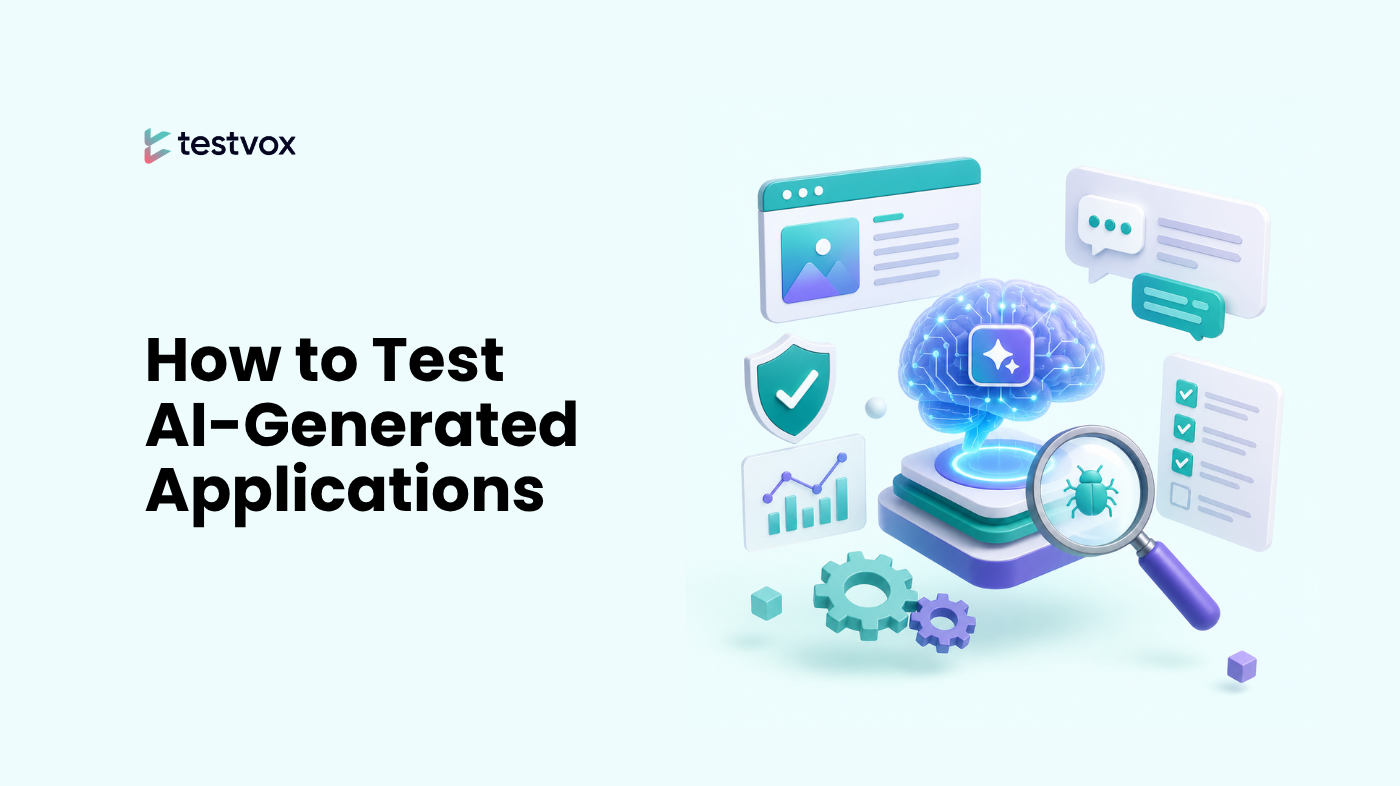
What Testing Actually Looks Like for a Vibe-Coded Web Application
14 July 2026
 4:44 MIN Read time
  BY
Pradeep K
BY
Pradeep K
“Vibe coding” — building fast with heavy AI assistance, often shipping features in hours instead of sprints — has quietly become the default way a lot of web apps get built in 2026. The code works. It compiles, it runs, the demo looks great. But “it works” and “it’s been tested” are two very different claims, and the gap between them is where vibe-coded apps tend to get burned.
The risk isn’t that AI-generated code is bad code. It’s that it’s unreviewed code at a velocity that outpaces traditional QA cycles. Nobody sat with the SQL query long enough to think “wait, is this parameterized?” Nobody asked “what happens if two requests hit this endpoint at the same second?” The code looks plausible, passes a quick smoke test, and ships. Testvox’s recent engagement project lays out a framework for exactly this problem, and it’s a useful lens for thinking through what a real testing strategy needs to cover — beyond “did the happy path work.”
1. Shift Security Left — Don’t Bolt It On Later
The single biggest gap in vibe-coded apps is security, mostly because nobody was looking for it. The fix isn’t a one-time audit before launch; it’s testing that runs on every commit.
SAST (Static Application Security Testing)— tools like Semgrep or SonarQube scan source code as it’s written, flagging insecure patterns, hardcoded secrets, and known vulnerability classes before the code is even built.
SCA (Software Composition Analysis) — AI-assisted coding pulls in dependencies fast and rarely vets them. Tools like Snyk or OWASP Dependency-Check continuously audit third-party libraries for known CVEs.
Secret scanning — TruffleHog or GitGuardian at the PR stage catch API keys and credentials before they ever land in the codebase, not after they’re discovered in a public repo.
A periodic, dedicated pentest — automated tools are good at catching known patterns. They’re bad at catching business-logic flaws: privilege escalation, broken access control, RBAC gaps. Those need a human looking specifically for “can this user do something they shouldn’t,” and a recurring (e.g. quarterly) pentest is the right cadence to catch what scanners structurally can’t.
The pattern worth internalizing: static analysis catches known problems automatically; logic flaws need deliberate human testing. A vibe-coded app needs both, and most teams only have the first.
AI + Human QA: The Hybrid Testing Model Perfect for Growing Startups
2. API-First Functional Automation
If you’re building UI test suites first, you’re testing the slowest, most brittle layer of the stack before the fastest, most stable one.
80% of automated tests are at the API layer, covering core CRUD operations. API tests run in sub-second time, don’t break when a button moves three pixels, and give developers near-instant feedback.
20% at the UI layer– reserved for genuinely critical, end-to-end business workflows — login, checkout, the things a user actually has to complete start to finish.
This isn’t a hard rule; the ratio should flex with what the application actually does. But the principle holds: test logic and data contracts at the API, and reserve UI automation for what UI automation is actually good at — verifying the experience, not the plumbing underneath it.
For API testing specifically, the checklist that matters most for a vibe-coded backend:
Authorisation, not just authentication. Can User A fetch User B’s data by changing an ID in the request? This is OWASP’s #1 API risk (Broken Object-Level Authorisation), and it’s exactly the kind of bug that “the code works” testing misses, because the happy path — your own user, your own data — never triggers it.
Input validation against malformed, oversized, and malicious payloads— not just valid inputs.
Consistent response shapes and status codes— vibe-coded endpoints frequently return 200 for everything, including errors, because nobody specifically tested the failure paths.
Rate limiting — frequently just absent, because nobody thought to add it and nothing in a quick functional test would reveal it’s missing.
Idempotency — does double-submitting a request create a duplicate record or double-charge a payment?
AI-Augmented QA: The Smart Way Startups Can Test Software Without Building a Large QA Team
3. Performance Testing Isn’t Optional Just Because It’s Not Broken Yet
Code generated quickly tends to have quietly expensive patterns baked in — N+1 queries, missing indexes, unbounded result sets — that work fine with five test users and fall over at five hundred. Performance testing exists to surface those problems before your users do.
Apache JMeter (or k6, Locust) simulating realistic multi-user load should be checked against defined targets: response time under load, error rate, throughput, resource utilization. The catch — and this is a gap worth calling out explicitly — is that this only works if you’ve actually defined what “acceptable” looks like. A performance test with no SLA target is just a number with no judgment attached. Before running the load test, define: how many concurrent users does this realistically need to support, and what response time is acceptable at that load?
4. Wire It Into CI/CD as a Quality Gate, Not a Checklist
The structural fix for “vibe coding outpaces QA” is making testing a blocking step in the pipeline, not a follow-up activity. Concretely:
– Tests trigger automatically on every commit and/or pull request.
– Promotion to UAT or production is gated by predefined, mandatory pass-rate benchmarks — not a manual “looks good to me.”
– All of this runs in a pre-production environment that mirrors production configuration, so results are trustworthy and nothing disrupts live users.
This is the part that actually solves the original problem. Fast AI-assisted development isn’t inherently risky — shipping it without an automated gatekeeper is. A quality gate lets development stay fast while making it structurally hard for an untested change to reach real users.
One thing worth being precise about here: pass-rate benchmarks need actual numbers attached to them (95% pass rate, zero critical/high vulnerabilities, P95 latency under a defined threshold) — not just “benchmarks exist.” A gate with no defined threshold isn’t really a gate.
5. Don’t Skip Data Integrity and Concurrency
Two categories that are easy to overlook because they don’t show up in a single-user functional test:
– Database-level constraints, not just application-level validation. If the app checks for a unique email but the database column itself isn’t constrained, a race condition will eventually create duplicates.
– Concurrent request handling — what happens when two requests modify the same resource at the same moment? Vibe-coded apps, built fast and tested by one person clicking through a UI, almost never get this tested until it breaks in production with real concurrent traffic.
The Real Takeaway
None of this is exotic. It’s the same testing discipline that’s always mattered for web applications — functional, API, performance, security. What’s changed is the velocity at which untested code can now reach a “looks done” state, and that means the testing strategy has to be built into the pipeline from day one rather than scheduled as a phase after development “finishes.”
If you’re shipping a vibe-coded app, the question isn’t whether to test it like a normal application. It’s whether your testing process can move at the same speed your development process now does — because if it can’t, the gap is exactly where things break.
25 May 2026
 24 June 2026
 17 June 2026

Founder of Testvox Helping startups and SMEs deliver high-quality software products to market, with over 10 years of experience in the software testing industry. Expertise in Automation Testing, Exploratory Testing, and Performance Testing. Passionate about enabling businesses to achieve seamless and robust software solutions through innovative testing methodologies.
ABOUT TESTVOX

Testvox is a software testing company help your product reach its full potential. Get full cycle testing for your mobile and web applications while ensuring all quality assurance standards are met... Read More
100+
Applications
Assured
Assured

5 Star Rating

5 Star Rating
“By participating in our release lifecycle, Testvox's standard QA process has helped us to launch quality products faster.”

Rima Hudaifa
Manager | Cadvil
Manager | Cadvil
