Virtual Meetings Application Software Testing - Cosmos

Overview

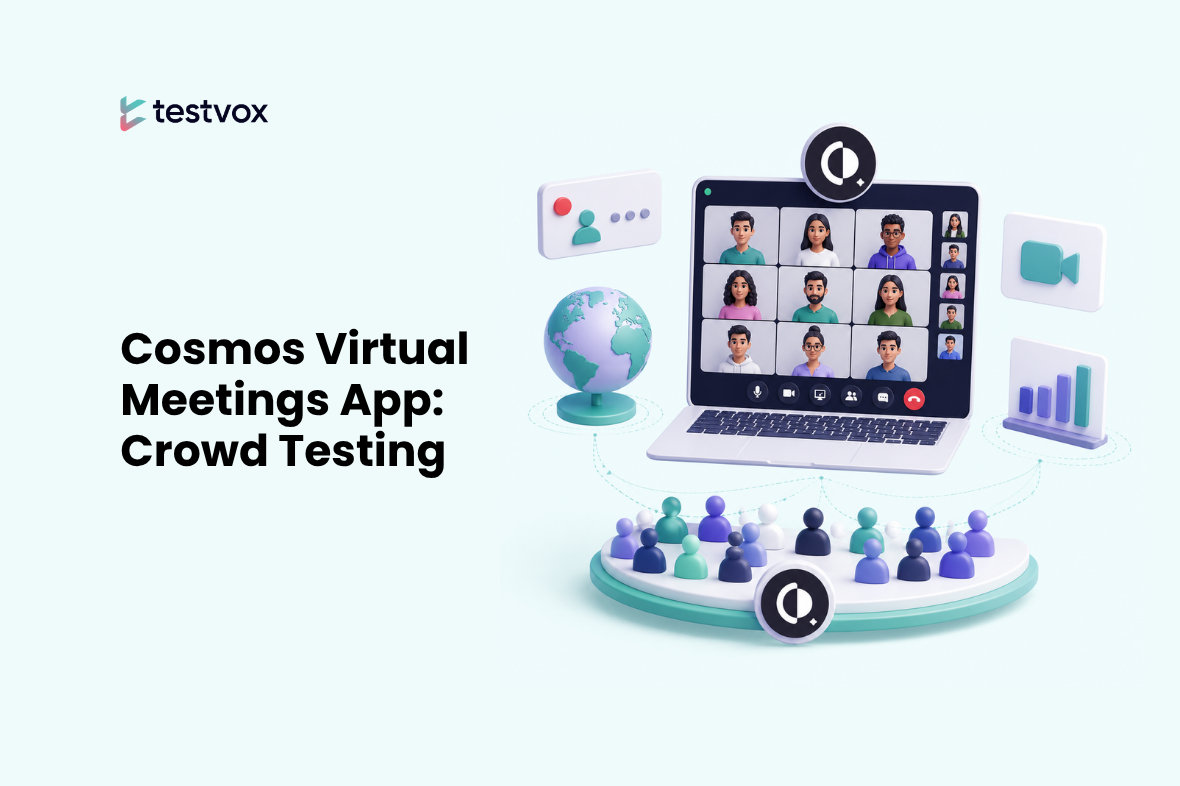
Cosmos is a virtual meeting platform which helps in recreating the feeling of being physically present in any office while working remotely. More than traditional video conferencing tools, it offers an interactive virtual space where users can move around, join conversations, collaborate with teammates and even take breaks to play games or socialize.

The platform blends communication with engagement. Users can switch between video calls, chat windows, shared screens and entertainment features within a single environment. This creates a more natural and immersive experience compared to standard meeting tools.

However, building such kind of an experience always has got its own challenges. The platform must handle real time interactions, support multiple features at once and perform consistently across different devices and network conditions.

Cosmos wanted to validate how the application would perform in real world scenarios, super specifically in diverse environments like India, where internet speeds, devices and usage patterns differ very hugely. To achieve this, they partnered with Testvox to conduct large scale functional and load testing.

The goal was clear. Ensure that the platform worked smoothly under real conditions, supported multiple users at once and delivered a consistent experience across all touchpoints.

Challenges

  • Testing In A Diverse Real World Environment One of the main requirements was to test the platform in an Indian environment. This meant dealing with a very huge range of devices, browsers and internet speeds.
    Users in different regions experience different levels of connectivity. Some use high speed broadband, while others rely on slower mobile networks. Ensuring consistent performance across these conditions was a major challenge.
    The client needed testers who could replicate these real world scenarios accurately.
  • Managing A Large Distributed Testing Team To simulate real usage, a large number of testers had to work simultaneously from different locations. Coordinating like distributed team required careful planning.
    Each tester needed to follow specific test cases while also interacting with others in real time. Without proper coordination, the results could become inconsistent or incomplete.
    Managing communication and task allocation at this scale was not simple.
  • Training Testers For A Complex Platform Cosmos is not a basic application. It includes multiple features notably like video calls, chat, screen sharing and interactive elements.
    Testers needed to understand how each feature worked and how they interacted with each other. Training a large group of testers within a limited time frame was a significant challenge.
    Without proper training, the quality of testing could be affected.
  • Executing Tests Within A Fixed Time Window The testing process had to follow a strict schedule defined by the client. All testers needed to be active at the same time to simulate real user load.
    This required precise coordination. Any delay or mismatch in timing could affect the accuracy of the results.
  • Identifying Maximum Load Capacity Another key requirement was to determine how many users the platform could handle at once. This involved gradually increasing the number of active users and observing system behavior.
    The challenge was to push the system to its limits without causing uncontrolled failures. The goal was to identify performance thresholds and improve them.

Our Solution

  1. Structured Functional Testing
  2. Testvox began by creating detailed functional and non functional test cases. These included all major features of the platform like video interactions, chat functionality, screen sharing and inapp activities. Testing was carried out across multiple browsers and devices to ensure compatibility. Exploratory testing was also used to identify issues that were not covered by predefined scenarios. After identifying defects, retesting and regression testing were conducted to ensure that fixes were effective and did not introduce new issues.

  3. Large Scale Crowd Testing Execution
  4. To replicate real world conditions, Testvox assembled a large group of testers from different locations. Each tester used their own device and network setup, providing a realistic testing environment. The team followed a structured approach where tasks were assigned clearly and progress was monitored very closely. This ensured that all test cases were executed efficiently. The diversity of devices and networks helped find out more issues that would not appear in controlled environments.

  5. Gradual Load Testing Strategy
  6. Instead of applying maximum load immediately, Testvox increased the number of active users step by step. Testing started with a smaller group and gradually scaled up to more than 75 testers working simultaneously. This approach helped identify performance bottlenecks at different levels. Each phase of testing provided better insights into how the system behaved under increasing load. This allowed the team to pinpoint areas that needed improvement.

  7. Training And Coordination Of Testers
  8. Before testing began, all testers were trained on how to use the platform and execute test cases. Clear instructions were provided to ensure consistency. Communication channels were established to address questions and provide real time guidance. This preparation ensured that all testers worked in sync, improving the quality and reliability of the results.

  9. Continuous Communication With Development Team
  10. Throughout the testing process, Testvox maintained close communication with the client’s development team. Issues were reported immediately, along with detailed information for reproduction. Developers worked on fixes and the testing team validated them quickly. This ongoing collaboration helped resolve issues faster and kept the project on track.

Result

Improved Application Performance

Load testing helped identify and resolve performance issues. As a result, the platform became more stable and capable of handling multiple users at once. The improvements ensured smoother interactions, even during peak usage.

Enhanced User Experience

By testing across real devices and networks, the platform delivered a more consistent experience. Users were able to interact, communicate and navigate the virtual environment without major disruptions.

Strong Compatibility Across Devices

With more than 75 testers using different devices, compatibility issues were identified and fixed. This ensured that the platform worked well across various browsers and hardware configurations.

Successful On Time Release

Despite the complexity of the testing process, the project was completed within the planned timeline. The structured approach and effective coordination played a key role in achieving this.

Scalable Testing Model

The crowd testing approach created a model that could be reused for future testing needs. It provided a reliable way to simulate real world usage and validate performance at scale.

Conclusion

Testing a virtual collaboration platform needs more than just any checking features. It seems to require understanding how real users interact with the system under different conditions. For Cosmos, the challenge was not just about building the platform but ensuring that it worked seamlessly in diverse environments. By combining functional testing, crowd testing and load testing, Testvox helped them to create a reliable and scalable solution. The platform was able to handle real world usage with confidence. With the right strategy and coordination, even complex platforms can be validated effectively, ensuring a smooth experience for users across the globe.

Related Resources