
 15 February 2023
How to spot and fix cybersecurity gaps in healthcare devices
14 April 2026
 8:44 MIN Read time
  BY
Amju
BY
Amju
Regulatory compliance is not the same as security. Many healthcare startups in India and the UAE pass audits, check every QMS box, and still ship devices with exploitable vulnerabilities baked into the firmware. Persistent root causes continue to appear even after responsible disclosure, meaning the problem is structural, not accidental. If you are a CTO or founder building connected medical devices, this guide will help you identify where the real gaps live, understand what local and global regulations actually require, and apply practical strategies to close those gaps before they become breaches.
Table of Contents
- Understanding regulatory frameworks for healthcare device cybersecurity
- Common cybersecurity gaps in medical devices: Root causes and persistent threats
- Security-by-design and mitigation strategies for healthcare startups
- Leveraging global standards for local compliance and export readiness
- What most guides miss: Hidden challenges and practical wisdom for startup founders
- Next steps: Secure your devices with expert support
- Frequently asked questions
Key Takeaways
| Point | Details |
|---|---|
| Frameworks are not enough | Regulatory compliance alone does not close all device cybersecurity gaps for startups. |
| Persistent root causes | Weak authentication and outdated encryption remain common vulnerabilities in healthcare devices. |
| Security-by-design is critical | Embedding threat modeling and SBOM early maximizes device protection and regulatory success. |
| Global standards support export | Leveraging FDA, NIST, and ISO principles positions Indian/UAE startups for international device launch. |
Understanding regulatory frameworks for healthcare device cybersecurity
Before you can fix a gap, you need to know what the rulebook says and, more importantly, what it leaves out. Regulatory frameworks in India, the UAE, and globally set the floor, but that floor has some serious cracks.
The most detailed framework comes from the FDA. FDA cybersecurity guidance mandates a Secure Product Development Framework (SPDF), a Software Bill of Materials (SBOM), vulnerability disclosure processes, encryption, access controls, and audit logging. This is a strong baseline. But it is a US framework, and most Indian and UAE startups treat it as optional reading rather than an operational blueprint.
In India, CDSCO under MDR 2017 requires quality management systems and risk management practices, but there is no specialized framework for Internet of Medical Things (IoMT) devices. Software lifecycle management and post-market surveillance are implied but not rigorously enforced for cybersecurity specifically. That leaves a lot of room for interpretation, and startups often interpret it in the most convenient way.
The UAE sits in a similar position. UAE MOHAP classifies devices by risk level and requires QMS compliance, but specific cybersecurity mandates for connected medical devices remain limited. The Data Protection Law (DPL) covers healthcare data broadly, but device-level security requirements are still catching up.
Here is a quick comparison to make the gaps visible:
| Framework | SBOM required | Vulnerability disclosure | IoMT-specific rules | Encryption mandated |
|---|---|---|---|---|
| FDA (US) | Yes | Yes | Yes | Yes |
| CDSCO/MDR 2017 (India) | No | Implied | No | No |
| UAE MOHAP | No | No | No | Partial |
The takeaway is clear. If you are building for the Indian or UAE market and not voluntarily aligning with FDA or NIST standards, you are operating in a regulatory gap. That gap is where attackers live.
Key areas to audit immediately include:
- SBOM completeness: Can you list every software component in your device?
- Vulnerability disclosure policy: Do you have a documented process for receiving and acting on reported flaws?
- Access control documentation: Are all authentication mechanisms formally specified?
- Audit logging: Does your device record who accessed what and when?
For teams working on connected hardware, reviewing IoT device testing insights can surface specific test scenarios you may not have considered. Startups that treat software testing for startups as a strategic activity rather than a final checkpoint tend to catch these issues much earlier.
Common cybersecurity gaps in medical devices: Root causes and persistent threats
Knowing the regulatory landscape is useful. Knowing exactly where devices break is more useful.
Empirical research consistently shows that the same root causes reappear across device categories even after vulnerabilities are publicly disclosed. This is not a knowledge problem. It is an incentive and process problem. Teams under launch pressure skip threat modeling. Cost-constrained hardware ships with default credentials. Legacy communication protocols get reused because switching them is expensive.
The most common gaps fall into three categories:
| Vulnerability type | Example | Risk level (CVSS) |
|---|---|---|
| Outdated cryptography | MD5 hashes in firmware | High (7.5+) |
| Weak authentication | Default or hardcoded passwords | Critical (9.0+) |
| Missing audit logging | No access records on patient data | Medium to High |
| Insecure BLE communication | Unencrypted ECG data transmission | High |
| No input validation | Buffer overflow via malformed packets | Critical |
Resource-constrained devices are a particular concern. A BLE-enabled ECG monitor, for example, often runs on minimal processing power. Devices like BLE ECGs are especially vulnerable to man-in-the-middle (MITM) attacks and denial-of-service (DoS) exploits because security features are trimmed to save battery life and memory. An attacker within Bluetooth range can intercept unencrypted cardiac data or crash the device entirely.
“The most dangerous assumption in medical device security is that low-power devices are low-risk targets. Attackers disagree.”
MITM attacks on BLE devices allow an adversary to silently read or modify data in transit. In a clinical setting, that could mean falsified readings reaching a physician. DoS attacks can render a monitoring device unresponsive at a critical moment. Neither of these scenarios requires sophisticated hacking skills. Both are well-documented in the research literature.

For VAPT testing, the focus should be on these edge cases specifically. Generic penetration testing that does not account for resource-constrained hardware will miss the vulnerabilities that matter most. A medical device security testing guide tailored to FDA-ready devices shows how these scenarios are structured in practice.
Pro Tip: Integrate SBOM generation into your CI/CD pipeline from day one. Knowing every component in your firmware makes vulnerability tracking dramatically faster when a new CVE drops.
Security-by-design and mitigation strategies for healthcare startups
Finding vulnerabilities is only valuable if you have a process to fix them systematically. Security-by-design means building protection into the architecture from the first sprint, not bolting it on before launch.
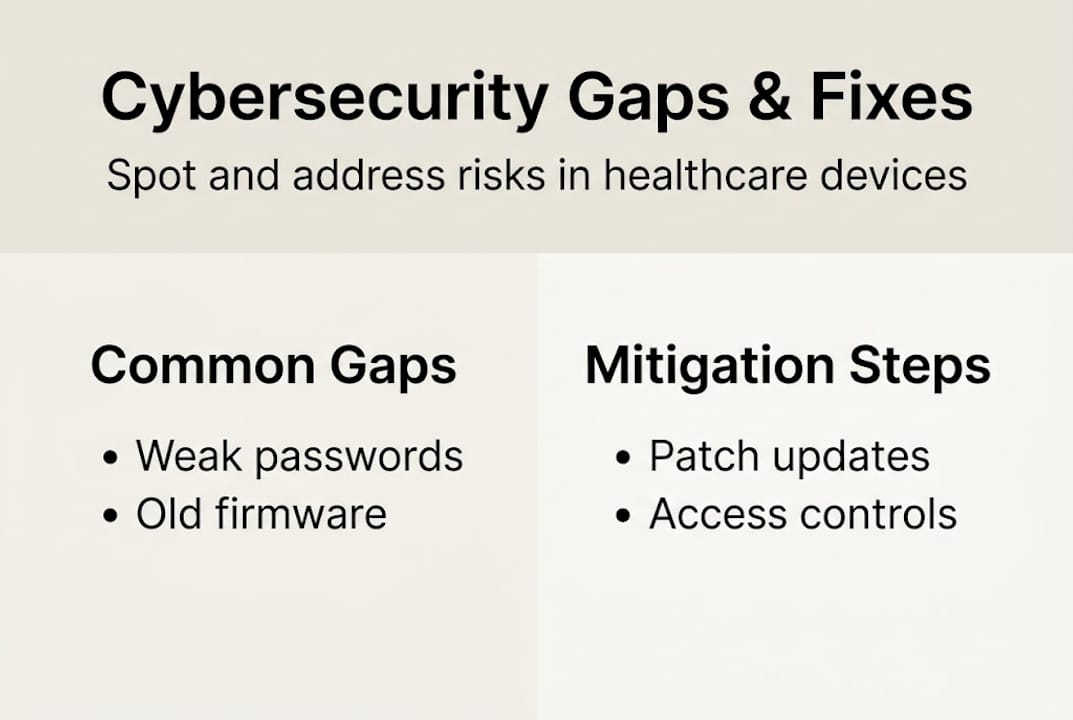
The FDA’s Secure Product Development Framework outlines the core pillars: threat modeling early in the development lifecycle, SBOM for supply chain transparency, regular penetration testing and VAPT, network segmentation, and zero-trust architecture. These are not theoretical ideals. They are practical controls that reduce your attack surface at every layer.
Here is a prioritized mitigation sequence for lean healthcare startups:
1. Conduct threat modeling in sprint zero.
Map every data flow, identify trust boundaries, and document attack vectors before writing a single line of firmware.
2. Generate and maintain an SBOM.
Every open-source library, third-party SDK, and OS component should be tracked with version numbers and known CVEs.
3. Implement CVSS-based risk scoring.
CVSS risk scoring gives you a standardized way to prioritize which vulnerabilities to fix first, which matters when your team has limited capacity.
4. Schedule quarterly VAPT.
Penetration testing should not be a one-time pre-launch activity. Threats evolve, and so should your testing cadence.
5. Apply network segmentation.
Medical devices should never share a network segment with general office infrastructure. Isolate them.
6. Adopt zero-trust principles.
Every device, user, and service should authenticate before accessing any resource, regardless of network location.
7. Establish a Coordinated Vulnerability Disclosure (CVD) program.
Give security researchers a formal channel to report issues before attackers exploit them.
For teams aligning with CDSCO or MOHAP QMS requirements, these steps map directly onto risk management documentation. You are not doing extra work. You are making your compliance evidence stronger.
Reviewing effective security testing methods helps teams understand which testing approaches apply at each development stage. For hardware-specific concerns, IoT device security testing covers the protocols and tools most relevant to connected medical devices.
Pro Tip: Run threat modeling sessions with both your engineering team and a clinical stakeholder. Engineers see technical attack vectors. Clinicians see operational misuse scenarios. You need both perspectives.
Leveraging global standards for local compliance and export readiness
Here is something most startup founders do not realize until they try to expand: the security work you do to meet global standards is the same work that makes your device exportable. You are not doing it twice. You are doing it once, correctly.
Aligning with global standards like FDA/NIST guidelines and ISO/IEC 27001 or IEC 62443 creates a compliance foundation that satisfies both CDSCO/MDR 2017 and MOHAP QMS requirements while simultaneously preparing your device for US or EU market entry.
The practical benefits of this harmonized approach include:
- Faster regulatory approvals. Reviewers in India and the UAE increasingly recognize ISO-aligned documentation, which reduces back-and-forth during submissions.
- Stronger investor confidence. A device with documented SBOM, threat models, and VAPT reports signals engineering maturity to investors who understand the space.
- Reduced rework costs. Building to a global standard once is far cheaper than rebuilding for each new market’s requirements separately.
- Supply chain credibility. Hospital procurement teams in the UAE and large Indian health networks increasingly ask for security documentation before vendor approval.
- Export licensing advantages. Some export categories for medical devices require demonstrated cybersecurity controls. Having them documented accelerates that process.
The key is treating ISO 13485 (quality management for medical devices) and ISO 14971 (risk management) as the structural backbone, then layering IEC 62443 for industrial control system security and NIST SP 800-53 for information security controls on top. This layered approach means your QMS documentation already contains the evidence regulators in any market want to see.
Startups that approach software testing for startups with export readiness in mind from the beginning spend significantly less time on compliance remediation later.
What most guides miss: Hidden challenges and practical wisdom for startup founders
Most cybersecurity guides for medical devices are written from a large-enterprise perspective. They assume you have a dedicated security team, a mature supply chain, and the budget to run a full red team exercise. That is not your reality.
The uncomfortable truth is that the biggest security risks in early-stage medical device startups are not in the firmware. They are in the overlooked endpoints: the companion mobile app that stores tokens insecurely, the cloud API that accepts unauthenticated requests from any device claiming to be yours, and the legacy EHR integration that uses a protocol designed in 2004.
Supply chain risk is also underestimated. A third-party BLE chip with an unpatched vulnerability in its SDK is your vulnerability, not the chip vendor’s problem. Your SBOM is the only tool that makes this visible.
Threat modeling early and often beats compliance-only thinking every time. Compliance tells you what the minimum bar is. Threat modeling tells you where your specific device, in your specific deployment context, is most likely to fail. Those are different questions with different answers.
Reviewing security testing case studies from real device deployments shows patterns that no checklist captures. The founders who build the most secure devices are not the ones who read the most frameworks. They are the ones who test the most aggressively and fix what they find.
Next steps: Secure your devices with expert support
Understanding the gaps is the first move. Closing them requires structured testing by people who know what to look for in medical device environments.
Testvox works directly with healthcare startups in India and the UAE to identify and remediate cybersecurity vulnerabilities in connected medical devices. From medical device security testing aligned with FDA readiness standards to full security testing services covering firmware, APIs, and companion apps, the team brings OWASP-aligned methodology to every engagement. If your device is approaching beta or regulatory submission, VAPT services provide the structured penetration testing evidence that regulators and investors want to see. Start the conversation before a vulnerability becomes a headline.
Frequently asked questions
What are the most common cybersecurity gaps in healthcare devices?
Outdated encryption, weak authentication protocols, and lack of real-time audit logging remain the most persistent issues in healthcare devices, often surviving multiple product generations without remediation.
How can a healthcare startup in India meet device cybersecurity standards?
Align your device QMS with CDSCO/MDR 2017 requirements, implement risk management practices per ISO 13485 and ISO 14971, and conduct regular VAPT to generate documented risk assessment evidence.
Which cybersecurity standards apply to healthcare devices in the UAE?
UAE MOHAP mandates QMS and device risk classification while the Data Protection Law covers healthcare data broadly, but device-specific cybersecurity regulations are still maturing and require proactive alignment with global frameworks.
What is the best approach to mitigating security risks in medical devices?
Adopt security-by-design principles from sprint zero, perform early and recurring threat modeling, maintain a complete SBOM, and schedule quarterly VAPT to catch new vulnerabilities as your device and its threat landscape evolve.
Recommended
- Medical Device Security Testing: A Complete Guide
- Security Testing Case Study: Compliance management system – Testvox
- VAPT Archives – Testvox
- Security Testing Archives – Testvox
- Cybersecurity for Insurers, tools and best practices – Digital Insurance Platform | IBSuite Insurance Software | Modern Insurance System
15 February 2023



ABOUT TESTVOX

Testvox is a software testing company help your product reach its full potential. Get full cycle testing for your mobile and web applications while ensuring all quality assurance standards are met... Read More
100+
Applications
Assured
Assured

5 Star Rating

5 Star Rating
“By participating in our release lifecycle, Testvox's standard QA process has helped us to launch quality products faster.”

Rima Hudaifa
Manager | Cadvil
Manager | Cadvil
