
 15 June 2026

Playwright Test Agents Explained: How Planner, Generator & Healer Kill Flaky Tests
17 July 2026
 11:44 MIN Read time
  BY
Harshit Gupta
BY
Harshit Gupta
A spec our team had written eight months earlier lit up a Slack alert at 1 a.m. The login test had gone red on the release branch, and the on-call engineer did the sensible modern thing before waking anyone: they let the Healer agent look at it first.
By the time we were properly awake and online, the agent had already replayed the failing steps, noticed the “Sign in” button had been renamed to “Log in” in a design tweak, patched the locator, re-run the test three times, and left a diff waiting for review. The fix was correct. It was also slightly ugly — it had swapped a clean variable for an inline regex — but it was correct, and it had landed while the team slept.
Here’s the value up front, because it’s the whole point. Playwright test agents are three AI agents — Planner, Generator, and Healer — that write, run, and repair your Playwright suite for you. They attack flaky tests at the root, turn AI test generation into committed TypeScript, and give you self-healing tests that patch themselves when the UI shifts. That takes the most tedious parts of test automation off your plate — while leaving the judgment calls firmly with you.
Playwright shipped these agents in v1.56 back in October 2025, and by the current release — v1.61, out 15 June 2026 — they’ve settled in enough that teams are building real workflows around them, not just kicking the tyres (release notes). If you’ve heard “Playwright can now write and fix its own tests” and mentally filed it under marketing, this is the piece that explains what’s actually happening under the hood, and where the line between “the agent handles it” and “you handle it” really sits.
What are Playwright test agents?
Playwright test agents are a set of three AI agents — the Planner, Generator, and Healer — introduced in Playwright v1.56 to automate the write-run-fix loop of end-to-end test automation (official docs).
The thing people get wrong first is imagining a single magic bot. It’s three separate agent definitions, each with a narrow job, meant to hand off to the next. They run through an agentic loop driven by an assistant like Claude Code or VS Code, using the Playwright MCP server for their picture of the page.
They are not, despite the marketing gloss, magic infrastructure. As one practitioner put it, the agents are “Markdown files with prompts and limited tool access.” That framing is worth holding onto — it sets your expectations at the right altitude.
How do the Planner, Generator, and Healer work?
Each of the three has one job and hands off cleanly to the next. Here’s the division of labour (official docs).
Planner: explores the app and writes a plan
The Planner explores your running app and writes a structured Markdown test plan — human-readable, listing the scenarios and steps it thinks matter. It’s the front of the pipeline and, as we’ll get to, the part that needs the most human oversight.
Generator: turns the plan into real tests
The Generator takes that plan and turns it into executable Playwright Test files, verifying selectors and assertions live as it goes. This is the AI test generation step — the point where a Markdown plan becomes TypeScript you can actually commit and run.
Healer: repairs failing tests automatically
The Healer runs the suite and automatically repairs failing tests — replaying steps, inspecting the page, patching locators or waits, and re-running until the test passes or it decides the feature itself is genuinely broken. This is where the self-healing tests promise lives.
You set them up with one command — npx playwright init-agents –loop=<target> — pointed at whichever assistant you drive them through. The supported loops today are vscode (needs VS Code v1.105 or newer), claude for Claude Code, codex, and opencode (docs). It drops agent definition files into your repo and generates a seed.spec.ts — a seed test that holds your fixtures and setup, and gets copied into everything the agents produce. Regenerate the definitions whenever you bump Playwright, because they carry version-specific tools and instructions.
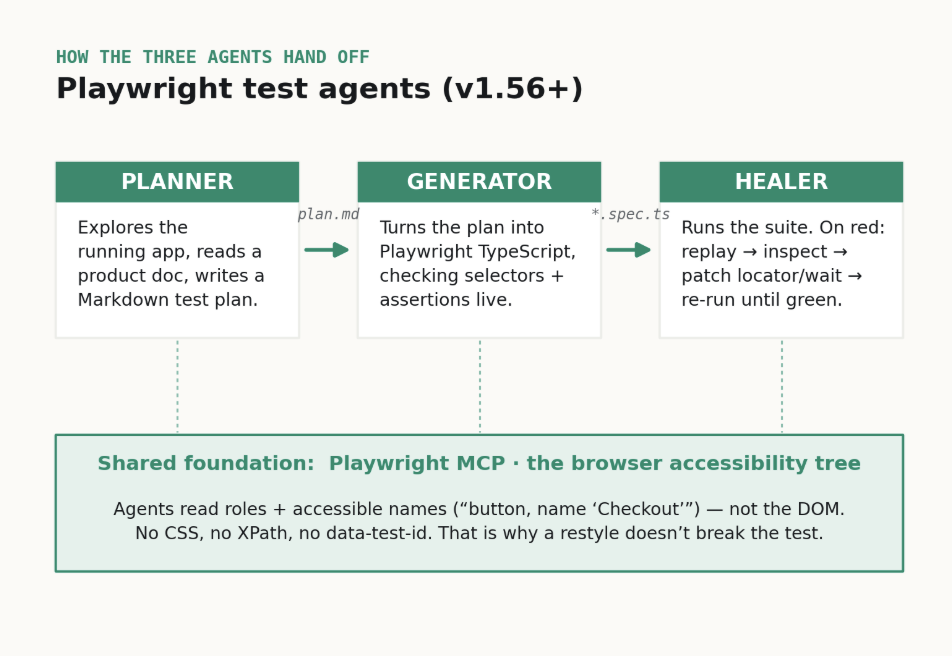
Three narrow jobs with clean handoffs, all sitting on the same accessibility-tree foundation. That foundation is the part that actually kills flakes.
Why does the accessibility tree matter for flaky tests?
Here’s the design decision that matters more than any of the three agents individually: they don’t read your HTML.
The Playwright MCP server — the thing feeding the LLM its picture of the page — exposes the browser’s accessibility tree, not the DOM (TestDino’s 2026 breakdown). No data-test-id, no CSS selectors, no XPath. What the agent sees is closer to what a screen reader sees: “button, name ‘Checkout’”, “textbox, name ‘Email’”, each tagged with a reference ID.
When the Generator writes a locator, it reaches for getByRole(‘button’, { name: ‘Checkout’ }) because that’s the vocabulary it’s been handed. It literally can’t write div.btn-v3 — it never saw the class.
This is why agents cut flaky tests at the root
Most flake in a mature suite isn’t timing anymore; Playwright’s auto-waiting handled the bulk of that years ago. It’s brittle coupling — tests bolted to markup that a designer reshuffles every sprint.
Rename a class, restructure a div, and a dozen selector-bound tests fall over for no functional reason. Agents that navigate by role and accessible name simply don’t notice most of those changes. The button is still “button, name ‘Checkout’” whether it’s a div or a <button> this week.
And when something does move in a way that matters, that’s the Healer’s entire reason to exist.
What does the Healer do when a test goes red?
Debugging is the part of test automation nobody signs up for and everybody does. A red test at 5 p.m. means opening the trace, scrubbing the timeline, cross-referencing console errors and network calls, forming a theory, changing one line, re-running, repeating. It’s slow and it’s dull.
The Healer automates that loop. It runs the failing test in debug mode, collects the console logs, network requests, and page snapshots, forms a hypothesis about why it failed, applies a patch — usually a locator update or a wait adjustment — and re-runs until it’s green or until it concludes the app is actually broken and a human should look. In one hands-on review, Adam Bondar of Bondar Academy called the Healer the standout of the three, watching it fix failing tests in roughly ten minutes of otherwise-manual debugging.
That’s the flake-killer in practice. A moved locator that used to burn an engineer’s afternoon becomes a diff waiting in your PR queue. The suite stops crying wolf over cosmetic changes, and — this is the real prize — the team slowly starts trusting red again. A red that means “something moved, already patched, glance at the diff” is a red people will actually look at.
Playwright Test Agents vs manual test maintenance
The honest way to judge the agents is against the thing they replace: writing and fixing tests by hand. Both get you a working Playwright suite; they cost you very different things to get there and to keep it there.
| Dimension | Playwright test agents | Manual test maintenance |
| Writing the first test | Planner explores the app, Generator emits Playwright TypeScript from a Markdown plan | You write every plan, spec, and assertion by hand |
| Element targeting | Role + accessible name via the accessibility tree (Playwright MCP) | CSS / XPath / data-test-id selectors you pick and maintain |
| Fixing a failed test | Healer replays, inspects, patches locators/waits, re-runs until green | Open the trace, form a theory, edit, re-run — manually |
| Reaction to a UI reshuffle | Role-based locators shrug off most class/DOM churn; Healer patches the rest | A renamed class can break many tests until each is hand-fixed |
| Time to fix a moved locator | Minutes, unattended — ~10 min in one hands-on review | An engineer’s afternoon of trace-scrubbing |
| Deciding what’s worth testing | Not covered — agents draft, they don’t own coverage judgment | Human owns it |
| Setup | npx playwright init-agents –loop=<target>, Playwright v1.56+ | Just your existing Playwright install |
| Output quality | Correct first draft with taste debt (inline regex, dup setup) — needs review | Written to team conventions from the start |
| Extra cost | Model access (Claude, Copilot, Codex, opencode) on top of Playwright | Engineer time |
Our verdict: for the mechanical half of test automation — the first draft and the moved-locator repair — the agents win clearly, and it isn’t close. They erase the debugging tax and the markup-coupling that produce most flaky tests, and they do it in minutes instead of afternoons. Where manual work still wins is judgment: deciding what maps to real business risk, and writing tests to a convention from the first line rather than cleaning up taste debt after. The right setup isn’t agents or hand-written tests. It’s agents doing the drafting and healing, with a human owning coverage and review.
What do Playwright test agents not solve?
We’re fans, but we’d be selling you something if we pretended it’s magic. The Planner is the weakest link, and it’s the one teams lean on hardest because it looks the most impressive.
In the same Bondar review, the Planner took over fourteen minutes and generated scenarios for features it had never actually explored — leaning on the model’s training data rather than your real app — and quietly missed a business rule (duplicate-title validation) that any tester who’d used the product for five minutes would have caught. The verdict was blunt: don’t make it your primary planning tool.
That tracks with what we know about web agents more broadly. When researchers benchmarked frontier agents on realistic live-website tasks instead of curated demos, performance came in well under the headline claims. These agents are strong drafters and unreliable owners.
So here’s the line, and it hasn’t moved much in 2026:
- The agents will not tell you what’s worth testing. Coverage mapped to business risk is a human call. An agent happily writes ten tests for the easy happy path and zero for the expired-session edge case that actually pages you.
- The Healer makes a test pass — it does not verify the test still asserts something true. A green test the Healer “fixed” can be a test that now checks nothing. Someone has to read the diff.
- Generated code carries taste debt. Inline regexes where a variable belonged, duplicated setup, assertions that are technically correct and practically useless. First draft, not deliverable.
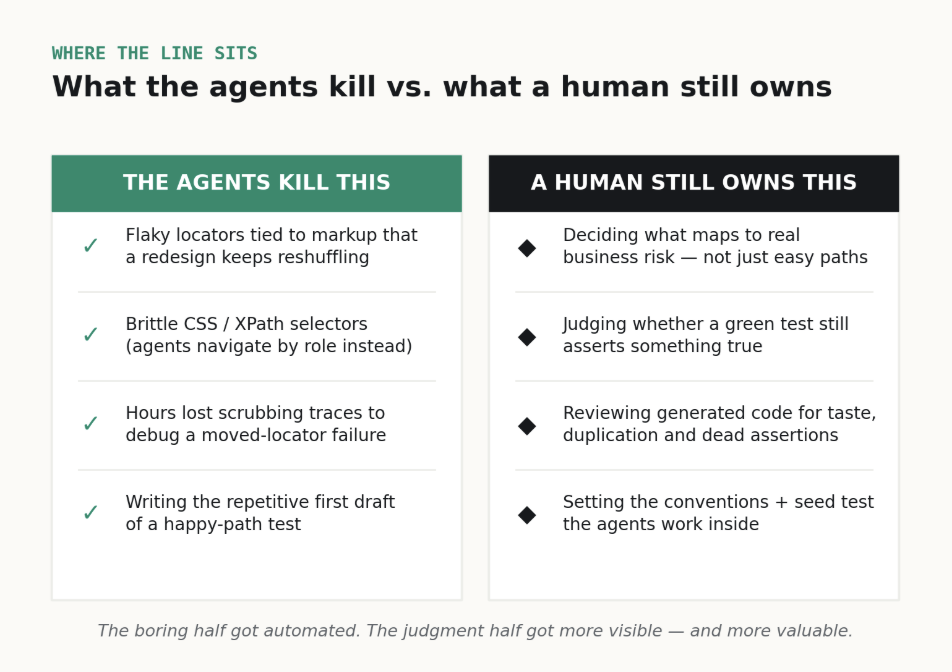
The boring half of testing got automated. The half that needs judgment got more visible — and more valuable.
How do you set up Playwright test agents?
If you’re starting from a current Playwright install, the on-ramp is short.
Install and initialise
Update to at least v1.56 (ideally the current v1.61), run npx playwright init-agents –loop=claude — or –loop=vscode, whichever assistant your team already lives in — and commit the generated agent files and seed test. Point the Planner at a running instance of your app, not a staging URL that’s half-broken, because it plans against what it can actually navigate.
Set guardrails before you generate a single spec
- Fill in the seed test properly. Auth state, base fixtures, test-data setup. Everything the agents generate inherits it, so a good seed multiplies across the whole suite.
- Treat generated tests as PRs, never direct commits. The Generator and Healer both produce code a human reviews. If you auto-merge agent output, you’re auto-merging its blind spots too.
- Give the Planner a product requirements doc. It accepts one as context, and it’s the single biggest lever on plan quality — it’s how you stop it inventing scenarios from training data.
- Regenerate agent definitions on every Playwright upgrade so you’re not driving v1.61 with v1.56’s instructions.
That’s genuinely most of it. The tooling is easy. The discipline around it is the job — and it’s exactly the kind of convention-setting that pays for itself the first time a redesign lands and your suite shrugs instead of catching fire.
If your team is standing this up on a real product and wants a second set of eyes on the conventions — what the agents should own, what stays human, how to structure the suite so it doesn’t rot — that’s the sort of automation review and setup we run at Testvox. We can also embed an automation engineer to drive the rollout if you’d rather not pull your own people off the roadmap, and the testing case studies show how that plays out on real suites.
Do Playwright test agents actually kill flaky tests?
They kill a specific, large category of it: the flake that comes from tests coupled to markup instead of behaviour, and the debugging tax that made moved-locator failures so expensive. That’s real, and it’s most of the day-to-day pain.
What they don’t kill is the harder question of whether your tests are checking the right things at all — and the Healer, left unsupervised, can quietly convert a meaningful red into a meaningless green. Point them at the boring work, keep a human on the judgment, and they earn their keep. Hand them the judgment too, and you’ve just automated your blind spots.
Frequently asked questions about Playwright test agents
What are Playwright test agents?
They’re three AI agents — Planner, Generator, and Healer — built into Playwright (v1.56+) that automate end-to-end test automation. The Planner explores your app and writes a test plan, the Generator turns that plan into runnable Playwright TypeScript, and the Healer repairs failing tests automatically. They run through an AI assistant using the Playwright MCP server.
How do I enable Playwright test agents?
Update to Playwright v1.56 or later (ideally v1.61), then run npx playwright init-agents –loop=<target> with claude, vscode, codex, or opencode as the target. That drops the agent definition files and a seed.spec.ts into your repo. Fill in the seed test, point the Planner at a running instance of your app, and start prompting.
Which Playwright version do I need for the agents?
v1.56 or later — that’s the release that introduced them, in October 2025. The current release as of mid-2026 is v1.61. Newer is better here, since agent definitions ship with version-specific tools; regenerate them with init-agents whenever you upgrade.
Do Playwright test agents replace my test suite?
No. They draft and repair tests, but a human still owns coverage decisions and reviews every diff. Treat generated tests as pull requests, not direct commits — the agents produce a correct-but-rough first draft, and the Healer can make a test pass without keeping it meaningful.
Playwright test agents vs writing tests by hand — which is better?
Use both. The agents win on the mechanical work — first drafts and moved-locator repairs in minutes instead of afternoons — because role-based locators and the Healer cut the flaky tests that come from markup coupling. Hand-written work still wins on judgment: deciding what to test against real business risk and holding the suite to convention. Let the agents draft and heal; keep a human on coverage and review.
Can the Healer make a broken test pass and hide a real bug?
Yes, and this is the failure mode to watch. The Healer optimises for a passing test, not for a test that asserts something true. It’s designed to stop and flag when it thinks the app is genuinely broken, but it can still “repair” a test into asserting nothing. Always review the diff — never auto-merge Healer output.
Do the agents replace Playwright Codegen?
Not really, and in some cases Codegen still wins. Reviewers have found Codegen faster and more reliable than the Generator agent for straightforward record-and-playback. The agents shine on the plan-generate-heal loop and especially on automated debugging — not on out-typing Codegen for a single quick capture.
Do I need MCP or a paid AI subscription to use them?
The agents run through an agentic loop driven by an assistant like Claude Code, VS Code Copilot, Codex, or opencode, using the Playwright MCP server for browser context. You’ll need whatever access that assistant requires. The Playwright side is open source; the model access is on you.
Key takeaways
- Playwright test agents are three agents, not one — Planner (writes a Markdown plan), Generator (turns it into Playwright TypeScript), and Healer (repairs failing tests). They shipped in v1.56 and run through an AI assistant via the Playwright MCP server.
- They kill flaky tests at the root by navigating the accessibility tree — role and accessible name — instead of CSS/XPath, so most markup reshuffles never break a test. The Healer patches the ones that do, often in minutes.
- Enable them with one command: npx playwright init-agents –loop=<target> on Playwright v1.56+. Fill in the seed test and give the Planner a requirements doc — plan quality depends on it.
- They don’t replace your test suite or your judgment. Agents draft and heal; humans decide what’s worth testing and review every diff. The Healer can make a test pass without keeping it true.
- Best used as agents plus humans, not agents instead of humans — self-healing tests for the drudgery, people for the coverage and taste debt.
Standing Playwright test agents up on a real product and want the conventions set right the first time — what the agents own, what stays human, and how to keep the suite from rotting? Talk to the Testvox automation testing team and we’ll help you turn AI test generation into a suite you can actually trust.

15 June 2026
 25 April 2026

AI Test Architect & Lead SDET with 11+ years of expertise in Playwright, API testing, automation, and AI/LLM evaluation. He focuses on delivering high-quality, user-centric software through AI-assisted testing, efficient testing strategies, and continuous innovation. Connect with him on
ABOUT TESTVOX

Testvox is a software testing company help your product reach its full potential. Get full cycle testing for your mobile and web applications while ensuring all quality assurance standards are met... Read More
100+
Applications
Assured
Assured

5 Star Rating

5 Star Rating
“By participating in our release lifecycle, Testvox's standard QA process has helped us to launch quality products faster.”

Rima Hudaifa
Manager | Cadvil
Manager | Cadvil
