 15 June 2026
Hire or Outsource Playwright Automation? An Honest 2026 Guide
9 October 2026
 8 Minutes Read
  BY
Amju
BY
Amju
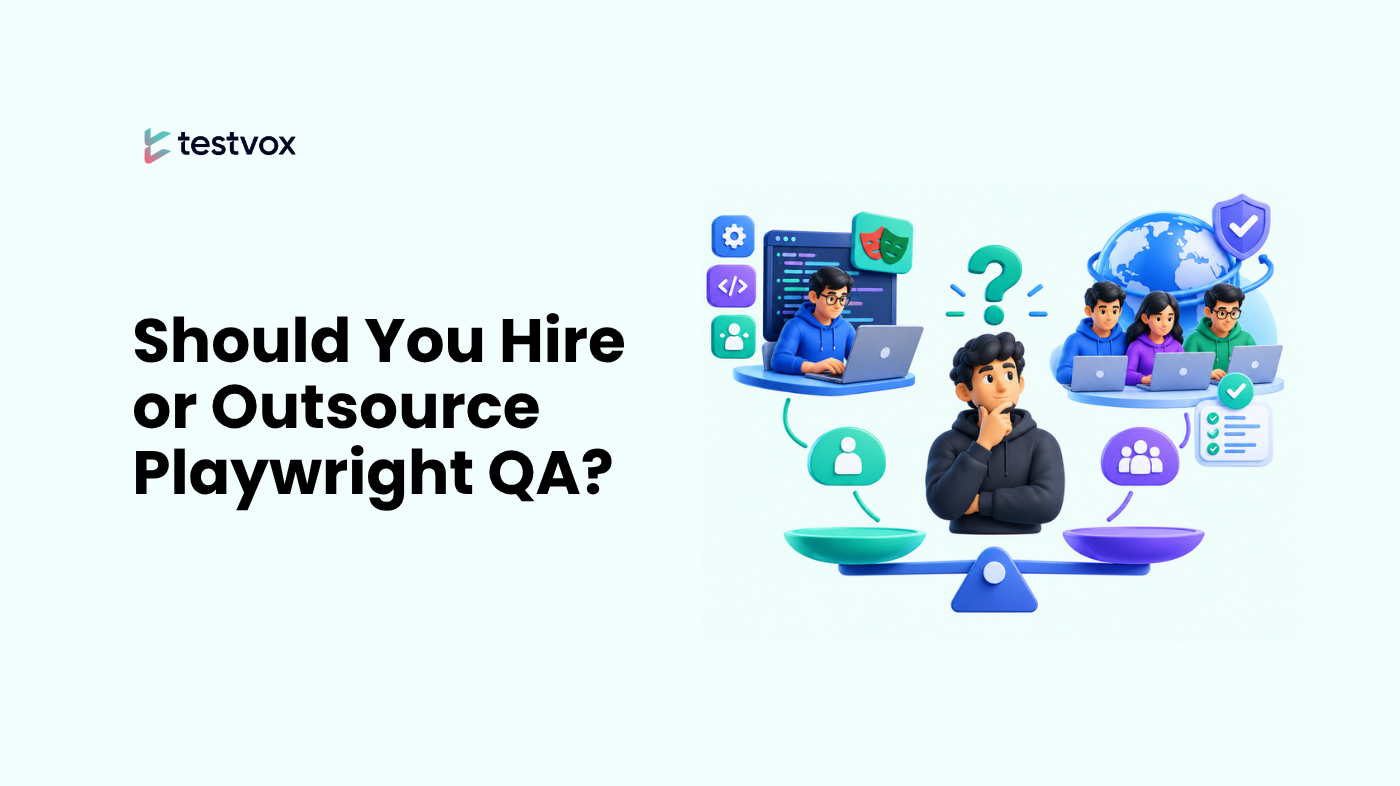
Should you hire or outsource Playwright automation? The honest answer depends on two things: how steady your testing workload will be next year, and how fast you need results.
Hire in-house when the work never stops and ties closely to your product. Outsource when the work is front-loaded, your load changes month to month, or you cannot yet justify a senior salary.
Most teams under 25 engineers do better with a partner in year one. Then they hire once the framework is stable.
This guide argues both sides fairly. That includes the cases where hiring clearly wins.
Why this question comes up
Nobody asks this in the abstract. It usually comes up in one of three moments.
First, a release breaks something a human would have caught. The team is tired of manual regression testing.
Second, an old automation suite turns flaky. Developers start ignoring red builds.
Third, a funding round or a big customer raises the quality bar. Suddenly QA needs a real plan.
In every case, the real question is not who writes the tests. It is this: what gets us a suite our developers trust, and can we keep it alive after month six?
That second half matters most. Building a Playwright suite is a project with an end date. Keeping it green is a permanent job. These are two different problems, and mixing them up causes most bad decisions here.
When hiring in-house genuinely wins
We sell a Playwright testing service. So treat this section as the argument against ourselves. It is still true.
Your workload never stops
Do you ship weekly or daily? Then your suite changes every sprint. Locators break. New flows appear. Old flows get retired.
That is a steady drip of work, not a project. An in-house engineer absorbs that drip faster than any outside team. They see the pull request before the test breaks.
Your product is unusual
Some products are hard to automate. Think heavy canvas rendering, WebGL, live collaborative editing, or a design system with no accessible roles.
Playwright handles all of this. But the setup is very specific to your product. An in-house engineer learns it once and builds on it. An outside team pays that learning cost again on every engagement.
Automation is part of your engineering culture
Some teams want developers writing their own tests. One specialist then owns the framework, the fixtures, the CI setup and the review standards.
That model works well. However, it needs an internal owner. You cannot outsource a culture change.
You have a hard data boundary
Can your test data leave your environment? If not, and external access needs a three-month security review, that friction may cost more than a salary. Healthcare, defence and banking teams often sit here.
You need two or more people, permanently
At that volume, in-house usually wins on cost per hour. Outsourcing carries a margin. Past a certain point, that margin costs more than running the function yourself.
If three of these describe you, hire. You can stop reading and write the job description.
When a QA partner is the better call
You need coverage in weeks, not quarters
Hiring a strong Playwright engineer in India takes six to twelve weeks in 2026. Then add the notice period. Then add four to six weeks of onboarding before real output.
Realistically, that means four to six months before your first stable suite.
A partner with a ready framework starts producing tests in week two. For a team racing a launch date, that gap decides everything.
The hard work comes first
Framework setup takes real skill. So does locator strategy, CI integration, parallel execution, reporting and the first hundred critical tests.
Maintaining that suite afterwards takes far less effort. So if you hire for the hard part, your senior engineer runs out of interesting work by month five. Bored automation engineers leave.
You cannot justify a senior salary yet
Indian salary surveys for 2026 show a wide band. Mid-level automation engineers with real Playwright skills commonly sit around ₹12–20 LPA. Engineers who can design a framework, rather than just write scripts, reach ₹18–25 LPA and higher.
Now add recruitment fees, equipment, tooling and employer costs. That is a serious yearly commitment before anyone writes a single test.
You need more than one skill
Real QA work is rarely only Playwright. You also need API automation, mobile coverage, a performance baseline, accessibility checks and a test strategy.
One hire cannot cover all of that. A partner brings in the right specialist for the weeks you need them. This is why many teams start with QA staff augmentation instead of a permanent role.
You want the option to stop
Scaling down a contract takes a notice period. Scaling down a team takes a layoff.
If your roadmap past two quarters is unclear, that difference matters more than the hourly rate.
Hire or outsource Playwright automation: a side-by-side view
|
Factor |
In-house hire |
QA partner |
|
Time to first stable suite |
4–6 months with hiring |
2–6 weeks |
|
Main year-one cost |
Salary, recruitment, tooling |
Monthly fee |
|
Cost predictability |
Fixed, but hiring can fail |
Fixed, scope can flex |
|
Skill breadth |
One person’s stack |
Several specialists |
|
Knowledge stays with |
The individual |
The partner |
|
Scaling down |
Slow and painful |
Notice period |
|
Best fit |
Steady, product-specific work |
Front-loaded or uneven work |
Here is the honest summary. In-house wins on cost at high, steady volume. Outsourcing wins on cost at low or uneven volume, and it always wins on speed. Every other argument matters less than these two.
What both sides forget to budget for
Teams who hire usually forget three costs.
They pay two to four months of salary before the work becomes useful. They underestimate attrition, and automation engineers get poached often in India. If your only expert leaves, the suite decays within a quarter. They also forget review time, because someone senior must check the framework design. If nobody can, you have hired an unchecked single point of failure.
Teams who outsource forget three other costs.
They skip context transfer. No partner writes good tests for a product nobody explains, so budget real engineering hours for onboarding. They also let ownership drift. When nobody internal owns quality, the suite becomes “the vendor’s problem” and developers stop caring about red builds. Finally, they skip exit planning. Ask before you sign: who owns the repository, how is the framework documented, and what does handover look like? A vague answer tells you plenty about the partner.
The hybrid model most teams land on
Splitting the build from the maintenance is not a compromise. For many teams, it is simply the right order.
Months 1 to 4. A partner builds the framework, automates your critical paths, wires up CI and sets up reporting. You get coverage fast. You pay for senior design decisions only while you need them.
Months 3 to 5. You hire one engineer into a codebase that already works. Documentation exists. The pipeline runs. They become productive in weeks, and the role is easier to fill because the hard part is done.
Month 5 onward. Your engineer owns daily coverage and maintenance. The partner stays on a smaller scope for audits, surges and the skills your hire does not have.
Most teams do the opposite. They hire first, spend four months on setup, then ask for help once the suite is already fragile. Unfortunately, fixing a broken framework always costs more than building it right. Our automation framework improvement case study shows exactly that situation.
How to decide whether to hire or outsource Playwright automation
Answer these five questions honestly.
- Will you have 30 hours of automation work every week, one year from now?
- Can someone senior inside your team review a framework design?
- Can you wait four to six months for real coverage?
- Is your product unusual enough that explaining it would take months?
- Are you confident enough in your roadmap to add permanent headcount?
Four or five yes answers mean you should hire. Two or three mean the hybrid model fits. Zero or one means outsource now and revisit next year.
Frequently asked questions
Is it better to hire or outsource Playwright automation?
It depends on workload and urgency. Hire when automation work is steady, product-specific and reviewable in-house. Outsource when the work is front-loaded, your load varies, or you need coverage before a release. Teams needing both often outsource the build and hire for maintenance.
Is outsourced Playwright automation lower quality?
Not by default. Quality follows the seniority of whoever designs the framework, plus the context they receive. A senior partner engineer with good onboarding beats a junior in-house hire working alone. The real risk with outsourcing is poor context, not poor skill.
How long does it take to build a Playwright suite?
For a mid-sized web app, expect four to eight weeks for a working framework with critical-path coverage. Full regression coverage takes longer. Build it in stages rather than all at once.
Can we outsource first and hire later?
Yes, and it is often the cheapest route. Just put it in the contract. Keep the code in your repository from day one. Require documented conventions and a clear handover process.
What if our suite is already flaky?
Start with an audit instead of a hire or a rebuild. Most flaky suites have three or four root causes, not a hundred. Finding them costs far less than rewriting everything.
Do we still need manual testers?
Yes. Automation catches regressions in flows you already know. It cannot do exploratory testing, judge usability, or validate a brand-new feature properly. Teams who cut manual testers right after automating usually rehire within a year.
Where Testvox fits
We have spent 9+ years in software testing. We have automated 100+ applications and delivered 500+ automated test cases for startups, SMEs and enterprise teams across India and the UAE. Clients rate us 4.5/5 across 200+ engagements, with public reviews on Clutch and G2.
Here is what that looks like in practice:
- A QA audit for BedzAI covering 340 test cases at 99% coverage before a production release.
- A FinTech functional and security engagement that found 171 defects across 1,400 test cases on Android, iOS and the admin panel.
- An LMS load test validated for 35,000+ concurrent learners and 167,500 transactions per hour.
We tell prospects to hire in-house often enough that it is worth saying here. If your automation work is steady, predictable and product-specific, hire someone.
But if you need coverage before your next release, or you want the framework built properly before you hire into it, that is our work. Early-stage teams can also start quickly through Quick QA for Startups.
Still unsure which side you fall on? A short audit will tell you more than another month of internal debate. Talk to a QA expert.
15 June 2026
 25 April 2026

ABOUT TESTVOX

Testvox is a software testing company help your product reach its full potential. Get full cycle testing for your mobile and web applications while ensuring all quality assurance standards are met... Read More
100+
Applications
Assured
Assured

5 Star Rating

5 Star Rating
“By participating in our release lifecycle, Testvox's standard QA process has helped us to launch quality products faster.”

Rima Hudaifa
Manager | Cadvil
Manager | Cadvil
