- Native-Speaker Crowd Testers, One Language at a Time
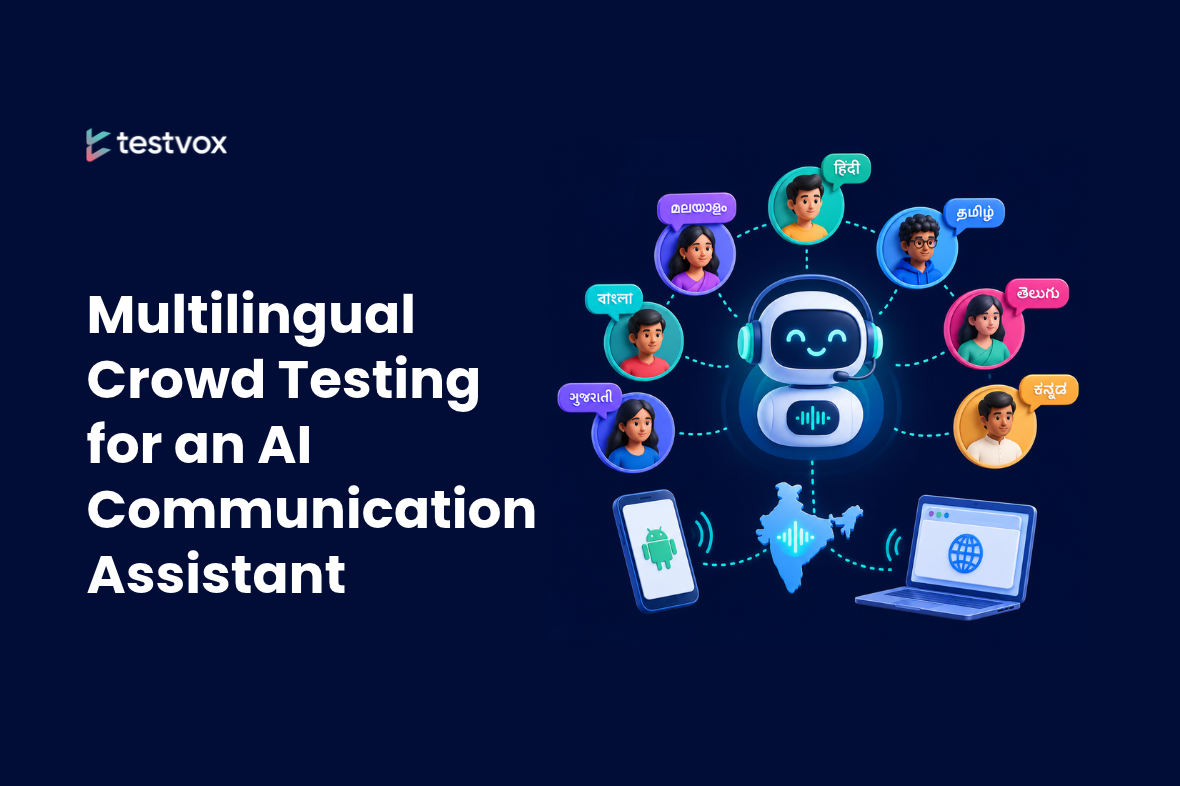
Testvox assigned native-speaker testers per language and ran a language-driven schedule across a 14-day window, coordinated by a dedicated project coordinator who allocated tasks, tracked daily progress, and handled client queries. Each language was executed against the same scenario set, so results stayed comparable across all seven rather than becoming seven unrelated test reports.
- A Shared Scenario Set With Stable Test IDs
The same numbered scenarios ran in every language: app language switching and persistence, profile creation and editing, topics to avoid, communication style, attention span, short and long response modes, sentence starters, listening durations, manual and auto trigger-word modes, speech recognition in quiet rooms and with regional accents, transcription display, AI response relevance, spoken playback and replay, and chat history with the feedback loop. Keeping test IDs identical across languages is what later made the cross-language patterns visible.
- Acceptance Criteria Written for AI Output
Because responses are generated rather than fixed, each AI scenario was judged against defined criteria — is the reply relevant to the question, natural to a native ear, grammatically correct, entirely in the selected language, age-appropriate, and consistent with the child's profile including any restricted topics. This let testers evaluate variable output consistently instead of arguing about one sample answer.
- App and Translated Web Content Tested Together
Alongside the Android app, testers validated the translated feature pages for translation accuracy and completeness, natural wording, terminology consistency against the app's own labels, text expansion and layout, and navigation. One scenario had a tester who had never used the app set it up using only the translated page — testing whether the documentation actually works as documentation.
- Defect Reports Built for a Small Team to Act On
Every defect was logged with the originating test ID, language, platform, reproduction steps, expected and actual result, severity and priority, and supporting evidence, in a single shared tracker. Daily status updates covered languages completed, features tested, defects found, and open issues.