
 4 July 2024
Outsource Playwright Automation for Scalable QA Results
16 April 2026
 7:55 MIN Read time
  BY
Aparna Arangil
BY
Aparna Arangil
Most CTOs assume setting up Playwright automation takes a sprint or two. Then reality hits: flaky tests, broken CI pipelines, authentication edge cases, and a growing backlog of test debt. Startups and SMEs in India and the UAE frequently try to handle Playwright in-house, only to discover that the real complexity sits beneath the surface, invisible until it slows down your release cadence. This guide breaks down exactly where DIY Playwright efforts fall short, what expert-level automation actually looks like, and how outsourcing to the right partner can transform your software quality without draining your engineering team.
Table of Contents
- The real complexity behind Playwright automation
- Expert strategies for reliable and maintainable automation
- The ROI of outsourcing Playwright automation
- How to evaluate and select your Playwright automation partner
- A contrarian view: Why in-house Playwright automation often backfires
- How Testvox can help you level up Playwright automation
- Frequently asked questions
Key Takeaways
| Point | Details |
|---|---|
| Expertise reduces flakiness | Specialist Playwright teams solve edge cases and boost test reliability far beyond DIY approaches. |
| Proven ROI | Outsourcing Playwright automation cuts costs and accelerates releases for startups and SMEs. |
| Better maintainability | Experts use modular frameworks and DRY principles, making test suites easier to update and scale. |
| Right partner matters | Choosing an outsourcing firm with Playwright-specific experience ensures long-term automation success. |
The real complexity behind Playwright automation
Playwright looks approachable on day one. You write a few tests, they pass locally, and your team feels confident. Then you scale. Suddenly, tests fail intermittently, authentication flows break in CI, and debugging consumes hours that should go toward shipping features.
The gap between “working tests” and “production-grade automation” is enormous. Playwright framework best practices include modular Page Object Models (POM), StorageState for session reuse, batch API updates, and DRY (Don’t Repeat Yourself) assertions. Miss any of these and your framework becomes a liability instead of an asset. Following automation testing benefits only materializes when the architecture is right from the start.
Here are the most common failure points that catch non-expert teams off guard:
- Authentication state management: Without StorageState, every test re-logs in, creating rate limit issues and slowing suite execution dramatically.
- Fragile selectors: Teams default to CSS selectors tied to class names that change with every UI update, causing cascading test failures.
- Test data pollution: Tests that share state or leave behind modified data produce unpredictable results across runs.
- Hardcoded waits: Using “page.waitForTimeout(3000)` instead of event-driven waits makes tests slow and brittle under load.
- Poor test isolation: One failing test cascades into five more when dependencies aren’t controlled.
“The difference between a 68% pass rate and a 98.5% pass rate isn’t the tool, it’s the discipline behind it.”
Following 10 best practices raised pass rates from 68% to 98.5% in real-world QA projects. That’s not a minor improvement. That’s the difference between a release you trust and one you dread.
Pro Tip: Replace hardcoded waits with Playwright’s built-in waitForSelector or waitForResponse. Pair role-based locators like getByRole('button', { name: 'Submit' }) with StorageState to make your tests resilient against UI changes and authentication overhead.
Expert strategies for reliable and maintainable automation
Experienced Playwright engineers don’t just write tests. They design systems. The difference shows in how the suite behaves six months after delivery, not just on the first run.

Expert optimization of Playwright centers on four pillars: modular Page Object Models, centralized assertions, StorageState for session management, and batch API handling. Each pillar targets a specific failure mode that DIY teams typically discover only after wasting weeks of debugging time.
Here’s a numbered breakdown of how specialists approach a Playwright framework build:
- Define page boundaries first. Each page or component gets its own POM class with clearly scoped selectors and actions.
- Centralize assertions. Shared assertion helpers prevent duplicate logic and make it easy to update expected behavior across the suite.
- Implement StorageState early. Save authenticated sessions once, reuse them across all tests that require login. This alone can cut suite runtime by 30 to 40 percent.
- Batch API calls. Instead of hitting endpoints one at a time during test setup, group them to stay within rate limits and speed up pre-conditions.
- Tag and filter tests. Use Playwright’s tagging system to separate smoke, regression, and integration suites for targeted CI runs.
| Area | DIY approach | Expert approach |
|---|---|---|
| Selectors | CSS class-based | Role-based, accessible locators |
| Authentication | Per-test login | StorageState session reuse |
| Assertions | Scattered inline | Centralized, DRY helpers |
| API setup | Individual calls | Batched requests |
| CI integration | Basic run script | Parallelized, tagged pipelines |
| Maintenance cost | High (breaks often) | Low (modular and isolated) |
Pro Tip: When hiring expert Playwright engineers, ask them to walk you through how they handle StorageState and test isolation. Their answer will immediately reveal whether they think in systems or just scripts.
The ROI of outsourcing Playwright automation
Let’s put numbers to this. Hiring a senior Playwright automation engineer in India costs between ₹18 to ₹30 LPA on average, and that’s before accounting for onboarding time, tooling, and the ramp-up period before they’re productive. In the UAE, the equivalent talent runs significantly higher. Meanwhile, a mid-level engineer without deep Playwright experience will cost you more in debugging time and rework than their salary saves.
Outsourcing to experts brings specialized Playwright skills without the overhead of building an internal team, enabling faster releases and measurable cost savings. The benefits of QA outsourcing go beyond salary. You also eliminate recruitment cycles, avoid knowledge loss when engineers leave, and get immediate access to proven frameworks.
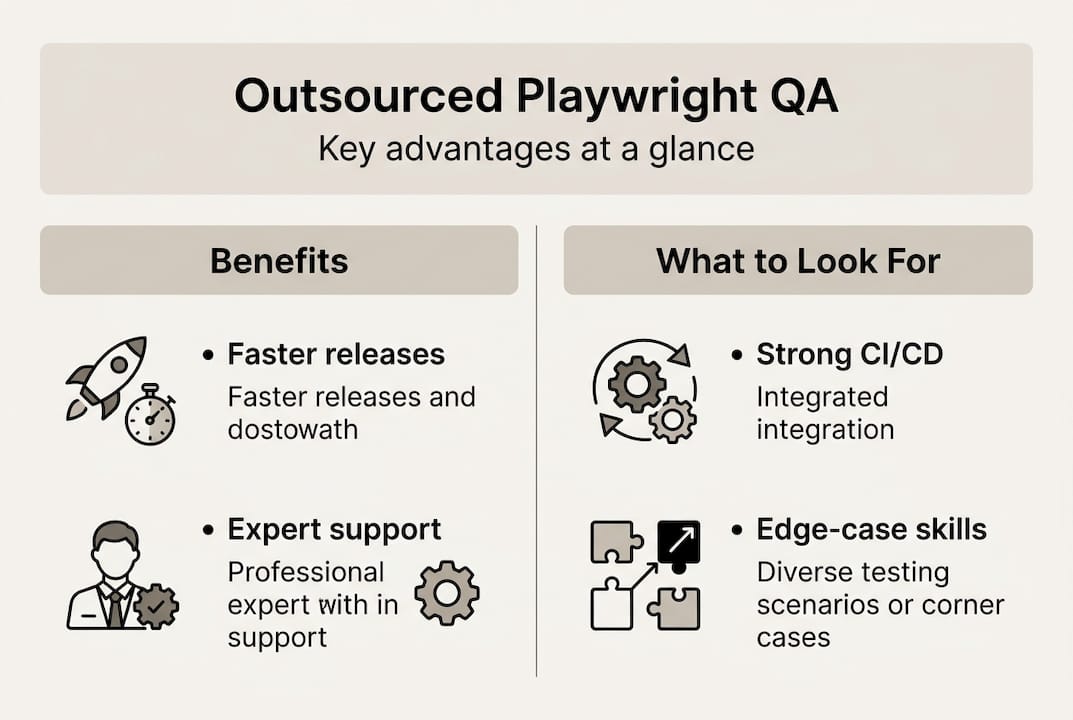
The QA outsourcing advantages become clearest when you factor in speed-to-market. A specialized team can have a working Playwright framework up and running in days, not months. For a startup racing toward beta launch, that difference is significant.
Top reasons startups and SMEs in India and the UAE choose to outsource Playwright automation:
- Immediate expertise: No ramp-up time. Specialists arrive with battle-tested frameworks.
- Faster CI/CD integration: Expert teams wire Playwright into your GitHub Actions or GitLab pipelines correctly the first time.
- Scalability on demand: Scale test coverage up or down with your sprint cycle, without headcount decisions.
- Reduced flakiness: Pass rates jump from averages near 68% to over 98% with proper implementation.
- Focus protection: Your core engineers stay focused on product development, not test maintenance.
The outsourcing benefits for startups are especially compelling at the Series A or pre-scale stage, when every engineering hour needs to generate product value.
How to evaluate and select your Playwright automation partner
Not every QA vendor claiming Playwright expertise actually has it. The vendor landscape is full of teams who run Playwright but haven’t built production-grade frameworks. Here’s how to filter effectively.
Start with a structured checklist. Any serious Playwright outsourcing partner should demonstrate fluency in framework architecture, CI/CD integration, and edge-case handling before you sign a contract.
What to validate in any candidate partner:
- Prior Playwright projects with documented pass rate improvements
- Experience handling multi-environment test configurations
- Proven StorageState and POM implementations
- CI/CD pipeline integration in GitHub Actions, GitLab, or Jenkins
- A clear process for handling flaky tests and root cause analysis
Here are the questions worth asking during evaluation:
- Can you share a case study showing how you improved a Playwright suite’s reliability?
- How do you manage authentication across test environments?
- What’s your approach to test data management and cleanup?
- How do you handle test failures in CI without blocking deployments?
- What does your handoff and documentation process look like?
Knowing which QA questions to ask during vendor evaluation separates teams that talk well from teams that deliver. Understanding the role of DevOps in automation also helps you assess whether a partner can truly own the CI/CD side of the automation equation.
Pro Tip: Ask for a live walkthrough of an existing Playwright project, not a demo. Real codebases reveal how a team thinks about architecture, maintainability, and edge cases in a way that slide decks never will.
A contrarian view: Why in-house Playwright automation often backfires
Here’s the uncomfortable truth most QA articles skip: the problem with building an internal Playwright team isn’t skill, it’s sustainability. Even when you hire a great automation engineer, the moment they leave, six months of framework knowledge walks out the door with them. Staff churn in QA is high, and startups feel it first.
The hidden costs are rarely accounted for in headcount decisions. Slow release cycles when tests break and no one owns them. Product engineers pulled into debugging automation instead of writing features. CI pipelines that half-work because no one had time to fix the flaky tests properly.
Contrary to what feels like control, building in-house automation often reduces quality by creating a distraction from your core product. The outsourcing software testing benefits compound over time. An external specialist team maintains the framework, absorbs the maintenance burden, and keeps your pass rates high. For most startups and SMEs, outsourcing isn’t a shortcut. It’s the smarter long-term architecture decision.
How Testvox can help you level up Playwright automation
If you’ve recognized your Playwright automation setup in any of the failure patterns above, you’re not alone. Most startups and SMEs reach the same inflection point where the in-house approach stops scaling.
Testvox works with startups and SMEs across India and the UAE to build, optimize, and maintain Playwright automation frameworks that actually hold up in production. From architecture reviews to full-suite rebuilds, we bring proven expertise and hire expert automation engineers who have solved these exact problems before. Our multi-year testing partnership model means we grow with your product, not just deliver and disappear. Ready to improve your pass rates and accelerate releases? Explore Testvox services and book a Playwright automation assessment today.
Frequently asked questions
What makes Playwright automation harder than expected?
Edge cases and flakiness require advanced strategies like StorageState, role-based locators, and proper CI integration that go far beyond basic test scripting. Without these, even simple test suites become difficult to maintain and unreliable at scale.
How does outsourcing Playwright automation save costs?
It removes the expense of hiring, onboarding, and retaining specialized QA staff, while delivering faster releases and ROI through expert-level frameworks from day one. You pay for results, not ramp-up time.
What should I look for in a Playwright automation outsourcing partner?
Prioritize partners with strong CI/CD integration, proven edge-case handling, and documented experience improving Playwright framework reliability. Case studies with measurable pass rate improvements are the clearest signal of genuine expertise.
Can outsourcing Playwright automation improve release speed?
Yes. Expert outsourcing delivers faster releases by eliminating the ramp-up time, reducing flaky test debt, and integrating reliable automation directly into your CI/CD pipeline from the start.
Recommended
- How Testvox Optimized a Playwright Automation Framework – Testvox
- Hire Automation Test Engineer | Playwright, Selenium, AI Tools – Testvox
- The Death of Brittle Scripts: Why Production-Led Quality Engineering is the New Standard for 2026 – Testvox
- Transforming Software Quality : DevOps in Automation Testing
4 July 2024


ABOUT TESTVOX

Testvox is a software testing company help your product reach its full potential. Get full cycle testing for your mobile and web applications while ensuring all quality assurance standards are met... Read More
100+
Applications
Assured
Assured

5 Star Rating

5 Star Rating
“By participating in our release lifecycle, Testvox's standard QA process has helped us to launch quality products faster.”

Rima Hudaifa
Manager | Cadvil
Manager | Cadvil
