 17 July 2026
From 40% to 77%: Why AI-Assisted Test Generation Became Standard in QA
1 August 2026
 12:33 MIN Read time
  BY
Harshit Gupta
BY
Harshit Gupta
Two years ago we sat in on a sprint review where a QA engineer apologised for using ChatGPT to draft a handful of test cases. Apologised. Like she’d been caught smoking behind the bike sheds. Her lead wanted to know whether the “AI stuff” was really trustworthy, whether it counted as real work, whether the tests would even run.
This past April we were on a call with a similar-sized team. Nobody apologised for anything. The AI had already written the first pass of the suite before the human opened her editor, and the entire conversation had moved on to the only question that still matters: which of these generated tests do we actually keep?
Here’s the value up front, because it’s the whole point. AI-assisted test generation — pointing an LLM or an agentic tool at a described flow and getting drafted test cases and runnable automation code back — has become the default way most QA teams start a test. In PractiTest’s State of Testing report, AI adoption in testing climbed from around 40% of companies in the 2024 edition to 76.8% in the 2026 edition, and test case creation is the single most common thing people point the AI at. The catch this whole article is about: drafting with AI is now standard, but trusting the draft without a skilled human is not.
That shift — from “are we allowed to?” to “which ones do we trust?” — happened faster than almost anyone predicted. Here’s what AI-assisted test generation actually is, why the curve bent the way it did, how it stacks up against manual test authoring, and where it’s quietly setting teams up to fail.
What is AI-assisted test generation?
AI-assisted test generation is the practice of having an AI model produce the first draft of your tests. You describe a flow — “log in, add two items to the cart, apply a promo code, check the total” — and the tool returns test cases and, increasingly, runnable automation code you can commit.
It sits inside the broader shift toward AI in QA: models that draft test data, triage failures, and suggest coverage gaps. Test generation is simply the piece that matured first, because drafting repetitive test automation is exactly the kind of pattern-heavy work large language models are good at.
One distinction matters before we go further. AI-assisted generation is not full autonomy. The AI drafts; a human still decides what to test, whether the assertions are meaningful, and whether the suite is safe to ship. That gap between “drafts the tests” and “owns the quality call” is the thread running through everything below.
How much has AI-assisted testing grown?
The short answer: from a quiet experiment to the baseline in about two years. The longer answer is worth having, because the numbers come from more than one place.
Do the adoption numbers agree across surveys?
They do, which is what makes the trend credible. PractiTest’s arc — 40% embracing AI in 2024 rising to 76.8% in 2026 — isn’t an outlier.
BrowserStack’s State of AI in Software Testing 2026, which surveyed over 250 testing leaders in February 2026, found 94% of teams now use AI somewhere in testing, with test case generation among the top use cases. And Capgemini’s World Quality Report 2025-26 — over 2,000 senior executives across 22 countries — reported 89% of organisations piloting or deploying generative-AI-augmented workflows, with test case design now leading that adoption.
Three different surveys, three different methodologies, one direction. When PractiTest, BrowserStack, and Capgemini all independently land on “most teams are doing this now,” you can stop treating it as hype and start treating QA automation with AI as the baseline.
The autonomy gap nobody talks about
The more honest number is the one people skip past. In that same BrowserStack report, only 12% of teams have reached full autonomy. So the headline isn’t “AI runs QA now.” It’s “almost everyone drafts with AI now, and almost nobody lets it drive unsupervised.”
Hold onto that gap. It’s the whole story.
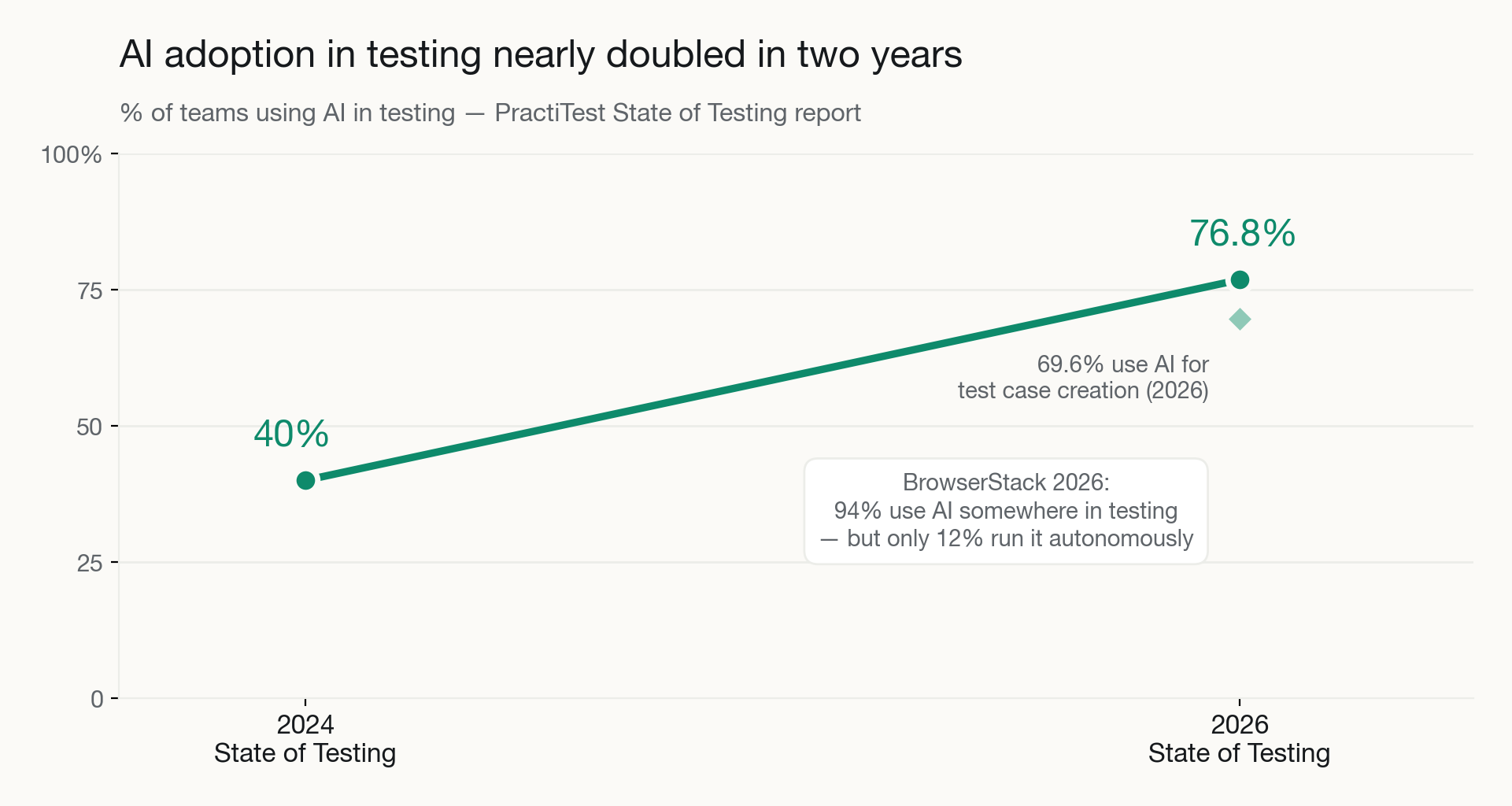
The adoption line is nearly vertical. The “we trust it to run alone” line barely moved. That distance is where the actual work lives now.
Why did AI test generation become standard in QA?
Adoption curves like this don’t bend because of a memo. Three things happened at once.
The tooling stopped being a toy
This is the big one for anyone in the Playwright world. In late 2025, Playwright v1.56 shipped Playwright Agents — a Planner that explores your app and writes a structured test plan, a Generator that turns that plan into runnable code, and a Healer that repairs failing tests by re-finding moved locators.
The v1.59 release in April 2026 leaned into it so hard the community nicknamed it “the agentic release,” adding a CLI debugger built for agent workflows and AI-optimised accessibility snapshots. By v1.61 in June 2026, this is just part of the furniture. Pair that with GitHub Copilot and Claude sitting in the editor, and generating a test went from an afternoon of fiddly scripting to describing a flow in plain English and getting working TypeScript back before your coffee cooled.
The economics became impossible to argue with
Capgemini’s report shows that teams have moved generative AI from analysing outputs to shaping inputs. They now use it for test case design and requirements refinement—the front of the process, where they spend most of their time.
When drafting a test costs minutes instead of hours, the cost-benefit maths for not using it stops making sense to any finance-minded manager.
The social permission arrived
This is the soft one, but it matters. Once the Katalon State of Software Quality 2025 report — 1,500 QA professionals — found that 82% believe AI skills will be critical in the next three to five years, “I don’t use AI for tests” stopped being a badge of craftsmanship and started looking like a career risk.
The engineer we watched apologise in 2024 wasn’t wrong to read the room. The room just changed.
None of these on their own would have moved the needle from 40% to 77%. Together, in about eighteen months, they made AI-assisted generation the path of least resistance. And people follow the path of least resistance. Every time.
What are AI test generation tools genuinely good at?
Credit where it’s due, because the capability is real and we don’t want to wave it away.
A modern Playwright agent works off the page’s accessibility tree, not raw HTML, so it navigates by “Role: button, Name: Checkout” rather than some brittle div.btn-v3 selector. That single design choice makes generated tests dramatically more durable than the copy-paste-XPath era they replaced.
The Generator produces tests that look like a competent human wrote them — role-based locators, sensible waits, readable structure. The Healer quietly fixes the class of failure that used to eat a QA engineer’s entire Monday: a locator moved, the test knows how to find it again.
For the boring 70% of any suite — the login flows, the CRUD paths, the form validations that every app has and nobody enjoys writing — this is genuinely close to free now. That’s not nothing. That’s the single most tedious part of the job, gone.
So if the drafting is solved, what’s left? Everything that was always the hard part.
AI-assisted vs manual test authoring
The question we get asked most is the direct one: should a team still write tests by hand, or hand it to the AI? It’s the wrong framing — the two aren’t mutually exclusive — but the comparison is worth making cell by cell, because each approach genuinely wins on different dimensions.
| Dimension | AI-assisted authoring | Manual authoring |
| Speed to first draft | Minutes — describe a flow, get runnable code back | Hours — hand-write locators, waits, and assertions |
| Boilerplate coverage (logins, CRUD, forms) | Near-free; the repetitive core is close to solved | Slow and tedious; the least enjoyable part of the job |
| Maintenance when the UI changes | Self-healing — Playwright’s Healer agent re-finds moved locators | Manual selector updates every time the markup shifts |
| Assertion correctness | Can confidently assert the wrong thing; 60% cite hallucination/reliability as a top barrier | Author knows the intended behaviour; assertions reflect real requirements |
| Review burden | High — every generated test needs a human to confirm it’s meaningful, not tautological | Lower per test — but far fewer tests ever get written |
| Business-risk & coverage judgment | None — reaches what’s easy to reach, not what matters most | Human maps test coverage to real risk |
| Trusted to run unsupervised | Only 12% of teams allow full autonomy | Human-owned by definition |
| Best for | Drafting the boring 70%, boilerplate, first-pass suites at scale | Edge cases, nuanced oracles, high-risk flows where correctness is subtle |
Our verdict: for raw speed, boilerplate test coverage, and maintenance, AI-assisted authoring wins outright — hand-writing login and CRUD tests in 2026 is a waste of a skilled engineer. Manual authoring still wins where it always mattered: knowing what’s worth testing and whether a passing test actually proves the thing you care about. The teams getting real value don’t pick a side. They let the AI draft and keep a human as the oracle. Treat it as one AI-assisted test generation workflow with a human review gate, not a contest, and you get the speed without inheriting a suite you can’t trust.
What is the over-reliance trap in AI test generation?
Here’s the honest bit, because we’ve watched this one hurt good teams.
When generating a hundred tests costs nothing, teams generate a hundred tests. Then two hundred. Coverage dashboards light up green and everyone feels productive. Except a chunk of those tests are testing the same happy path three slightly different ways, a few are quietly tautological — asserting that the mock returns what the mock was told to return — and nobody has read all of them. You didn’t build a safety net. You built a very convincing-looking pile of one.
This isn’t a fringe worry. Capgemini’s respondents named hallucination and reliability concerns (60%) among their top barriers to scaling GenAI in QA. An AI that confidently writes a test asserting the wrong thing is worse than no test, because it comes wrapped in a green checkmark that tells your team to stop looking.
And the autonomy numbers make the point on their own. If AI-generated testing were actually trustworthy end-to-end, that BrowserStack “full autonomy” figure wouldn’t be stuck at 12%. It’s low because the people closest to the work know the drafts need a human between them and production. The research agrees: when frontier web agents were tested on realistic live-website tasks instead of tidy benchmarks, they came in well below the success rates earlier reports had implied. Brilliant fast drafters. Unreliable owners.
The failure mode we see most isn’t dramatic. It’s slow. A team leans on generation for a quarter, the suite balloons, the signal-to-noise ratio rots, and one day a broken checkout ships past four hundred passing tests. By then the suite is so big nobody wants to audit it. That’s the bill AI-assisted generation quietly runs up while everyone’s admiring the velocity.
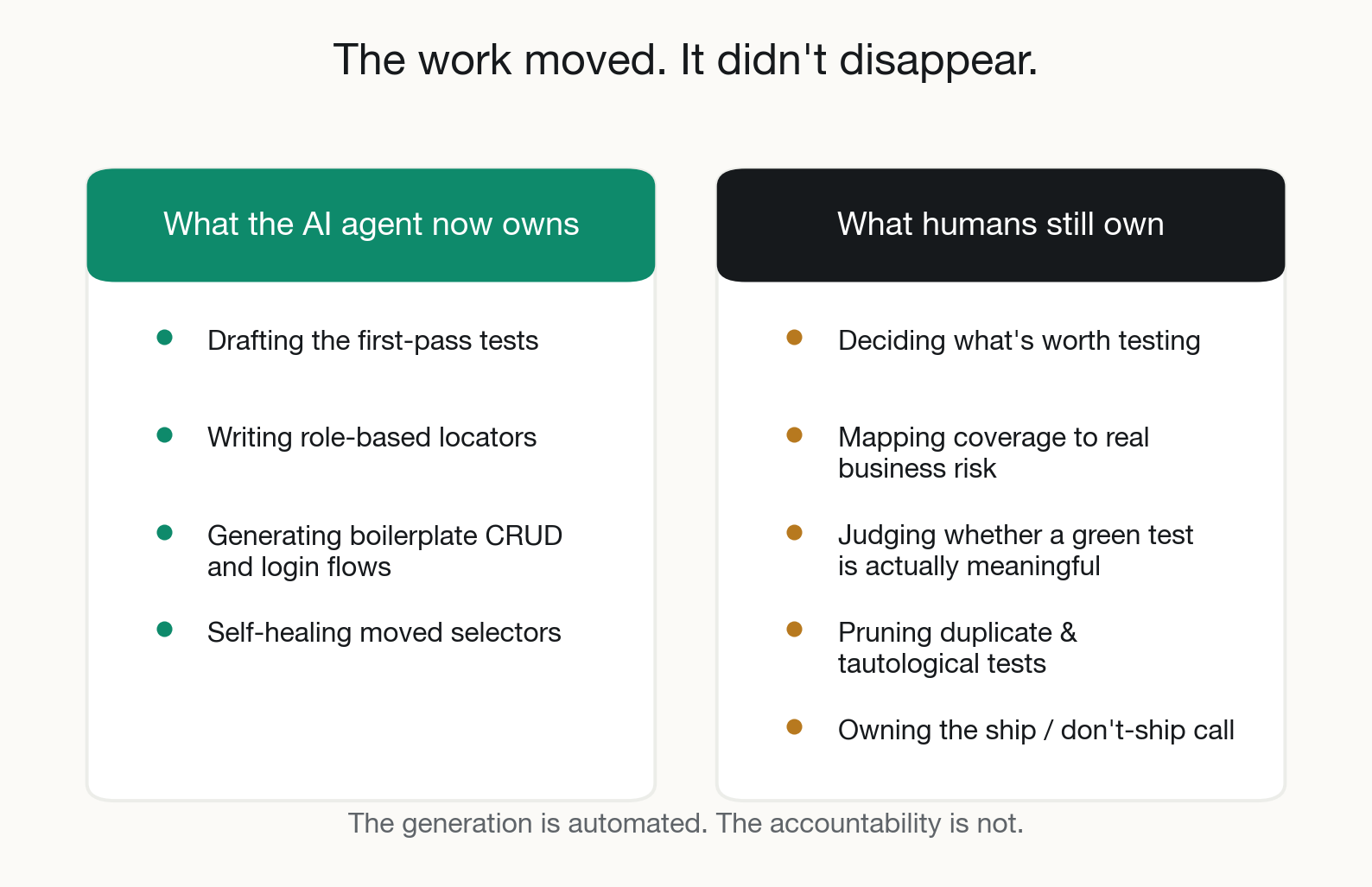
The generation is automated. The accountability is not. That right-hand column is the job now.
Where do humans still own the judgment?
Strip away the drafting and what’s left is the part that was always valuable and is now, finally, visible.
AI can generate and execute tests, but deciding what to test remains a human responsibility. Even a green test suite deserves scrutiny—is it green because the product works, or because the tests are too forgiving? Finally, someone has to remove duplicate tests before they pile up, define the locator and naming conventions AI agents follow, and make the final ship or don’t ship decision.
That’s the test oracle problem, and no model has solved it, because it isn’t a code problem. It’s a judgment problem about what correct even means for your product.
This is why the role is shifting from test author to quality owner. The typing is a commodity. The taste — knowing which hundred of the thousand generated tests deserve to live — is the scarce thing now. Katalon’s survey caught the anxiety underneath this shift honestly: 20% of QA professionals said they’re worried AI will replace their role. We’d gently reframe that. AI is replacing the part of the job that was never the point. What it can’t touch is the part that always was.
How do you adopt AI-assisted test generation without the trap?
So — is AI test generation really “standard” now? Yes, with an asterisk the size of a building. Drafting tests with AI is standard — 77% of teams, and the holdouts are shrinking. Trusting that draft without a skilled human reviewing it is not standard, and the 12% autonomy figure says the market knows it.
The teams getting real value aren’t the ones generating the most tests. They set conventions early, review what the agents produce, and treat generation as a fast first draft rather than a finished deliverable. In practice that means three things: agree locator and naming conventions before you let an agent loose, put a human review gate between generated tests and the main branch, and audit for duplicates and tautologies on a regular cadence instead of letting the suite sprawl.
That’s the review we run for startup and SME teams at Testvox — going through a generated or half-generated suite to work out what’s earning its keep, what’s noise, and what conventions will stop the whole thing sliding back into brittleness a quarter from now. If you’d rather not pull your own people off the roadmap to do it, we can embed an automation engineer to set the guardrails, or run it as a fixed-scope automation and QA review. The case studies show what that looks like when it works.
Frequently asked questions about AI-assisted test generation
What is AI-assisted test generation?
It’s the practice of having an AI model draft your tests — you describe a flow in plain English and the tool returns test cases and runnable automation code. It covers everything from an LLM suggesting test cases to an agent like Playwright’s Generator writing committed TypeScript. It speeds up drafting; it doesn’t remove the need for a human to decide what’s worth testing.
Is AI going to replace QA engineers?
No — it’s replacing the slowest, most tedious slice of the job, which is drafting tests from scratch. The parts that were always hard (deciding what to test, judging whether coverage maps to real risk, owning the release call) are exactly the parts AI can’t do. If anything the surveys suggest demand for people who can govern AI-generated testing is rising, not falling.
How much of a test suite can AI realistically generate today?
The repetitive core — logins, CRUD, form validation, standard happy paths — is close to free now with tools like Playwright’s Generator agent and an assistant like Copilot or Claude. The edge cases, the messy real-world flows, and the “is this assertion even meaningful” judgment still need a human. Treat generated tests as a strong first draft, never a finished suite.
What’s the biggest risk of leaning on AI test generation?
False confidence. AI will happily generate tests that pass while asserting the wrong thing, or flood your suite with near-duplicates that inflate coverage numbers without adding real safety. Capgemini’s respondents flagged hallucination and reliability as a top barrier for a reason. A green pipeline full of soft tests is more dangerous than a smaller suite you actually trust.
AI-assisted vs manual test authoring — which is better?
Neither, on its own. AI-assisted authoring wins on speed, boilerplate coverage, and self-healing maintenance; manual authoring wins on assertion correctness and business-risk judgment. The strongest teams pair them — the AI drafts, a human reviews and owns the quality call — rather than treating it as an either/or.
Does AI-assisted test generation work with Playwright?
Yes, and Playwright is one of the most mature options. Since v1.56 it ships Planner, Generator, and Healer agents natively, and later releases (v1.59 through v1.61 in 2026) added agent-focused debugging and AI-optimised accessibility snapshots. Generated tests use role-based locators off the accessibility tree, which makes them noticeably more durable than selector-based scripts.
We already generate a lot of tests with AI — what should we do first?
Audit before you generate more. Find the duplicates and the tautological tests, map what’s actually covered against what carries business risk, and set locator and naming conventions the agents follow. It’s cheaper to fix a 200-test suite now than a 2,000-test one next year.
Is AI-assisted test generation production-ready and safe to trust?
The drafting is production-ready; the autonomy isn’t. Only 12% of teams let AI run testing unsupervised, and that’s the right instinct. Use AI to draft and maintain tests fast, but keep a human review gate before anything gates a release. Safe adoption is a workflow choice, not a tooling one.
Key takeaways
- AI-assisted test generation is now standard — adoption in testing rose from ~40% (2024) to 76.8% (2026) across PractiTest, with BrowserStack and Capgemini independently confirming the trend. Drafting tests with AI is the baseline, not the edge.
- Full autonomy is not — only 12% of teams let AI run testing unsupervised. The gap between “drafts the tests” and “owns the quality call” is where the real work now lives.
- AI-assisted vs manual authoring isn’t a contest — AI wins on speed, boilerplate coverage, and self-healing maintenance; humans win on correctness judgment and mapping test coverage to business risk. Pair them.
- The over-reliance trap is quiet, not dramatic — generated suites balloon with duplicate and tautological tests until a real bug ships past hundreds of green checks. Hallucination and reliability are the #1 scaling barrier (60%, Capgemini).
- The role shifted from test author to quality owner — the typing is a commodity; the taste to decide which generated tests deserve to live is the scarce, human part.
Ready to get the speed of AI-assisted test generation without inheriting a suite you can’t trust? Talk to the Testvox team and we’ll help you set the conventions and review gates that keep generated tests honest.

17 July 2026

 25 April 2026

AI Test Architect & Lead SDET with 11+ years of expertise in Playwright, API testing, automation, and AI/LLM evaluation. He focuses on delivering high-quality, user-centric software through AI-assisted testing, efficient testing strategies, and continuous innovation. Connect with him on
ABOUT TESTVOX

Testvox is a software testing company help your product reach its full potential. Get full cycle testing for your mobile and web applications while ensuring all quality assurance standards are met... Read More
100+
Applications
Assured
Assured

5 Star Rating

5 Star Rating
“By participating in our release lifecycle, Testvox's standard QA process has helped us to launch quality products faster.”

Rima Hudaifa
Manager | Cadvil
Manager | Cadvil
