
 27 August 2024
Independent QA: Save 50% and launch securely in 2026
15 April 2026
 8:33 MIN Read time
  BY
Aparna Arangil
BY
Aparna Arangil
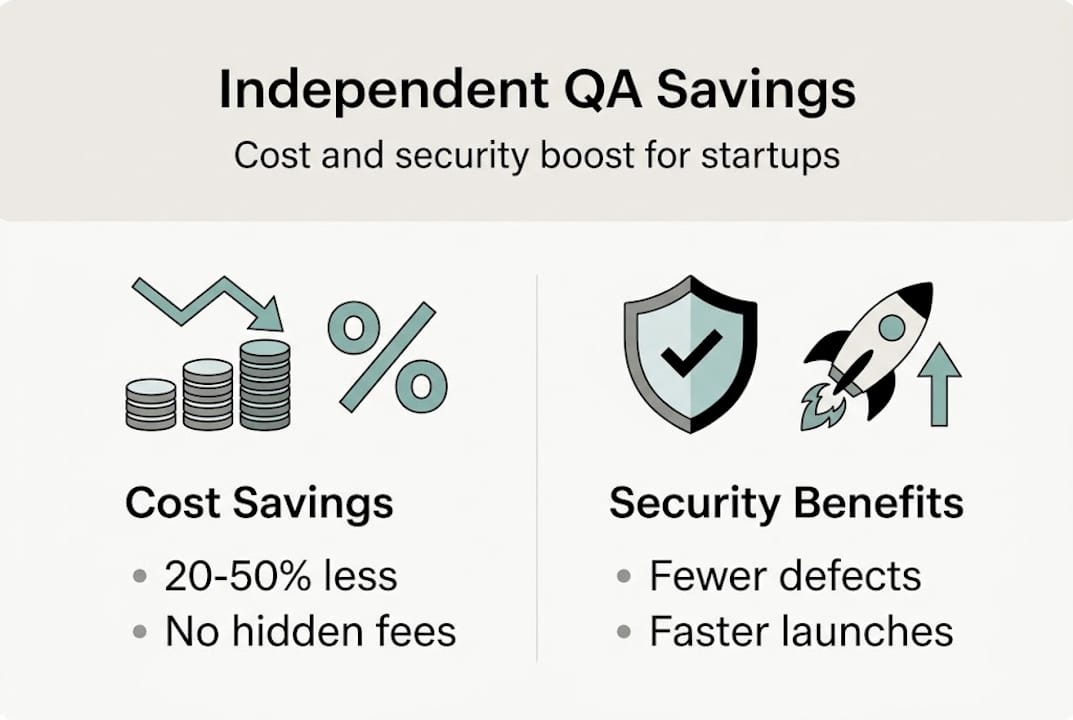
Fixing a bug after launch costs up to 30 times more than catching it during development. Yet most startup CTOs still rely entirely on internal teams to test their own code before going live. That assumption is expensive. Independent QA firms consistently deliver 20 to 50% cost reductions compared to in-house setups, while catching the exact security gaps and transaction failures that sink fintech and e-commerce launches. This guide breaks down why outsourcing your QA function is one of the smartest financial and technical decisions you can make before your next release.
Table of Contents
- Cost benefits: Why independent QA is smarter for startups
- Security and trust: Launching safer fintech and e-commerce apps
- Conversion and performance: QA’s impact on revenue
- Practical considerations: Making independent QA work for you
- Why independent QA is the CTO’s secret weapon
- Partner with Testvox for secure, scalable QA
- Frequently asked questions
Key Takeaways
| Point | Details |
|---|---|
| Drastic cost savings | Independent QA teams can save startups 20-50% compared to building an internal QA department. |
| Enhanced app security | Outsourced QA experts help identify critical bugs and vulnerabilities before launch. |
| Boosted conversion rates | Bug-free e-commerce apps achieve up to 95% conversion rates with independent QA testing. |
| Faster regression cycles | Independent, AI-powered QA speeds up testing by 70%, enabling quick iterations and launches. |
| Strategic startup advantage | Using independent QA allows CTOs to focus on core tech and scaling, rather than QA recruitment and management. |
Cost benefits: Why independent QA is smarter for startups
Why Building an In-House QA Team Isn’t as Simple as It Looks
Building an in-house QA team looks straightforward on paper. Hire a few testers, give them access to your staging environment, and ship. The reality is messier. You are paying full salaries, benefits, and training costs for a function that scales unevenly with your sprint cycles. Independent QA flips that model entirely.
Cost Savings and Early Defect Detection
Cost savings of 20 to 50% are typical when startups move from in-house to independent QA. Beyond the headline number, the real financial win is early defect detection. The IBM rule of thumb holds: a bug caught in development costs roughly 1x to fix. That same bug found post-launch costs 30x. Independent teams are wired to find those bugs early because testing is their only job.
The Hidden Costs of In-House QA
The hidden costs of in-house QA are rarely discussed. You are not just paying salaries. You are absorbing tool licensing, onboarding time, knowledge gaps when testers leave, and the productivity tax on developers who end up doing QA by default. Understanding the cost benefits of staff augmentation versus full internal hiring reveals just how much startups overspend on testing without realizing it.
| Factor | In-house QA | Independent QA |
|---|---|---|
| Setup cost | High (hiring, tools, training) | Low (onboard quickly) |
| Scalability | Slow, headcount-dependent | Fast, on-demand |
| Defect detection speed | Variable | Consistently early |
| Domain expertise | Generalist | Specialized (fintech, e-commerce) |
| Cost vs. in-house | Baseline | 20 to 50% lower |
Here is what independent QA teams bring that internal teams rarely match:
- Dedicated focus: No context switching between building and testing
- Proven frameworks: Pre-built test suites reduce setup time dramatically
- Scalable capacity: Ramp up before a major release, scale back after
- Fresh perspective: No emotional attachment to the codebase
The benefits of outsourcing QA go beyond cost. Speed, objectivity, and specialized tooling all compound over time. And when you streamline developer collaboration with a dedicated external QA team, your engineers spend more time building and less time debugging.
Pro Tip: Allocate QA budget at the start of your product roadmap, not as a line item you add when launch is close. Teams that engage independent QA in the early sprint cycles consistently see lower total defect counts at release.
Security and trust: Launching safer fintech and e-commerce apps
For fintech startups, a single uncaught bug is not just a UX problem. It is a regulatory event. Transaction errors, data exposure, and failed compliance checks carry fines that can wipe out a funding round. Independent QA mitigates these high failure costs by bringing specialized security expertise that most internal teams simply do not have.
Three catastrophic scenarios that independent QA prevents:
- Double-charge transaction bugs: Payment gateway logic errors that charge users twice, triggering chargebacks and regulatory scrutiny
- KYC/AML compliance failures: Identity verification flows that pass internally but break under edge-case inputs, creating legal exposure
- Session hijacking vulnerabilities: Authentication flaws that allow unauthorized account access, destroying user trust overnight
The table below shows where independent QA makes the biggest difference:
| Bug type | Risk level | QA mitigation result |
|---|---|---|
| Payment gateway errors | Critical | Caught pre-launch via integration testing |
| Data exposure (PII leaks) | Critical | Identified through VAPT and security scans |
| Checkout flow failures | High | Resolved via end-to-end functional testing |
| API timeout errors | Medium | Caught during performance load testing |
| UI/UX inconsistencies | Low to medium | Fixed before beta via usability testing |
The efficient QA approach for startups is not about running every possible test. It is about running the right tests with the right expertise. A QA team that specializes in fintech knows exactly where payment flows break. They do not need months to get up to speed.
“Our independent QA partner flagged a compliance gap in our KYC flow two weeks before launch. Fixing it post-launch would have cost us a six-figure fine and a delayed license approval. That single audit paid for itself ten times over.” — Fintech founder, Series A
Real-world QA auditing case studies show this pattern repeatedly. The Y Combinator startup QA case is a strong example of how a focused, independent audit before a major release catches the issues that internal teams normalize because they have seen them so many times.

Security is only one part of the equation. Let’s explore how QA independence also drives your conversion rates upward.
Conversion and performance: QA’s impact on revenue
Buggy apps do not just frustrate users. They kill revenue in measurable, trackable ways. Cart abandonment spikes when checkout flows stutter. Users churn when payment confirmations fail silently. The numbers are stark: e-commerce outsourcing boosts conversions to 95% versus only 50% for apps with unresolved bugs. That gap is your revenue ceiling.
Three QA fixes that immediately lift conversions:
- Checkout flow validation: End-to-end testing of every payment path, including edge cases like expired cards and network timeouts
- Mobile responsiveness testing: Catching layout breaks and tap-target failures that cause mobile users to abandon
- Load performance testing: Ensuring your app holds up under peak traffic, especially during promotional events or market volatility
Speed matters too. AI-augmented QA for startups has compressed regression testing cycles by up to 70% in fintech environments. That means faster releases, fewer rollbacks, and more time for your team to ship features instead of chasing regressions.
Key performance numbers to benchmark against:
- Conversion rate with clean QA: up to 95%
- Conversion rate with unresolved bugs: as low as 50%
- Regression cycle speedup with AI-assisted independent QA: 70%
- Post-launch fix cost multiplier versus pre-launch: 30x
A dedicated testing team brings consistency that ad-hoc internal testing cannot. They run the same regression suite every sprint, flag deviations immediately, and maintain a living test library that grows with your product. The regression testing implementation model shows how this plays out in practice for scaling startups.
Pro Tip: Schedule your most intensive QA cycles for the week before a major launch or sales event. Independent teams can surge capacity on short notice. Internal teams usually cannot without burning out your developers.
Practical considerations: Making independent QA work for you
Choosing the right independent QA partner is not just about price. The cheapest option often costs the most in rework and miscommunication. Here is what to evaluate before you sign.
Selection criteria for a QA partner:
- Proven experience in your specific domain (fintech, e-commerce, or both)
- Clear documentation practices and transparent reporting
- Flexible engagement models (staff augmentation, managed service, or one-time audit)
- Alignment with your development workflow (Agile, CI/CD, sprint-based)
- References or published case studies from comparable companies
Integration steps for seamless collaboration:
- Define your test scope clearly before kickoff. Ambiguity here is the number one cause of missed defects.
- Share your product roadmap and upcoming release dates upfront so the QA team can plan capacity.
- Set up shared communication channels (Slack, Jira, or equivalent) from day one.
- Agree on defect severity classifications so both teams prioritize the same way.
- Schedule a weekly sync to review open defects, blockers, and upcoming test coverage.
Common mistakes to avoid when onboarding a QA partner:
- Skipping the discovery phase: Jumping straight into testing without a proper scope review leads to gaps in coverage
- Treating QA as a final gate: Independent QA works best when integrated throughout your sprint cycles, not just at the end
- Underestimating documentation needs: Your QA partner needs access to specs, user stories, and API docs to test effectively
The outsourcing QA guide covers the full selection and onboarding process in detail. The 20 to 50% cost reduction only materializes when the partnership is set up correctly from the start. Communication and a defined test scope are not nice-to-haves. They are the foundation.
Why independent QA is the CTO’s secret weapon
Here is the uncomfortable truth most CTOs discover too late: your internal team is the worst possible group to find your most dangerous bugs. Not because they are bad engineers. Because they built the system. They know how it is supposed to work, so they test it the way it is supposed to work. That blind spot is where critical failures hide.
Independent QA teams bring accountability that internal teams structurally cannot. They have no incentive to ship fast at the expense of quality. Their reputation depends entirely on finding what your team missed. That is a fundamentally different incentive structure, and it produces fundamentally different results.
Scalability is the other underrated advantage. You do not need a full QA headcount between major releases. Independent teams scale with your actual workload. That flexibility is exactly what early-stage startups need.
As we see consistently through efficient QA audits, the most valuable thing an outside team delivers is not a test report. It is the bugs they find that your team had already normalized. The best CTOs we work with treat independent QA not as a vendor relationship but as a standing check on their own blind spots.
Partner with Testvox for secure, scalable QA
If the cost savings, security coverage, and conversion gains described above sound like exactly what your next launch needs, Testvox is built for this.
Testvox works with fintech and e-commerce startups to catch the bugs that matter most before they reach your users. From payment gateway validation to VAPT security audits, our teams specialize in the exact failure points that cost startups the most. Browse our fintech QA case studies, explore our e-commerce QA work, or review our QA auditing case studies to see how we have helped teams like yours ship with confidence. Ready to talk scope? Reach out to Testvox and let’s map out your next launch together.
Frequently asked questions
How does independent QA detect defects earlier than in-house teams?
Independent QA teams focus exclusively on testing, using proven frameworks and fresh eyes that catch issues in-house developers overlook. Early detection reduces fix costs by up to 30 times compared to post-launch patches.
What are the biggest risks of skipping independent QA for fintech apps?
Fintech startups that skip independent QA face transaction errors and compliance failures that can trigger major regulatory fines and permanently damage customer trust before the product gains traction.
How does independent QA improve e-commerce conversions?
Cleaning up checkout bugs and performance issues through outsourced QA can raise conversion rates to 95%, compared to roughly 50% when unresolved bugs disrupt the purchase flow.
What should startups look for when choosing a QA partner?
Prioritize domain expertise in fintech or e-commerce, a transparent cost structure, clear communication practices, and published case studies from companies at a similar growth stage to yours.
Recommended
- How to ensure software quality: expert steps for secure launches
- QA in cloud apps: boost security and efficiency in 2026
- Code review and testing – It’s Importance in software development.
- QA Auditing Archives – Testvox
- Essential Website Maintenance Checklist for 2025 Success|BM
27 August 2024
 29 October 2024


ABOUT TESTVOX

Testvox is a software testing company help your product reach its full potential. Get full cycle testing for your mobile and web applications while ensuring all quality assurance standards are met... Read More
100+
Applications
Assured
Assured

5 Star Rating

5 Star Rating
“By participating in our release lifecycle, Testvox's standard QA process has helped us to launch quality products faster.”

Rima Hudaifa
Manager | Cadvil
Manager | Cadvil
